

500-Million-Year-Old Fossil Discovery Shatters Everything We Knew About Spider Origins
 By
Ethan Reid
By
Ethan Reid
| IN A NUTSHELL |
|
The discovery of a 515-million-year-old fossil, Mollisonia symmetrica, has challenged traditional views on the evolution of spiders. This ancient marine creature possesses a brain structure remarkably similar to that of modern arachnids, suggesting that spiders may have an aquatic origin rather than a solely terrestrial one. This revelation comes from a study led by Nicholas Strausfeld, a neurobiologist at the University of Arizona, who used advanced imaging techniques to examine the fossil. The findings could significantly reshape our understanding of spider evolution and the broader evolutionary history of arthropods.
Reevaluating Spider Evolution: The Impact of Mollisonia Symmetrica
For decades, spiders have been considered quintessential terrestrial animals, with their respiratory systems, hunting behaviors, and adaptations to dry environments reinforcing this perception. Scientists long believed that spiders’ ancestors emerged from the ocean around 400 million years ago, much like the first amphibians. These assumptions were primarily based on external morphological traits, such as chelicerae, segmented exoskeletons, and jointed legs.
However, appearances can be deceiving in paleontology. The internal structure of Mollisonia symmetrica’s head has upended these longstanding assumptions. The discovery of a fossilized brain within this ancient creature provides unprecedented insight into its evolutionary history. This brain structure, remarkably similar to that of modern arachnids, suggests a much more complex lineage than previously thought.
Modern-Like Brain Structure in an Ancient Marine Creature
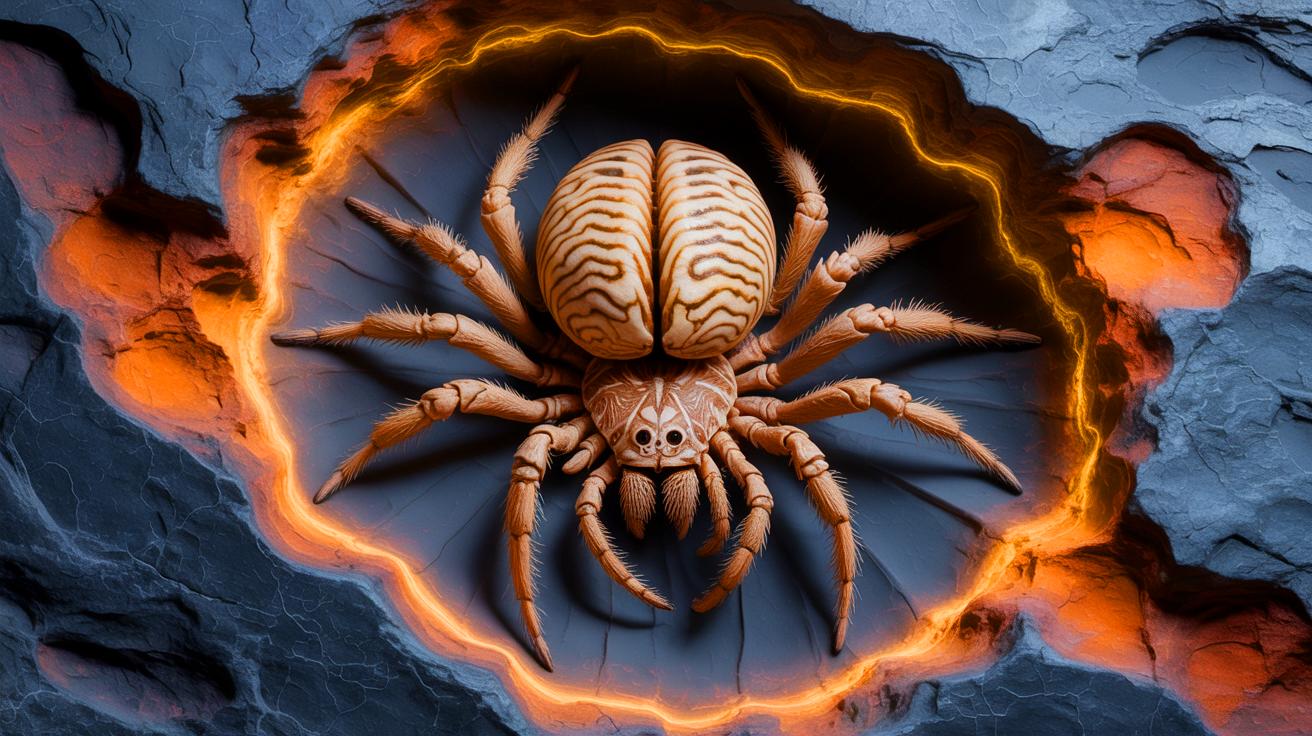
Found in Canadian shale, the Mollisonia fossil belonged to a marine organism from the middle Cambrian period. Researchers used advanced optical imaging to reconstruct the architecture of its nervous system. They identified a fan-shaped brain configuration with reversed lobes and nerves connected to the legs. This structure bears a striking resemblance to the brains of contemporary spiders.
The significance of this discovery lies in the preservation of internal data rarely found in fossils of such antiquity. Nicholas Strausfeld emphasizes that this brain structure is crucial to spiders’ agility and precision. He posits that Mollisonia might not just be a distant cousin but a direct aquatic ancestor of modern spiders. The study also involved a comprehensive phylogenetic analysis of 115 brain and morphological traits, confirming a close relationship between Mollisonia and arachnids, dismissing the notion of mere evolutionary coincidence.
Potential Paradigm Shift in Arthropod Evolution
If the hypothesis holds, it could lead to a major revision in our understanding of evolutionary history. Spiders might be redefined not only as terrestrial creatures but as descendants of a marine lineage with early-developed advanced neurological capabilities. This revelation also reignites the debate on the emergence of complex brains, suggesting that traits considered recent might have existed in early multicellular life forms.
The implications of this study extend beyond spiders and could alter our timeline for neurological specialization in the animal kingdom. The findings challenge previous assumptions and open new avenues for research into the evolutionary pathways of arthropods and their neurological development.
Broader Implications for Evolutionary Biology
This discovery of Mollisonia symmetrica holds substantial implications for the field of evolutionary biology. By challenging the long-held belief that spiders exclusively evolved on land, it prompts researchers to reconsider the evolutionary history of other arthropods. The findings suggest that the development of complex neurological features may have occurred much earlier in history than previously thought.
Furthermore, this study has the potential to influence future research directions in paleontology and evolutionary biology. By providing evidence of ancient, advanced neurological traits, it highlights the importance of examining internal structures in fossils. As researchers continue to explore the origins of complex life forms, the case of Mollisonia symmetrica serves as a reminder of the complexity and interconnectedness of evolutionary history.
The discovery of Mollisonia symmetrica’s fossilized brain challenges our understanding of spider evolution and opens new questions about the origins and development of complex life. How might this revelation reshape future research in evolutionary biology, and what other surprises might ancient fossils hold?