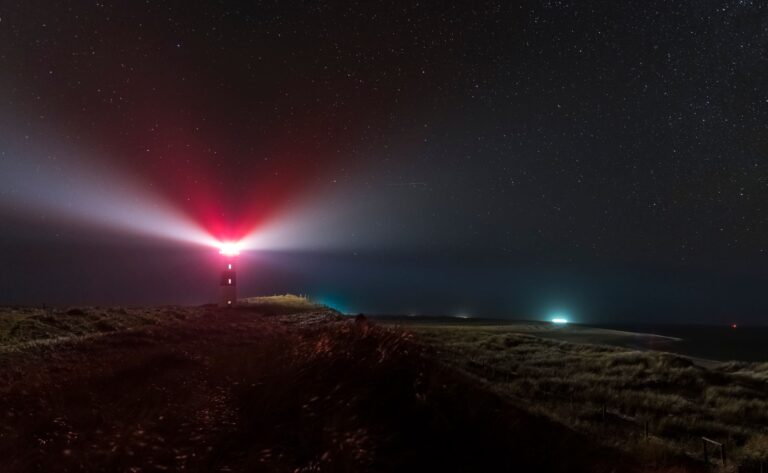



Un troisième phare fantôme au large de Lady Elliot Island
On a Great Barrier Reef island with two lighthouses, visitors keep spotting a third light at the horizon, and a new Bayesian study traces it to the brain.
 By
Leah Morrison
In brief
- Lady Elliot Island has two lighthouses, yet visitors report a third beam shining on the horizon at night.
- Researchers recreated the effect in virtual reality and published the work in Open Mind in 2026.
- The illusion persists even when the observer knows the light is actually behind them.
- The theory predicts the effect appears at about 70 meters, far closer than earlier reports suggested.
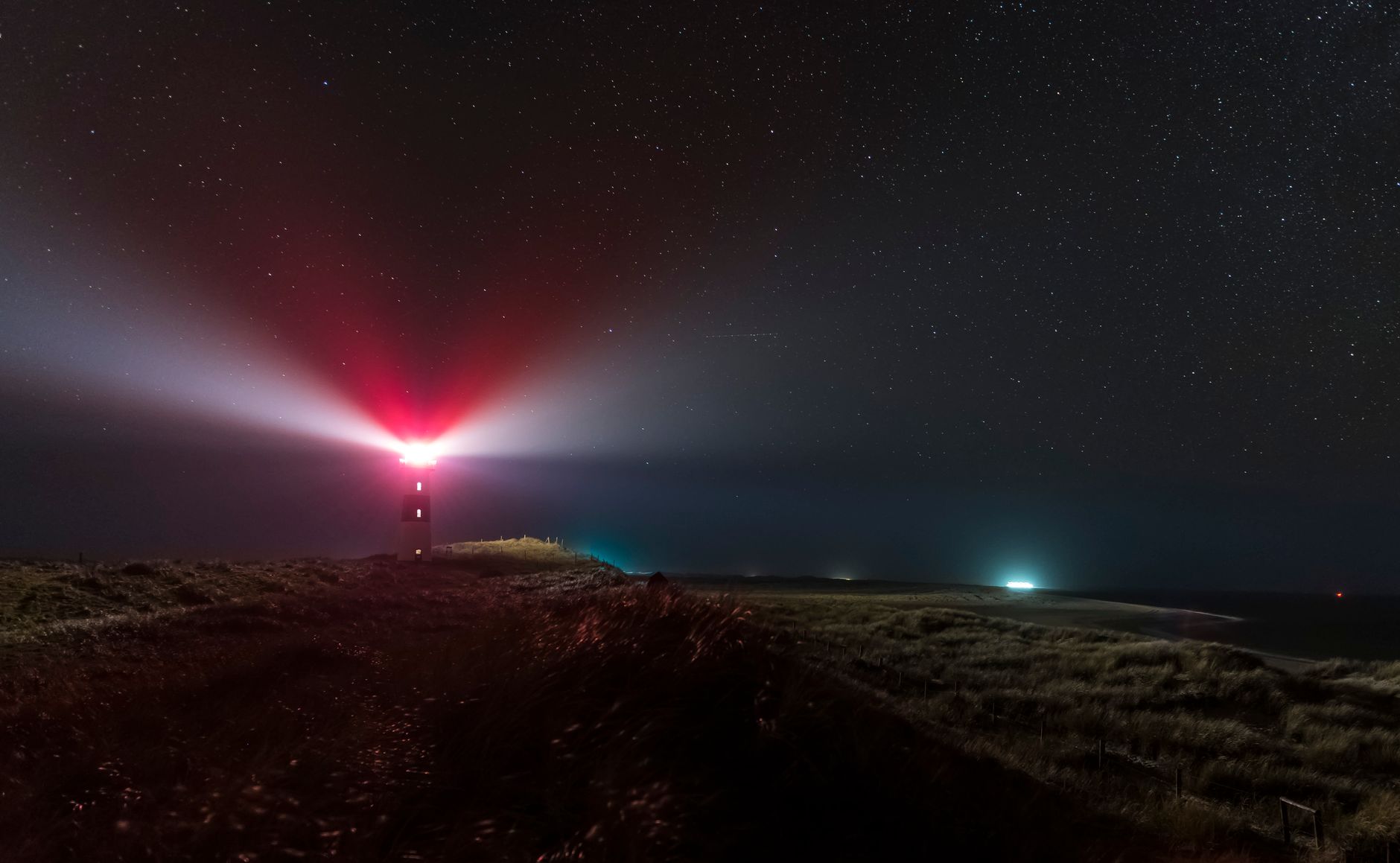
At the southernmost tip of Australia’s Great Barrier Reef, Lady Elliot Island has exactly two lighthouses. Yet after dark, visitors regularly describe the beams of a third one, sweeping across the horizon far out at sea. A study reported by Phys.org, republished from The Conversation, argues that the culprit is the brain’s habit of blending expectation with sensory evidence.
Two real lighthouses and one that is not there
The first lighthouse on the island was built in 1873 and decommissioned in 1995, when the second took over the job of warning ships off the reef. The phantom beams belong to neither. The effect is known well enough that the island’s guide for tourists mentions it.
It is also not a local quirk. The earliest known report of the phenomenon was published in 1937 and described it off the coast of Brittany, France.
Trying it, and testing it in virtual reality
One of the study’s authors traveled to Lady Elliot Island to investigate. The researchers then rebuilt the illusion in a virtual reality environment, and the lab results matched the real-world observations remarkably well. The work appeared in the journal Open Mind in 2026 as “A Bayesian Account of the Phantom Lighthouse Illusion” (DOI 10.1162/opmi.a.390).
To see it for yourself at night, the recipe is simple:
- Stand at least 70 meters from the lighthouse, between it and the sea.
- Look up at the lighthouse and watch its rotating beam where you would expect it.
- Turn your back to the tower and face the sea. The light seems to come from the horizon.
Knowing better does not help. The illusion persists no matter how many times the observer turns around to check the source. In the virtual version, the beam is generated by a lighthouse 300 meters behind the observer, yet it looks like a moving source in front.

How expectation overrides the evidence
According to the authors, what people see is a combination of what they expect and what their senses report. At night, few distance cues exist, so the evidence is sparse and the visual system leans on expectations about how far away each part of the beam is.
The authors offer an analogy: in a completely dark room with one small glowing disk at eye level, the disk could be a close, small object or a large, distant one. With ambiguous evidence, expectation decides.
The beam works the same way. People expect points along it to be much closer than they are. In reality the far end is very distant and moving extremely fast. If it is instead perceived as nearer and slower than the closer end, the natural reading is that the source sits somewhere in front of the observer.
Earlier reports against the new theory
| Question | Earlier reports | Bayesian account |
|---|---|---|
| Distance at which the illusion appears | 1-4 km (0.6-2.5 miles) from a lighthouse | Around 70 m should be enough |
| Check | Reported by observers | Confirmed in the virtual study and on Lady Elliot Island |
The authors describe the brain as a “prediction machine” that combines expectations with current data. Usually this yields accurate inferences, which is why illusions are revealing: they are the moments when the process errs, and they show how it gets things right the rest of the time. The location of a lighthouse may be misjudged by tens of kilometers, they say, for the same reason we correctly understand our surroundings almost always.
Photo: Felix Rottmann / Pexels