

“Is This the End?”: China’s Nuclear Project Terrifies the U.S. with Super-Laser That Mimics the Sun’s Power
 By
Ethan Reid
By
Ethan Reid
| IN A NUTSHELL |
|
In the city of Mianyang, China is constructing a colossal laser fusion facility that has the potential to redefine global nuclear research and energy production. This ambitious project aims to replicate the reactions that power the Sun, showcasing China’s determination to surpass the United States in fusion science. The facility, which is set to be significantly larger than America’s National Ignition Facility, underscores China’s commitment to becoming a leader in clean energy production. However, beneath the surface of this energy revolution lies a complex narrative of geopolitical strategy and potential military applications that has caught the attention of international observers.
The World’s Largest Laser Fusion Project Takes Shape in Mianyang
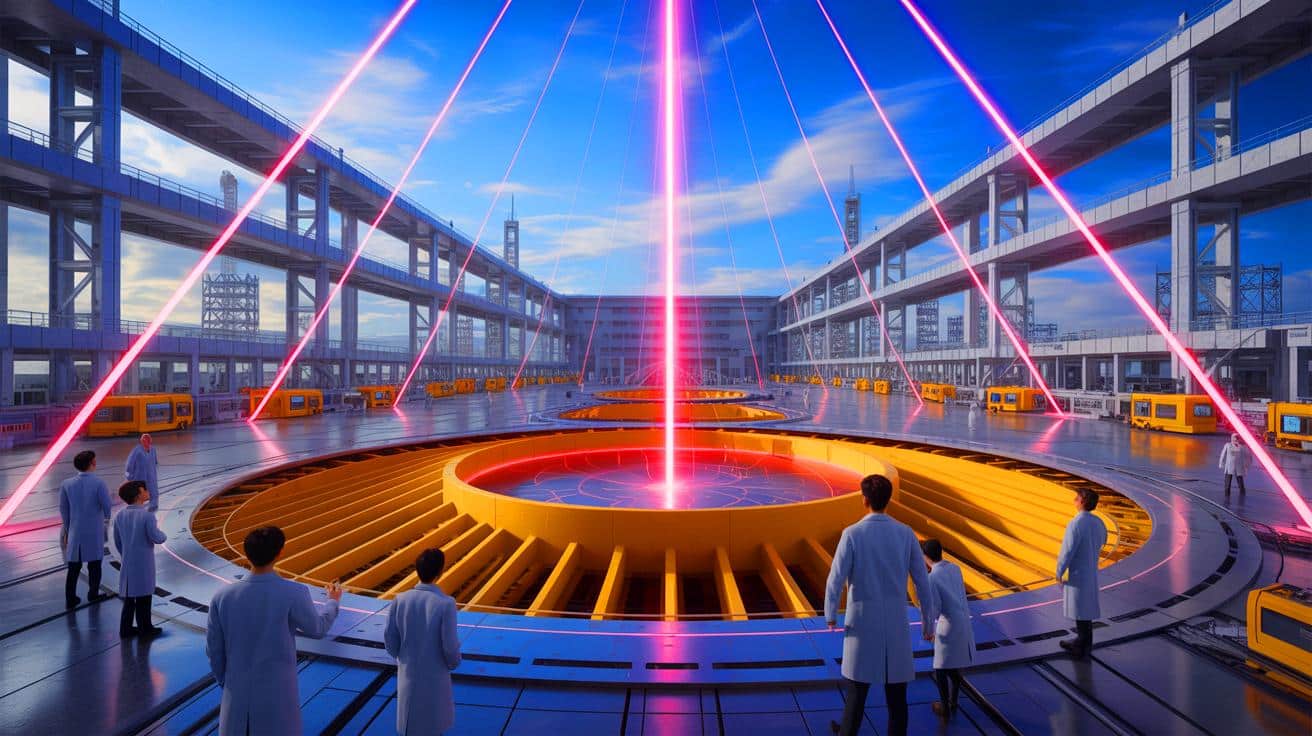
Imagine a vast hall where enormous lasers converge toward a tiny hydrogen capsule. This is the scene at Mianyang, where China is building what will become the world’s largest laser fusion installation. The aim is nothing short of extraordinary: to recreate the Sun’s nuclear fusion processes here on Earth. This billion-dollar endeavor is not only a testament to China’s scientific prowess but also a strategic move to potentially leapfrog the United States in nuclear fusion research.
The Mianyang complex will be 50% larger than the National Ignition Facility in the U.S., currently the world’s most powerful laser setup. Its design involves four laser arms focusing on a central chamber, compressing material to temperatures and pressures akin to the Sun’s core. This method, known as inertial confinement fusion, allows nuclear models to be tested without actual nuclear explosions, theoretically keeping China within international treaty bounds while gaining a substantial scientific edge.
Fusion Energy: A Promise and a Potential Threat
Nuclear fusion is often hailed as the Holy Grail of clean energy, offering limitless power without CO₂ emissions or long-term waste. If China masters this technology first, it could become the leading energy superpower, breaking free from the need for coal, oil, or gas. This would revolutionize energy production, providing a sustainable and safe energy source for the future.
However, the dual-use nature of this technology poses concerns. The same technology that enables fusion can simulate the conditions of a nuclear explosion, facilitating the development of advanced weapons without actual detonations. This dual capability has led to suspicions, particularly from Washington, that Mianyang may serve a hidden military agenda, potentially modernizing China’s nuclear arsenal while adhering to international agreements. As China’s defense budget continues to grow, these suspicions fuel an atmosphere of increasing distrust.
A Global Race to Harness Fusion Power
China is not alone in the pursuit of nuclear fusion. The United States, France, Japan, and South Korea are all investing heavily in this field, vying to achieve fusion breakthroughs before their competitors. Despite the global effort, China appears to be moving at an unparalleled pace, centralizing resources and backing research with robust support to secure a decisive lead.
This scenario mirrors the space race of the 1960s, where each rocket launch was a display of national strength. Today, each fusion experiment symbolizes technological dominance. Should China succeed in generating fusion energy before the United States, it would not only solidify its status as a scientific and industrial leader but also blur the lines between civilian and military research in a way that could shift the global balance of power.
Mianyang: A Beacon of Hope or a Harbinger of Conflict?
The implications of China’s laser fusion project hinge on its future transparency and cooperative stance. If China opts for openness, the Mianyang facility could significantly advance the global transition to sustainable energy. This would mark a historic leap for humanity.
Conversely, if the project remains shrouded in secrecy, it may exacerbate international tensions and spark a new arms race. Thus, nuclear fusion represents both a promise and a peril, a promise of a carbon-free world and a peril of renewed strategic rivalry. The question that remains is whether this scientific breakthrough will promote peace or sow discord. How will global powers navigate the challenges and opportunities presented by this monumental endeavor?