


“Ancient Beast Unleashes Chaos”: Scientists Stunned by Double-Headed Monster Discovery in China That Challenges History
 By
Leah Morrison
By
Leah Morrison
| IN A NUTSHELL |
|
In the realm of paleontology, discoveries often shed light on the intricate history of life on Earth. Recently, a remarkable fossil found in Liaoning, China, has sparked interest among scientists worldwide. This 120-million-year-old specimen of the aquatic reptile Hyphalosaurus presents a rare case of axial bifurcation, a condition where the spine splits, resulting in two heads. Such anomalies provide a unique opportunity to explore embryonic development in ancient species. This discovery not only enriches our understanding of evolutionary biology but also challenges existing notions about the limits of animal life during the Cretaceous period.
An Unusual Reptilian Fossil Challenges Evolutionary Theories
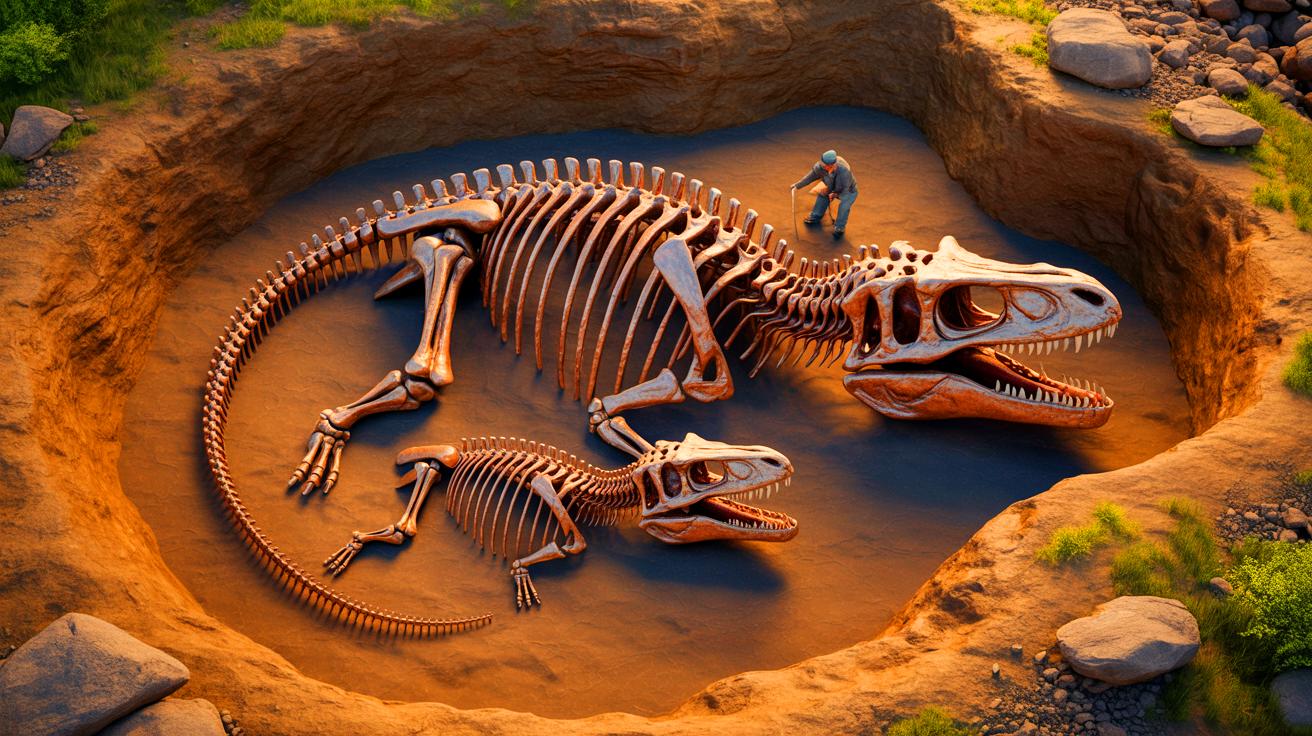
The Hyphalosaurus, a small aquatic reptile with a notably long neck, existed over 120 million years ago. Among the numerous fossils unearthed in Liaoning, a single specimen stands out due to its unusual morphology. From its pectoral girdle, the creature’s spine bifurcates, leading to two distinct necks and fully formed heads. This phenomenon, known as axial bifurcation, occurs when embryonic division results in incomplete twin formation.
Despite the rarity of such fossils, similar anomalies are observed today in turtles, snakes, sharks, and deer. However, these organisms rarely survive to adulthood. The fossil in question, measuring a mere 2.8 inches, likely represents an embryo or a newborn that lived briefly. The significance of this specimen lies in its ability to offer insights into the evolutionary constraints and adaptations of Cretaceous aquatic reptiles.
Exceptional Fossilization Sheds Light on Rare Biological Phenomena
The discovery of this fossil is a significant event in paleontology due to the rarity of such malformations in the fossil record. The exceptional preservation of the specimen, along with the integrity of the stone slab in which it was found, has enabled scientists to verify its authenticity. The presence of sediment on the bones rules out the possibility of human tampering.
This fossil represents the oldest known instance of axial bifurcation, making it a crucial piece in understanding the evolutionary history of reptiles. The discovery underscores the fact that even biological anomalies, though fleeting, can sometimes be preserved through time. This insight reminds us of the evolutionary pathways that have shaped modern biodiversity.
Implications for Understanding Evolution and Developmental Limits
The two-headed Hyphalosaurus fossil extends beyond mere scientific curiosity, prompting profound inquiries into the limits of embryonic development and evolutionary potential. It raises questions about how many rare malformations might have existed without leaving any trace in the sedimentary record.
By examining such anomalies, researchers can gain a deeper understanding of the biological mechanisms governing the formation of living organisms. These studies highlight the delicate nature of gestational processes. Ultimately, this fossil serves as a tangible testament to the complexity of life and its history, urging us to reconsider the diversity of the animal kingdom through a new lens where developmental failures also play a role.
The Scientific Significance of Axial Bifurcation in Fossils
Axial bifurcation, while observed in modern species, is rarely documented in fossils. This discovery provides a rare glimpse into the embryonic development of ancient reptiles. The phenomenon occurs when the embryo’s attempt to form twins is unsuccessful, resulting in conjoined features. Such cases are invaluable for understanding the evolutionary and developmental processes that have influenced species over millions of years.
By comparing these ancient anomalies with contemporary occurrences, scientists can identify patterns and deviations in developmental biology. This research not only informs evolutionary biology but also contributes to the broader understanding of biodiversity and adaptation. The Hyphalosaurus fossil thus serves as a critical point of reference for scientists exploring the intricacies of ancient life forms.
The discovery of the two-headed Hyphalosaurus fossil in China opens new avenues for understanding evolutionary biology and embryonic development. As scientists continue to study this remarkable specimen, it raises intriguing questions about the potential for undiscovered anomalies in the fossil record. What other secrets might ancient fossils hold, waiting to be uncovered by future generations of paleontologists?