


Ancient Tunnels Stun: A 4,500-Year-Old Secret Shatters China’s History Forever
 By
Leah Morrison
By
Leah Morrison
| IN A NUTSHELL |
Recent archaeological discoveries in northern China have unveiled a sophisticated network of tunnels beneath a Neolithic city, hidden for 4,500 years. This revelation not only captures the imagination but also reshapes our understanding of ancient Asian civilizations. The complex structure and strategic depth of this site demonstrate a level of planning and defense previously unassociated with the Neolithic era. As researchers continue to unearth more about this site, it becomes increasingly clear that these ancient civilizations were far more advanced than previously believed, challenging long-held assumptions about their capabilities and societal structures.
Fortified City Built with Strategic Precision
Initial excavations at Houchengzui, which began in 2019, quickly revealed that what lay beneath was not a typical rural settlement. Instead, archaeologists found a sprawling, complex city covering more than half a square mile, featuring a central area, a peripheral zone, and multiple concentric walls. Designed as a defensive stronghold, each wall served as a barrier, enhancing the city’s security. This structural sophistication indicates that the society possessed advanced strategic planning skills, contradicting common perceptions of the Neolithic period as a time of primitive settlements.
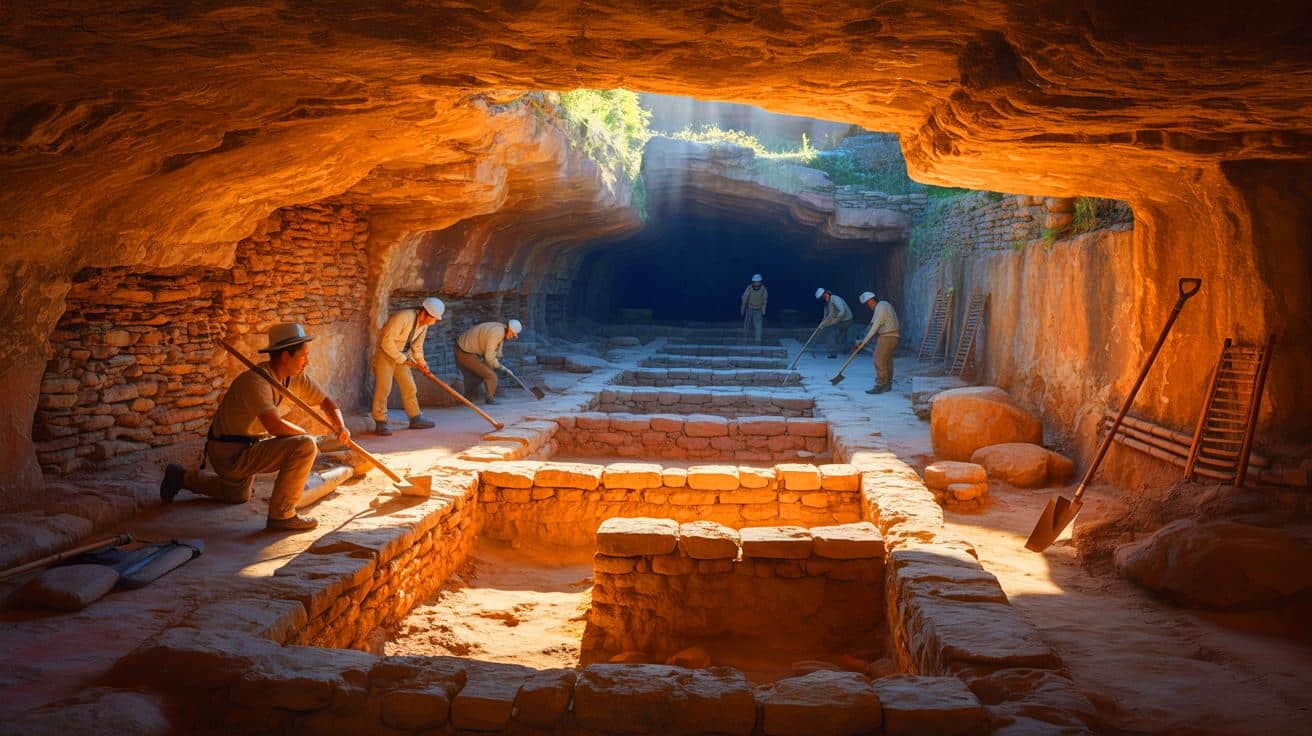
Perhaps the most astonishing discovery was the network of tunnels lying up to 20 feet below the surface. These tunnels were not accidental; they were deliberately integrated into the city’s original design. This suggests that the builders had a clear vision for a fortified city that emphasized defense and strategic depth. Such foresight showcases a remarkable understanding of spatial planning and security that challenges our understanding of Neolithic societies.
Invisible Warfare Through Ingenious Tunnels
The site comprises six tunnels, each designed with military use in mind. These underground passages allowed inhabitants to move supplies and personnel covertly, maintaining the element of surprise. This system of invisible warfare connected various parts of the city, facilitating reinforcements and making direct assaults perilous. The tactical advantage provided by these tunnels highlights both offensive and defensive capabilities that seem extraordinary for the time.
Importantly, the tunnels were not an afterthought but a planned aspect of the city’s construction. This strategic decision underscores the notion that these civilizations considered three-dimensional space, not just surface layouts. Such an approach reveals a sophisticated understanding of warfare and urban planning, suggesting that these ancient peoples were far ahead of their time in terms of military strategy and urban design.
A Neolithic Civilization Beyond Expectations
Houchengzui was not an isolated anomaly; it was part of a larger cultural and political hub. The site demonstrates not only high levels of urban planning but also an adeptness in managing their environment and territory. Current excavations continue to reveal artifacts and structures that reinforce the idea that Chinese Neolithic civilization was vibrant and dynamic. This ongoing research hints at the possibility of uncovering even more groundbreaking findings in the coming years.
The tunnels and the city they served tell a story beyond military strategy. They reflect a rare architectural intelligence and an ancient approach to security that was both discreet and forward-thinking. This combination of stealth and strategic foresight presents a narrative of a civilization capable of remarkable innovations, far exceeding previous historical assumptions.
Implications for Modern Understanding of Ancient Societies
The discovery of this ancient tunnel network challenges the modern understanding of ancient societies and their technological and strategic capabilities. It suggests that these early civilizations were not only advanced in their architectural and urban planning skills but also possessed a complex societal structure that allowed for such innovations. This perspective reshapes how historians and archaeologists view the evolution of human societies and their ingenuity.
Moreover, these findings prompt a reconsideration of the narrative surrounding ancient Chinese civilizations and their contributions to human history. The strategic and architectural innovations uncovered at Houchengzui provide a new lens through which to view the development of early human societies. As more discoveries are made, these insights could redefine historical timelines and influence contemporary interpretations of ancient human achievements.
As archaeologists continue their work at Houchengzui, the revelations about this ancient city and its remarkable tunnel network invite further questions about the ingenuity of early civilizations. What other hidden marvels might still lie beneath the surface, waiting to change our understanding of history? The answers may not only transform our knowledge of the past but also inspire future generations to explore the depths of human innovation. What other secrets do you think our ancient ancestors have left for us to uncover?