


Shocking Discovery: “This Marine Cell” Challenges Everything Scientists Thought They Knew About Life, Raising Global Stakes in the Quest for Knowledge
 By
Ethan Reid
By
Ethan Reid
| IN A NUTSHELL |
|
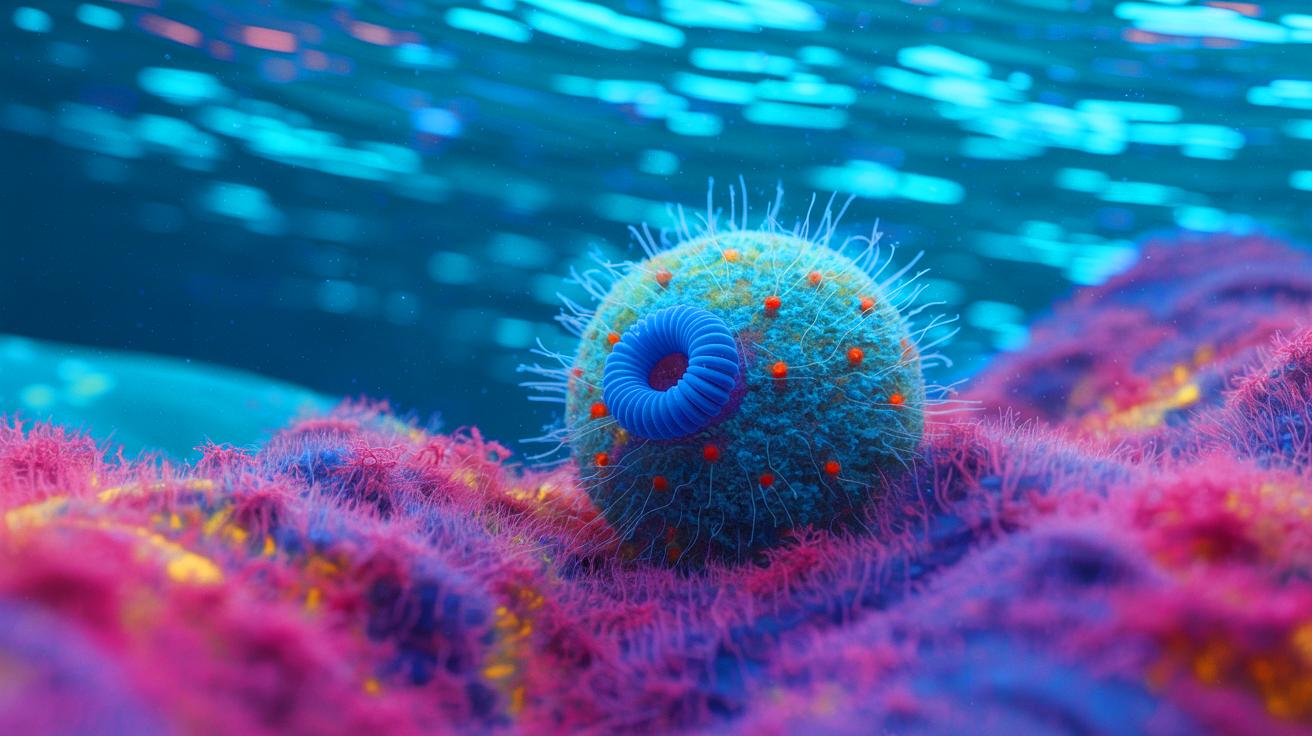
In the depths of the ocean, an astonishing discovery has emerged that challenges the very foundations of biology as we know it. A minute cell, nestled within marine plankton, has been identified as Sukunaarchaeum mirabile, a microorganism that defies existing classifications of life. This microscopic entity blurs the lines between what is considered living and non-living. Biologists are both perplexed and captivated by this unprecedented biological case, which could potentially reshape our understanding of life itself.
A Discovery That Challenges Biological Foundations
The journey began with the detection of a genetic anomaly in the DNA of the plankton species Citharistes regius. Researchers studying its bacterial symbionts stumbled upon an unknown DNA loop that was absent from all existing databases. This discovery led them to the realization that they had uncovered a previously unobserved organism. Named Sukunaarchaeum mirabile, this microorganism exists as a parasite within the plankton, occupying an unexplored gray area between bacteria and viruses.
Unlike typical bacteria or viruses, Sukunaarchaeum does not conform to traditional biological classifications. Its presence within the plankton raises questions about the nature of life and challenges longstanding definitions. This organism’s unique characteristics and its enigmatic existence have left scientists questioning the very essence of what it means to be alive. The discovery of Sukunaarchaeum mirabile has sparked a wave of curiosity and debate within the scientific community.
An Ultra-Reduced Genome Dedicated to Survival
One of the most surprising aspects of Sukunaarchaeum mirabile is its exceptionally small genome, consisting of only 238,000 base pairs. This is significantly less than the genomes of some giant viruses, making it remarkably minimal for a cellular organism, even one that is parasitic. The genome lacks any identifiable metabolic pathways, indicating that Sukunaarchaeum does not produce energy or nutrients on its own.
Instead, it retains the genetic material necessary for three key functions: DNA replication, transcription into RNA, and protein translation. This extreme reductionist strategy allows the organism to focus solely on reproduction, leading researchers to describe it as a cell with a minimalist, yet highly effective, mode of operation. Sukunaarchaeum mirabile’s streamlined genetic architecture raises intriguing questions about the limits of cellular life and the strategies employed by organisms to survive in diverse environments.
Neither Virus nor Typical Cell: A Biological Oddity
What makes Sukunaarchaeum mirabile particularly fascinating is its dual nature. On one hand, it possesses ribosomes and messenger RNA, enabling it to synthesize its own proteins, features typical of living cells and absent in viruses. On the other hand, it relies entirely on its host for other vital functions. This unique intermediate position between autonomy and dependency challenges traditional definitions of life.
“In our study, the ‘zombie cells’ represent up to 10% of all cells in the sea,” noted a researcher involved in the study.
This biological contradiction prompts a fundamental question: can Sukunaarchaeum still be considered a living cell? Analyses suggest it belongs to the archaea, ancient microbes from which eukaryotes (animals, plants, and humans) are derived. However, Sukunaarchaeum bears little resemblance to any known organism, further complicating its classification and understanding.
A Boundary-Pushing Entity Redefining Life
The discovery of Sukunaarchaeum mirabile challenges our comprehension of minimal life. It questions the established distinctions between biological autonomy and total parasitism. This unique case compels biologists to reconsider the fundamental criteria of life itself. Beyond this singular cell, researchers speculate that it might be the first of many similar entities. There could exist an entire ecosystem of such organisms, previously invisible, that thrive at the edge of what we define as living.
This living enigma serves as a reminder of nature’s boundless surprises. Even in the depths of plankton, it continues to push the limits of possibility, urging us to reevaluate our understanding of life and its myriad forms. The case of Sukunaarchaeum mirabile underscores the ever-evolving nature of scientific discovery and the mysteries that remain hidden in the least expected places.
As we delve deeper into the mysteries of life, Sukunaarchaeum mirabile stands as a testament to the complexity and wonder of the natural world. Its discovery prompts us to ask: how many more such enigmas await our exploration, and what might they reveal about the intricate tapestry of life on Earth?