

Archaeologists Shocked by “This Changes Everything” as 2,600-Year-Old Tomb Reveals Untold Secrets of Human History
 By
Ethan Reid
By
Ethan Reid
| IN A NUTSHELL |
|
An extraordinary archaeological discovery in Italy has captured the attention of historians and researchers worldwide. In the necropolis of San Giuliano, a tomb sealed for 2,600 years has been unearthed, revealing four individuals resting on stone beds, surrounded by over a hundred precious artifacts. This finding opens a unique window into the Etruscan civilization, which vanished over two millennia ago. The implications of this discovery are profound, shedding light on a society long overshadowed by the Romans. As archaeologists carefully examine the contents of the tomb, the world waits in anticipation for the secrets it promises to reveal about this enigmatic culture.
A Sealed Tomb Unveiled After Millennia
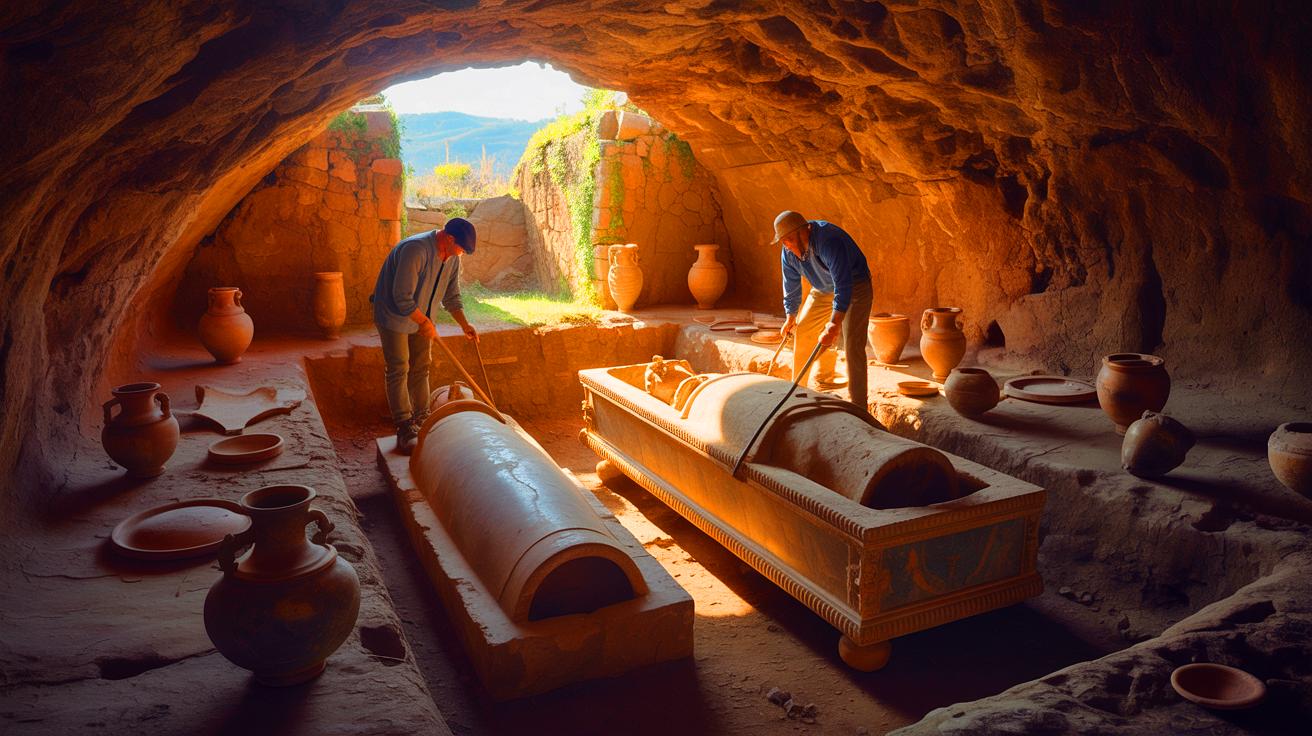
On July 15, an international team under the San Giuliano Archaeological Research Project (SGARP), led by Baylor University in Texas, lifted the stone slab protecting a 7th-century BC tomb. This remarkable site is located in the Marturanum Regional Park, about 43 miles from Rome. The tomb’s unparalleled preservation distinguishes it from many others in the region, which have been looted over the centuries. Here, fortune favored the archaeologists, granting them access to a monument that remained untouched by time.
Within the tomb, archaeologists discovered decorated vases, bronze ornaments, iron weapons, and delicate silver accessories. These items were impeccably preserved and strategically placed around the bodies. The intact state of these artifacts offers a rare glimpse into Etruscan burial practices and social hierarchies. The discovery of such a well-preserved site is a testament to the Etruscans’ craftsmanship and the region’s historical significance.
Decoding Clues from Extraordinary Funerary Artifacts
The arrangement of the bodies and artifacts within the tomb raises intriguing questions for researchers. Initial observations suggest the presence of two couples, each consisting of a man and a woman. However, anthropological and genetic analyses are required to confirm this hypothesis. The presence of Etrusco-Corinthian vases indicates trade interactions with ancient Greece, highlighting the Etruscans’ extensive commercial networks.
The wealth of the funerary artifacts suggests that these individuals may have belonged to a social elite. Each object serves as a clue to their status and beliefs. The findings are expected to provide invaluable insights into Etruscan society, which was known for its complex social structures and cultural influence on neighboring civilizations. As the analysis continues, researchers hope to piece together the lives and identities of the tomb’s occupants.
Exploring the Life and Religion of a Cultured People
The Etruscans thrived between the 9th and 1st centuries BC in central Italy. Renowned for their maritime trade and metallurgical expertise, they were distinguished by their ritual banquets, the significant role of women, and a sophisticated lifestyle. Their religion was central to their society, featuring highly structured funerary rites and divinatory practices that gained recognition throughout the ancient world.
Gradually absorbed by Rome, the Etruscans contributed significantly to Roman culture, institutions, and religious practices. Professor Davide Zori describes the tomb as “a unique opportunity to study the funerary traditions of a people considered the most religious in the ancient world.” This discovery provides a rare chance to explore the intricacies of Etruscan life and their lasting impact on Roman civilization.
Offering Archaeology a Unique Time Capsule
This discovery goes beyond the mere aesthetic value of the objects found. It represents an intact time capsule that could unveil new details about Etruscan society. Future excavations are likely to enhance our understanding of their rituals, trade interactions, and role in Mediterranean history. Through this preserved tomb, a lost world emerges.
Each vase, weapon, and piece of jewelry is an essential component of the Etruscan historical puzzle. This finding not only enriches our knowledge of ancient societies but also challenges modern perceptions of cultural and historical development. As we continue to unravel the mysteries of this ancient civilization, what other secrets might the Etruscans hold for us today?