

“Unearthed Secrets of the First Ruler: Archaeologists Stumble Upon a Stunning Royal Tomb in Mysterious Mayan City in Belize”
 By
Ethan Reid
By
Ethan Reid
| IN A NUTSHELL |
|
After decades of meticulous archaeological exploration, the discovery of the founder’s tomb in the major Maya city of Caracol has captivated scholars worldwide. This extraordinary find sheds light on the ancient political dynamics and the rich cultural tapestry of the Maya civilization. Located in modern-day Belize, Caracol was once a thriving metropolis that dominated the region. The unearthing of this royal burial site not only reveals the grandeur of its past rulers but also provides invaluable insights into their societal structures and external influences.
The Legacy of Te K’ab Chaak
Te K’ab Chaak, the legendary founder of Caracol, established his reign during the 4th century AD. At its peak around 650 AD, Caracol boasted a population of approximately 100,000 people and covered an area of over 77 square miles. Less than a century earlier, Caracol’s military might had triumphed over the city-state of Tikal, significantly enhancing its influence throughout Central America.
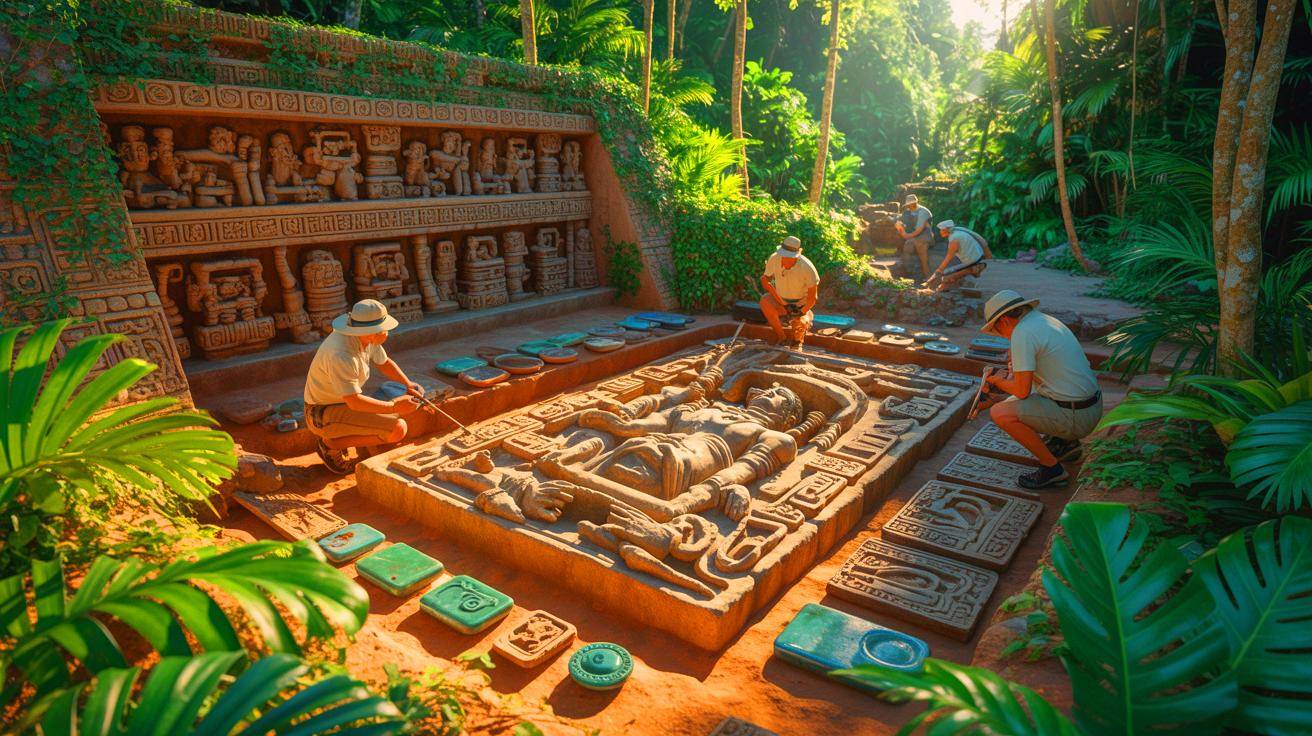
The tomb of Caracol’s first ruler was discovered at the base of one of its main sanctuaries. Inscriptions found at the site confirmed the identity of the deceased, whose toothless jaws suggested a diet typical of the elite and a death at an advanced age. This remarkable discovery has provided a new perspective on the life and death of Maya aristocracy.
Complementing his high social status, the funerary artifacts found alongside the ruler included a jadeite death mask and pendant, intricately carved bone tubes, and spondylus shells sourced from the Pacific. These findings underscore the wealth and far-reaching connections of Caracol’s ruling class during this period.
A Timeline Transformed
Previously, it was believed that Teotihuacan, the influential city now known as Mexico City, extended its sphere of influence to the Maya lowlands in 378 AD. However, the unearthed objects suggest close contact between Teotihuacan and Caracol nearly three decades earlier, revising our understanding of this historical timeline.
One of the excavated tombs contained 15 obsidian blades from the Pachuca region, located about 60 miles north of Mexico City, as well as atlatl spear points, ancient weapons used by Teotihuacan warriors and later by the Aztecs. These artifacts illustrate the monumental distances traversed by officials of these city-states over 1,600 years ago. It is estimated that a journey from Teotihuacan to Caracol, over 746 miles apart, would have taken 153 days on foot.
Earlier this year, Maya tattoo needles were also discovered in a burial cave in Belize, further enriching our understanding of their cultural practices.
Archaeological Revelations and Their Implications
According to Diane Chase from the University of Houston, the tomb of Te K’ab Chaak and the two neighboring royal burials dating back to around 350 AD challenge our perceptions of the geopolitical dynamics in the region at that time. The newly discovered artifacts indicate vibrant interactions between Caracol and distant city-states, suggesting a more interconnected ancient world than previously thought.
These revelations have revolutionized the field of Mesoamerican archaeology, prompting scholars to reassess the developmental timelines of the Maya and their interactions with other civilizations. The implications of these findings extend beyond historical curiosity, offering new insights into the sophisticated social and political systems that existed long before European contact.
Such discoveries highlight the importance of archaeological endeavors in uncovering the mysteries of the past and reshaping our understanding of ancient civilizations.
The Future of Maya Archaeology
The recent discovery in Caracol has set a precedent for future archaeological investigations across the Maya world. As researchers continue to unearth new sites and artifacts, they are piecing together the complex puzzle of Maya history, one excavation at a time. This ongoing work not only enriches our knowledge of past cultures but also fosters a deeper appreciation for the resilience and ingenuity of ancient societies.
As we delve further into the mysteries of the Maya, we are reminded of the enduring legacy of these ancient peoples and their contributions to human history. Each discovery adds a new chapter to the story of the Maya, inviting us to explore and understand the rich tapestry of their civilization.
What other secrets might the ancient cities of the Maya still hold beneath their jungle canopies, waiting to be discovered by the archaeologists of tomorrow?