

“Earth’s Spin Slashed Days By 2 Hours!”: Scientists Alarmed As Strangely Shorter Summer Days Baffle Global Experts
 By
Ethan Reid
By
Ethan Reid
| IN A NUTSHELL |
|
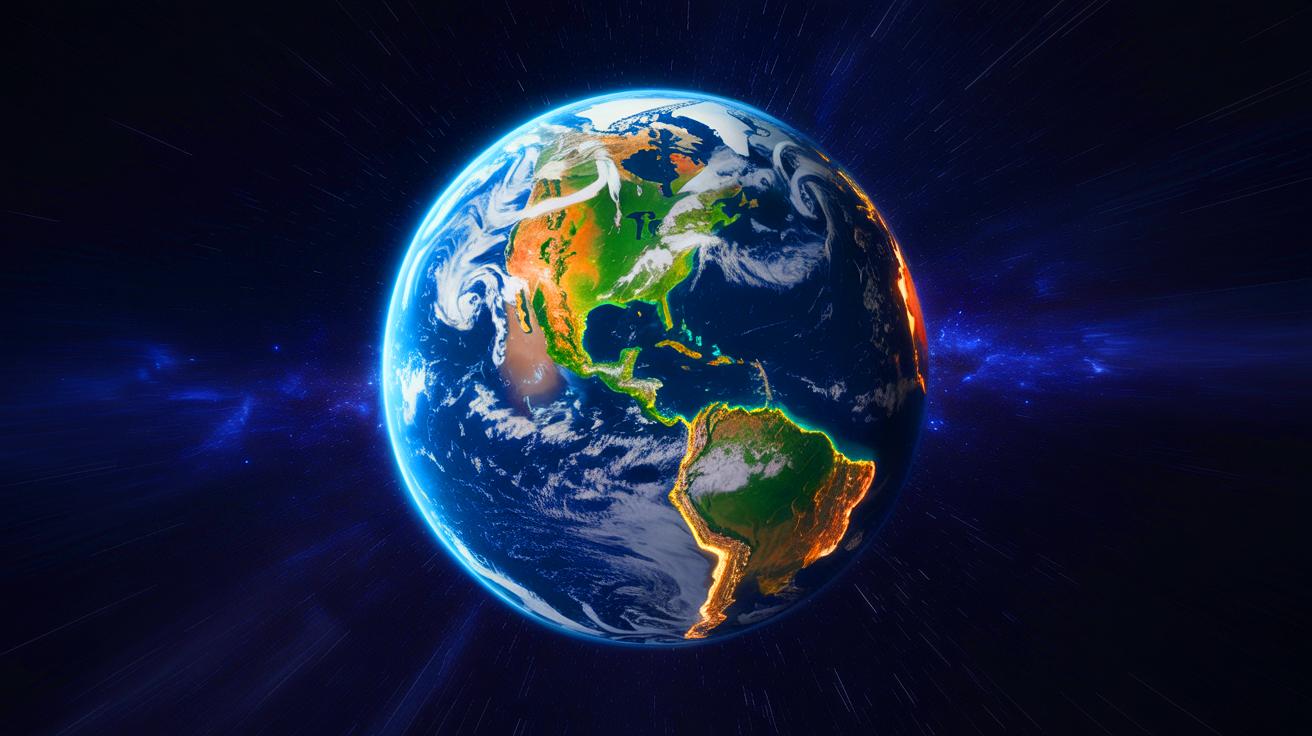
Each summer, we relish long, sunlit evenings; yet, beneath our feet, a subtle phenomenon is unfolding: the Earth is spinning faster. Recent data indicates that some days have been up to one millisecond shorter than the traditional 24 hours. This acceleration is influenced by multiple, sometimes surprising, factors. Understanding these changes is crucial, as they affect our planet’s timekeeping and could have significant implications for technology and climate science.
The Earth’s Record-Breaking Spin: How Precision Instruments Are Detecting Shorter Days
On July 9, the Earth recorded an unprecedented event: a day was 1.34 milliseconds shorter than usual. This record-breaking day was documented by the United States Naval Observatory and the International Earth Rotation and Reference Systems Service. Two other dates, July 22 and August 5, also rank among the shortest days ever recorded. These findings rely on the atomic clock, which is accurate to a billionth of a second.
Over the past decade, the average length of a day has decreased, with the trend intensifying over the last five years. According to Nicholas Stamatakos, an astronomer, some days now fall short of the full 24-hour cycle. This consistency in measurements underscores the importance of precision instruments in tracking Earth’s rotational speed and its variations.
The Three Major Factors Accelerating Earth’s Rotation
Several mechanisms are contributing to this acceleration. First, the Moon exerts a variable gravitational influence. Twice a month, when the Moon is near the equator, it slightly decelerates the Earth. Conversely, when it approaches the poles, it aids in speeding up the planetary rotation.
Next, the atmosphere plays a role. During summer, the jet stream slows down. To maintain the balance of angular momentum, the Earth compensates by spinning faster. This complex interplay between the atmosphere and Earth’s rotation is a fascinating aspect of our planet’s dynamics.
Finally, the Earth’s core presents intriguing data. Over the last fifty years, it has slowed down, prompting the outer layers to accelerate to maintain global equilibrium. Geophysicist Duncan Agnew notes that the reasons for this slowdown remain unknown, raising questions about its duration and impact on the planet’s rotational speed.
The Technological Implications of Shorter Days
Losing a millisecond per day is imperceptible for most people, but it poses significant challenges for astronomers and engineers. A cumulative discrepancy between astronomical time and atomic time occasionally necessitates the addition or potential removal of a “leap second.” Since 1972, twenty-seven leap seconds have been added to account for Earth’s overall deceleration.
However, the current acceleration might lead to the first negative leap second by 2029. This scenario could create complications for GPS, telecommunications, and computer systems, which are all based on the assumption that time always moves forward. The potential need to subtract a second highlights the intricate relationship between Earth’s rotation and human technology.
How Climate Change Could Reverse the Current Rotational Trend
Adding to this complexity is the growing influence of climate change. Melting ice, rising sea levels, and the depletion of groundwater reserves alter the distribution of Earth’s mass, which tends to slow down the rotation. This factor makes any prediction beyond six months highly uncertain.
Researchers face the daunting task of understanding these shifts and their potential impacts on Earth’s rotational dynamics. Although we can be certain that the Sun will rise tomorrow, the duration of daylight remains unpredictable. This uncertainty raises crucial questions about how we adapt and respond to these natural changes.
As we continue to study Earth’s acceleration, we must consider the broader implications for technology and climate science. The interplay between natural forces and human activity presents challenges and opportunities for future research. How will we adapt to these changes, and what strategies will we develop to manage the impact on our technological infrastructure and environmental policies?