

Scientists Stunned: “This Interstellar Visitor Should Never Have Existed” Shattering Our Cosmic Beliefs and Sparking Fierce Debate Among Experts
 By
Ethan Reid
By
Ethan Reid
| IN A NUTSHELL |
|
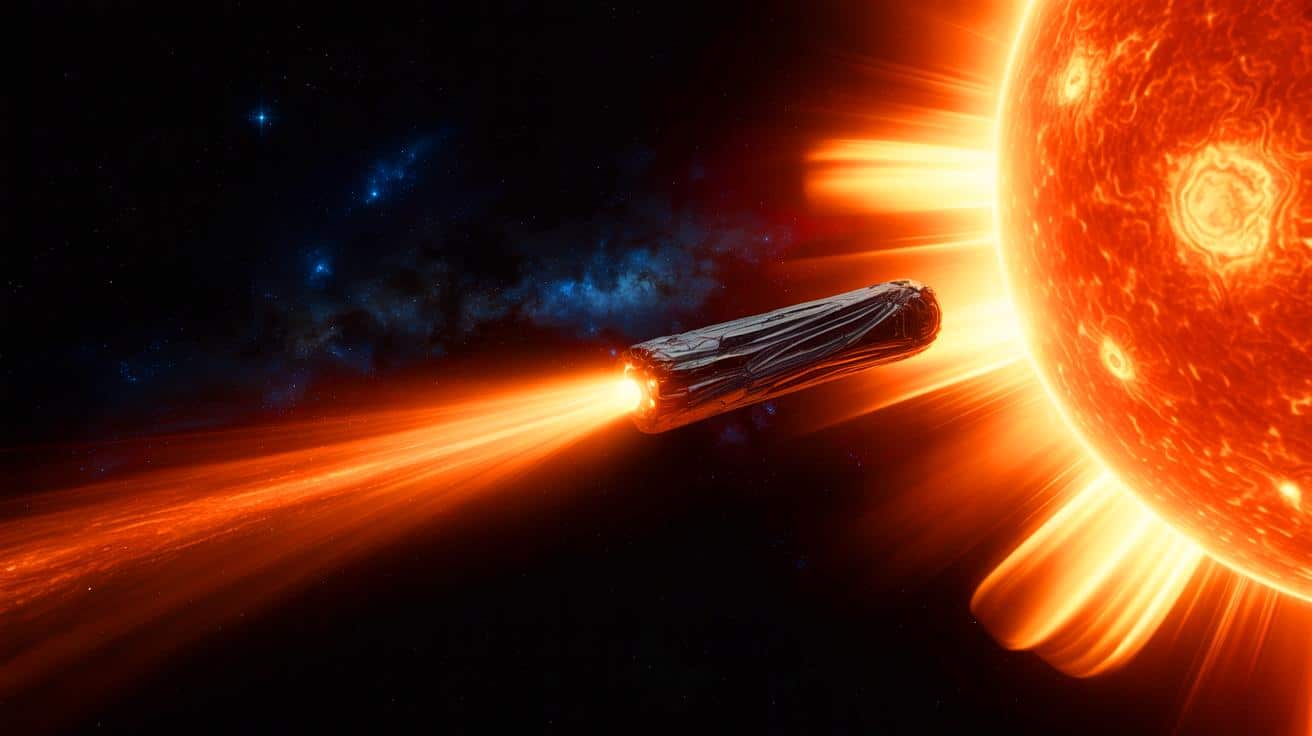
In recent years, the cosmos has continually presented humanity with astonishing revelations that challenge our understanding of the universe. The latest enigma captivating astronomers is the interstellar object known as 3I/ATLAS. Unlike any known comet or ordinary asteroid, 3I/ATLAS has entered our solar system, leaving scientists in a race against time to decipher its mysteries before it vanishes back into the depths of space. As it approaches the Sun, 3I/ATLAS offers a rare opportunity to study an object from beyond our solar system, igniting a flurry of scientific activity and speculation about its origins and implications.
The Origins of 3I/ATLAS: A Cosmic Traveler
3I/ATLAS’s hyperbolic trajectory confirms its interstellar origin, differentiating it from celestial bodies native to our solar system. The mystery surrounding its provenance fascinates scientists and stargazers alike. Initial theories suggest that 3I/ATLAS may hail from the thick disk of the Milky Way, a region rich with ancient stars. If this hypothesis holds true, it could mean that 3I/ATLAS is a traveler from over eight billion years ago, potentially originating from a star long since disappeared.
The notion of such an ancient object challenges existing models of stellar formation and evolution. Its age and chemical makeup could provide unprecedented insights into the processes that shaped the early galaxy. As researchers gather data, each piece adds to the cosmic narrative, offering glimpses into the past that might reshape our understanding of how celestial bodies form and interact over time.
Revised Dimensions: Implications for Interstellar Objects
Originally believed to be approximately 12 miles in diameter, 3I/ATLAS is now estimated to be significantly smaller, measuring between 0.6 and 1.2 miles. This revelation has profound implications for the detection and study of similar objects. The smaller size suggests that many interstellar travelers may go undetected, slipping through the vastness of space without our knowledge.
This uncertainty raises important questions about the prevalence of small interstellar objects. Could there be a multitude of such entities, too faint for our current technology to observe? If so, they could serve as time capsules, carrying information from other star systems and epochs. 3I/ATLAS might be just the first of many discoveries that could transform our understanding of the cosmos and its myriad inhabitants.
Composition and Challenges: The Survival of 3I/ATLAS
The approach of 3I/ATLAS towards the Sun presents both an opportunity and a challenge. Its close passage may induce comet-like activity, potentially releasing primitive ices, carbon dioxide, and even ammonia. Detection of these elements would corroborate its extreme age and pristine condition, suggesting that it remains largely unchanged since its formation.
However, the intense solar environment poses a threat to 3I/ATLAS’s survival. The fate of previous visitors like ‘Oumuamua, which remained intact, and the fragmented comet Borisov, highlights the uncertainty surrounding its structural resilience. Will 3I/ATLAS withstand the Sun’s thermal and gravitational forces? Observatories like the James Webb Space Telescope and Hubble are closely monitoring the object, seeking answers to these pressing questions.
A Glimpse Into Galactic History
3I/ATLAS is not merely a fascinating object in space; it is a witness to the galaxy’s past, a moving puzzle, and potentially a gateway to a deeper understanding of cosmic phenomena. As scientists strive to unravel its secrets, 3I/ATLAS continues to spark curiosity and debate within the astronomical community.
With each observation, researchers hope to unlock new insights into the formation and evolution of the galaxy. The data collected could pave the way for future explorations and discoveries, shedding light on the complex interactions that govern the universe. As 3I/ATLAS departs, it leaves behind a legacy of questions and possibilities, challenging us to expand our horizons and explore the mysteries of the cosmos.
As 3I/ATLAS makes its way back into the vastness of space, it leaves a profound impact on our understanding of interstellar objects and the history of our galaxy. Its journey has opened new avenues for scientific inquiry and challenged existing models of cosmic evolution. What other secrets does the universe hold, waiting for us to discover? And how might these revelations shape our future explorations of the stars?