


“Finally, Hawking Was Right”: This Cosmic Collision Confirms His Theories (and it’s more relevant than you think)
 By
Ethan Reid
By
Ethan Reid
| IN A NUTSHELL |
|
In a groundbreaking confirmation of Stephen Hawking’s theory, a recent cosmic event has lent credence to his revolutionary ideas about black holes. On January 14, the Laser Interferometer Gravitational-Wave Observatory (LIGO) detected gravitational waves from a massive collision between two black holes. This event not only captured the attention of the scientific community but also validated a fundamental principle proposed by Hawking in 1971. The collision revealed that the total surface area of the resulting black hole increased, supporting Hawking’s assertion that the surface area of a black hole can never decrease. This finding sheds new light on the nature of black holes and their role in the universe.
When Two Cosmic Giants Merge and Redefine Gravity’s Laws
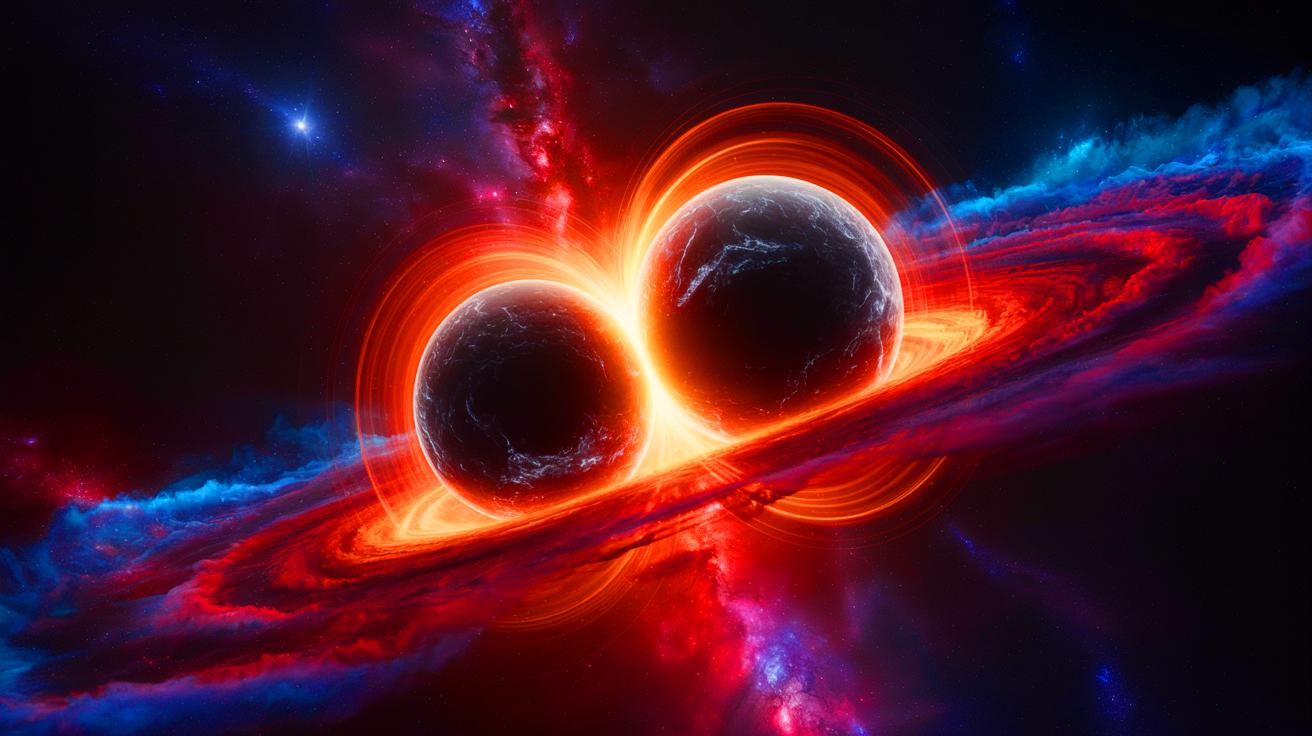
Picture two colossal entities, each several times more massive than our Sun, hurtling toward each other at tremendous speeds. As they collide, the very fabric of spacetime ripples like a taut sheet shaken by a gust of wind. This is precisely what researchers at LIGO observed during the event known as GW250114. Such collisions are not only dramatic but also transformative.
The aftermath of this particular collision left scientists astounded. The resulting black hole was larger than the combined mass of its parent black holes. This unexpected outcome confirmed a critical aspect of Hawking’s theory: the total surface area of a black hole’s event horizon, the boundary beyond which nothing can escape, must always increase. This principle, known as the “second law of black hole mechanics,” emphasizes the indomitable nature of black holes. Even amidst cosmic cataclysms, they adhere to laws that are as elegant as they are unforgiving.
Hawking’s Law: A Visionary Idea Linking Entropy, Time, and Matter
In 1971, Stephen Hawking proposed a radical idea: the event horizon of a black hole behaves similarly to entropy in thermodynamics. Like entropy, it can only increase. The more matter a black hole consumes, the more its surface area expands. This concept was groundbreaking at the time, weaving together the threads of gravity, thermodynamics, and quantum mechanics for the first time.
Now, over fifty years later, the collision detected by LIGO has finally confirmed this theory. Maximiliano Isi, a researcher at Columbia University, notes,
“Even if this principle seems simple, it reveals profound truths about the quantum structure of spacetime.”
Hawking’s foresight was remarkable. Black holes, once thought to be mere passive chasms, are dynamic systems that follow fascinating and implacable laws. They pulse with the rhythm of the universe, challenging our understanding of the cosmos.
The Gravitational Song of Black Holes: Decoding the Silent Music of the Cosmos
The researchers essentially listened to the gravitational waves emitted during the fusion, a veritable cosmic symphony. Like a resonating bell, the newly formed black hole produced a series of characteristic vibrations known as “ringdown.” By analyzing these signals, scientists measured the final black hole’s surface area and confirmed that it exceeded the sum of its progenitors.
This “sonic signature of the universe” helped resolve a long-standing mystery. Additionally, the discovery also validated the Kerr metric, a mathematical description of rotating black holes. As Katerina Chatziioannou from Caltech explains,
“At equal mass and rotation, two black holes are identical.”
In other words, nature remains consistent, providing a coherent framework for understanding these cosmic phenomena.
A New Era for Gravitational Astronomy: Humanity Begins to Listen to the Universe
Since the first detection of gravitational waves in 2015, LIGO has undergone a remarkable transformation. Today, researchers are identifying a fusion every three days, a stark contrast to a single event per month a decade ago. This progress is impressive, yet it marks only the beginning of what is possible.
By 2030, new instruments like LIGO-India, the European Einstein Telescope, and the American Cosmic Explorer will be operational. These advancements will enable us to hear the first fusions of the primordial universe, gradually tracing back to the birth of the first stars and black holes. One can imagine Stephen Hawking, somewhere in the vastness, smiling at the beauty of this confirmation. His insights continue to guide science, serving as a theoretical star that illuminates our understanding of the cosmos.
As we stand on the brink of unprecedented discoveries in gravitational astronomy, we are reminded of the visionary contributions of scientists like Hawking. Their work propels us forward, offering a glimpse into the universe’s most profound mysteries. How might these revelations about black holes reshape our understanding of the universe and our place within it?