

This Ancient Visitor Reveals Secret That Could Shatter Everything We Knew About Life’s Origins In Our Solar System
 By
Ethan Reid
By
Ethan Reid
| IN A NUTSHELL |
|
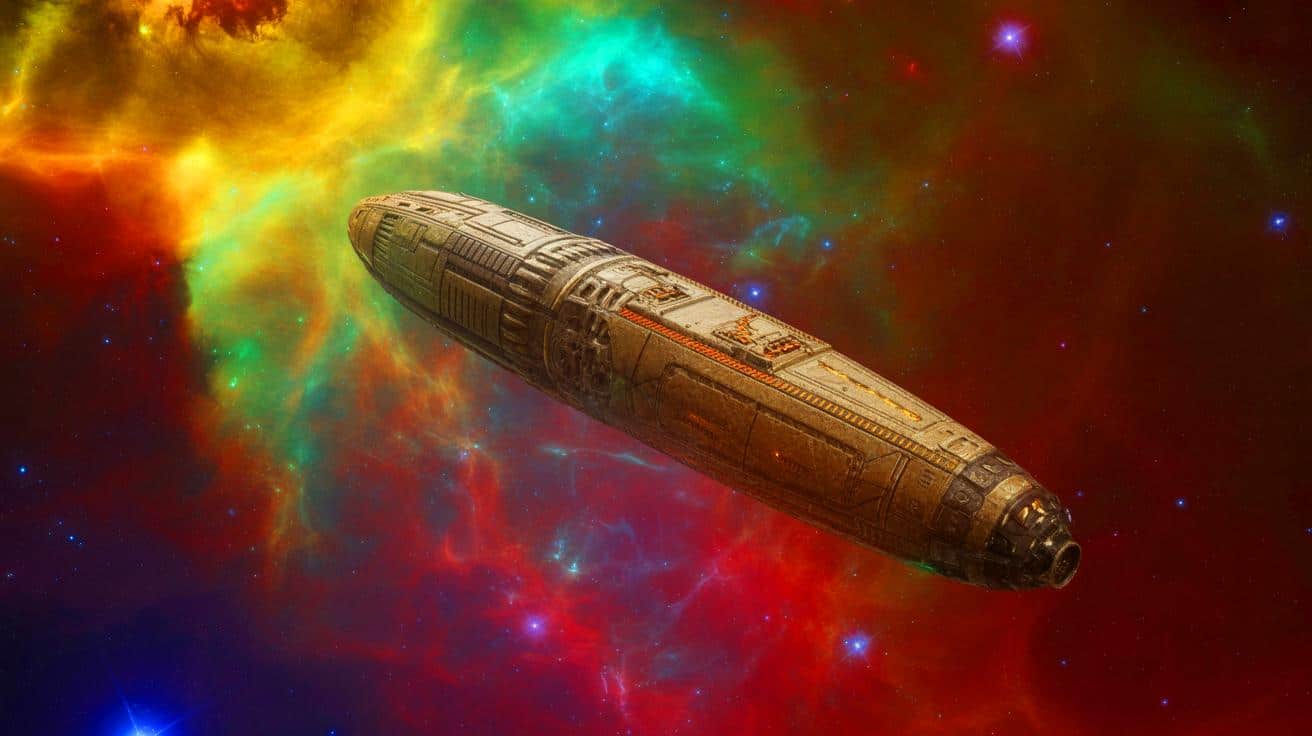
The vastness of space continues to challenge our understanding of life’s origins, sparking theories that stretch the imagination. A new hypothesis posits that interstellar objects, such as the recently identified 3I/Atlas, might have played a pivotal role in the genesis of planets and life within our solar system. Detected in 2025, this ancient visitor, older than our own solar system by billions of years, could hold the key to unraveling the mysteries of planetary formation. This theory, presented at the Europlanet Congress, suggests a cosmic dance where interstellar objects seed young star systems, offering a fresh perspective on how planets might emerge and evolve.
3I/Atlas: More Than a Mere Visitor
In July 2025, the ATLAS system detected 3I/Atlas, marking it as the third known interstellar object after 1I/Oumuamua and 2I/Borisov. What sets 3I/Atlas apart is its age, estimated to be about three billion years older than our solar system. This discovery has led astrophysicist Susanne Pfalzner to propose that such objects might serve as the seeds from which planets form. The theory, presented at Europlanet 2025, is rooted in the idea that in the protoplanetary disks surrounding young stars, countless interstellar objects like 3I/Atlas are captured by gravity, forming cores around which other matter congregates. This could potentially solve a long-standing cosmic puzzle regarding planet formation.
The hypothesis suggests that these interstellar visitors are not mere transients but may have a profound impact on the evolution of solar systems. As gravitational forces capture them, they could initiate the accretion process essential for planet formation. The presence of these objects could bridge the gap between theory and observation, providing a tangible mechanism for how dust and particles coalesce into planetary bodies.
Overcoming the Planetary Accretion Barrier
One of the significant challenges in planetary science is understanding how tiny dust particles in space manage to stick together to form planets. Theoretical models of accretion suggest a gradual process, yet in practice, these particles tend to bounce off each other or shatter rather than adhere. Moreover, once an aggregate reaches a few inches in size, the gas in the protoplanetary disk slows it down, causing erosion or even its descent toward the star, a conundrum known as the “centimeter barrier.”
Interstellar objects like 3I/Atlas offer a potential solution by bypassing this barrier. Due to their substantial size compared to mere dust particles, they can act as planetary seeds that survive initial formation challenges. These seeds could serve as stable foundations, promoting further growth and potentially leading to the birth of new worlds. This perspective not only enriches our understanding of planetary formation but also emphasizes the significant role that interstellar objects might play in the broader cosmic narrative.
Implications for the Formation of Gas Giants
The implications of this theory extend to the formation of gas giants such as Jupiter. Massive stars often have protoplanetary disks that dissipate quickly, sometimes within two million years. This time frame is seemingly too short for giant planets to form through traditional accretion processes. However, if these systems can rapidly capture interstellar objects, these cosmic seeds could serve as catalysts, accelerating the planet formation process.
Astrophysicist Susanne Pfalzner suggests that massive stars might attract more of these cosmic germs, offering an explanation for why they often host large planets. If these interstellar visitors can indeed expedite the formation of gas giants, they might be crucial in understanding the diverse planetary architectures observed across different star systems. This hypothesis prompts a reevaluation of how we perceive planetary formation, particularly in systems with massive stars.
Exploring the Prevalence and Activity of Cosmic Seeds
The next steps in this research involve verifying the frequency and activity of these cosmic seeds. Susanne Pfalzner and her team aim to continue their investigations to determine how many interstellar objects end up in protoplanetary disks. They also seek to understand the mechanisms that attract these objects and whether certain regions are richer in interstellar visitors.
The upcoming close approach of 3I/Atlas, skimming past Mars at approximately 17.4 million miles in October, might provide invaluable clues regarding its chemical composition. Such data could reveal what this ancient traveler has brought from the far reaches of the galaxy. If 3I/Atlas proves to be a harbinger of life, it might redefine our understanding of interstellar visitors, not merely as observers, but as progenitors of life.
The theory surrounding 3I/Atlas and its potential role in planetary formation offers a captivating glimpse into the interactions between interstellar objects and young solar systems. As research progresses, the scientific community remains eager to uncover the secrets these cosmic visitors hold. Could these ancient travelers indeed be the ancients of our cosmic lineage, offering a bridge between the stars and the planets? As we continue to explore these possibilities, what other mysteries might these interstellar objects unveil about the universe and our place within it?