


Scientists Reveal Unseen Celestial Phenomenon: “It Changed Everything in June”: What They Discovered Could Alter Our Understanding Forever
 By
Ethan Reid
By
Ethan Reid
| IN A NUTSHELL |
|
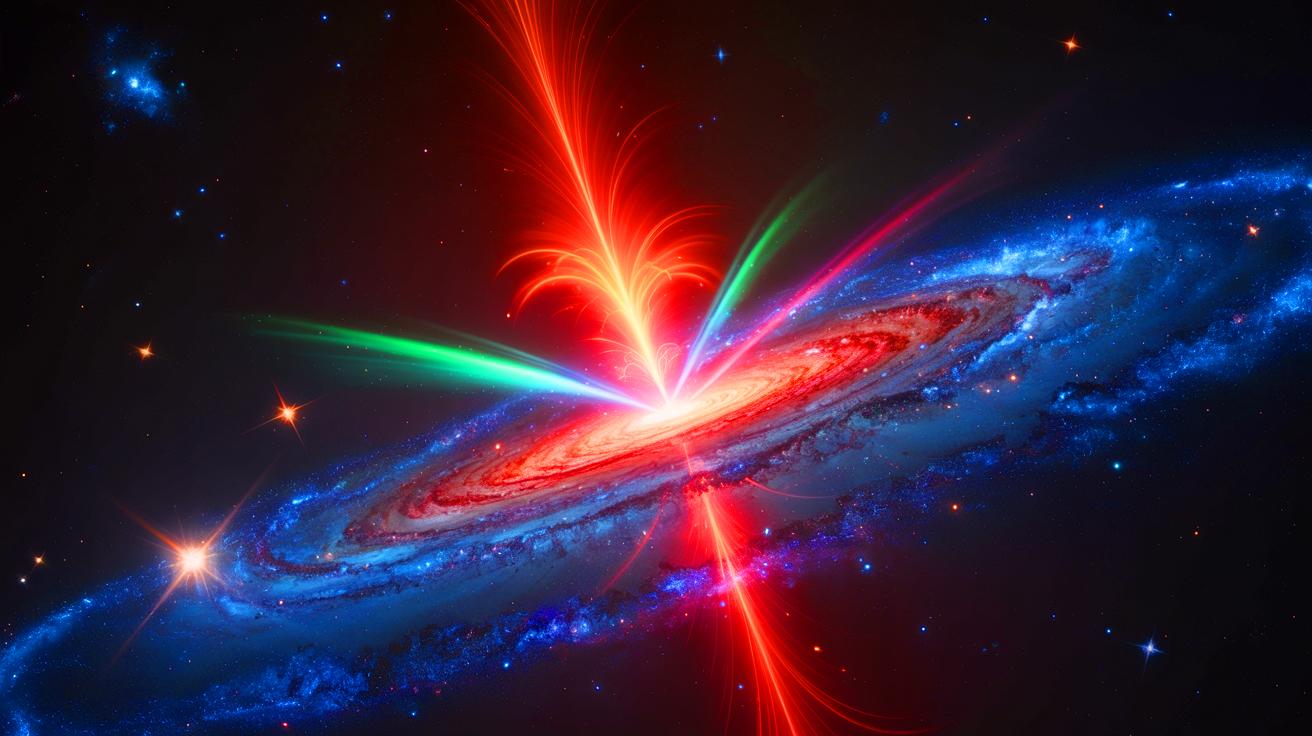
On July 2, 2025, telescopes worldwide focused on an unprecedented cosmic anomaly: a series of gamma-ray bursts from a single source, observed over several hours. This violent, prolonged, and unexplained phenomenon challenges existing knowledge about the universe’s most powerful explosions. Typically, gamma-ray bursts are short-lived, lasting from a few milliseconds to a few minutes, marking the death of a massive star or its merger with a black hole. However, the recent event defied these norms by repeating from the same source, raising significant questions about our understanding of cosmic events.
A Breakthrough in Gamma-Ray Burst Observations
Gamma-ray bursts typically last only a few milliseconds to minutes, signaling the death of a giant star or its collision with a black hole. These events are usually non-repetitive, ending with the phenomenon that causes them. Yet, on July 2, three successive bursts appeared within hours from the same source. Antonio Martin-Carrillo, an astronomer at University College Dublin, described it as “different from anything observed in fifty years.” The signal lasted up to 1,000 times longer than average bursts.
Astronomers traced the event to a galaxy billions of light-years away, far beyond the Milky Way. This distance implies that the light we observe is ancient, yet so intense that it still affects us today. Such an observation challenges the understanding of gamma-ray bursts and suggests that our knowledge of cosmic phenomena may be more limited than previously thought.
Potential Explanations for the Anomaly
Two main hypotheses dominate discussions on this cosmic enigma. The first suggests an atypical collapse of a very massive star, capable of generating immense energy over an extended period. Perhaps this involves a previously unknown celestial body beyond typical categories. The second possibility involves the disintegration of a dense celestial object by an unusual black hole, whose behavior remains poorly understood. This interaction could involve extreme gravitational effects or exceptional magnetic fields.
In both cases, researchers are compelled to revise their models. The intensity curves, duration, and repetition do not align with theoretical predictions. Additionally, this observation underscores the power of modern tools. The synergy of the Einstein Probe mission, the Hubble Telescope, and the Very Large Telescope enabled data cross-verification, confirming the anomaly. Without this collaboration, such a phenomenon might have gone unnoticed.
Implications for Our Understanding of the Universe
This summer, we may have witnessed the emergence of a new category of cosmic phenomena. Although unnamed and unexplained, the event is significant enough to challenge decades of certainties. Ultimately, this celestial anomaly acts as a reminder that, despite all our satellites and telescopes, space remains largely unexplored, with mysteries waiting to be uncovered.
Perhaps one day, this signal will have a name, a model, and an explanation. However, for now, it represents the universe’s ability to surprise us. It invites scientists and enthusiasts alike to ponder the complexities of the cosmos and consider what other secrets the universe might hold.
The Role of Technology in Unveiling Cosmic Mysteries
The detection of these gamma-ray bursts highlights the vital role of technology in modern astronomy. Advanced telescopes and collaborative missions enable scientists to capture and analyze phenomena that were previously beyond reach. The ability to observe such an anomaly underscores the progress made in observational astronomy and the importance of continuing to develop and deploy cutting-edge technology.
The collective efforts of international teams and the integration of diverse data sources have been instrumental in identifying and understanding these bursts. This collaborative approach not only enriches our knowledge but also sets a precedent for future astronomical investigations. As technology advances, the potential for discovering new cosmic events and understanding their implications grows exponentially.
The recent gamma-ray burst anomaly challenges long-held assumptions about cosmic events, pushing the boundaries of our understanding. It serves as a catalyst for further exploration and inquiry. How might this discovery influence future research, and what other cosmic mysteries await our discovery?