



James-Webb Telescope Uncovers 13 Billion-Year-Old Black Hole, Igniting Hawking’s Theories with Shocking New Evidence
 By
Ethan Reid
By
Ethan Reid
| IN A NUTSHELL |
|
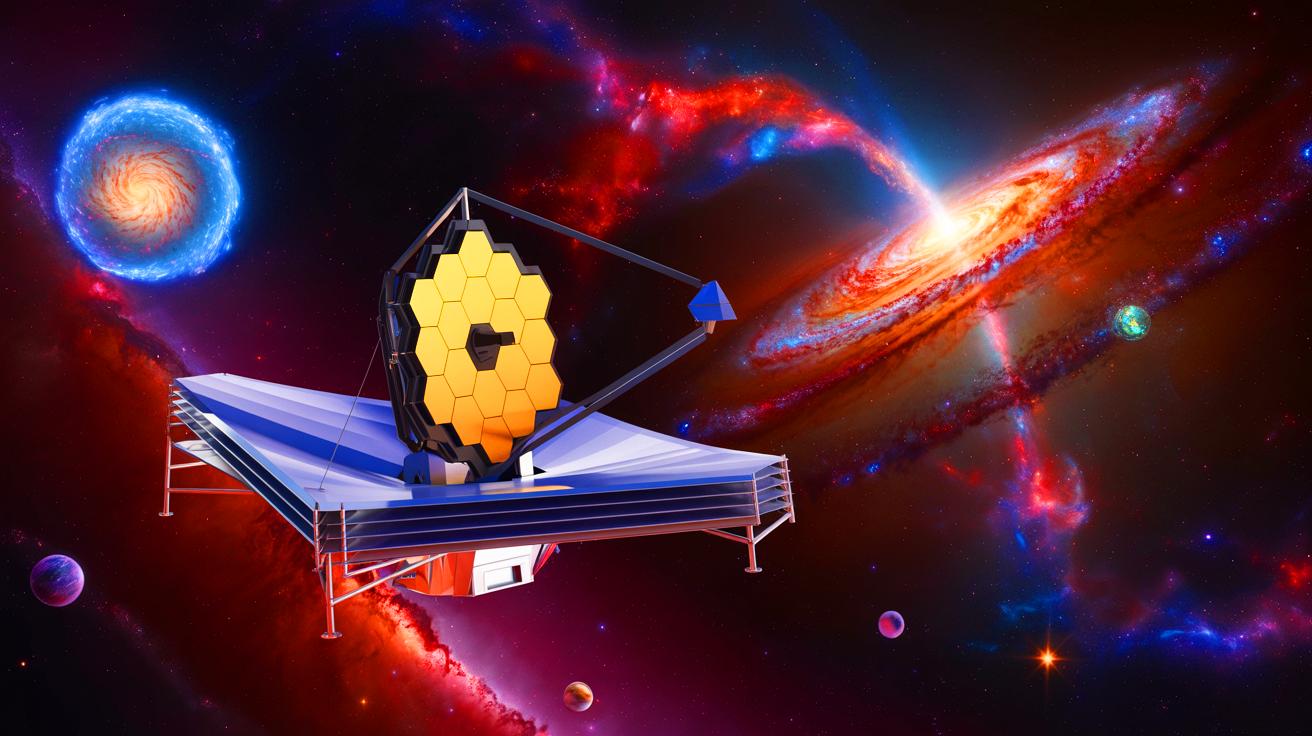
The James-Webb Space Telescope (JWST) has potentially unveiled one of the primordial black holes theorized by Stephen Hawking over 50 years ago. This groundbreaking discovery, facilitated by the gravitational lensing effect, could significantly alter our understanding of the early universe and dark matter. The image of a massive black hole in deep space has fueled research into quantum physics and Hawking’s visionary work. As scientists delve deeper into this discovery, the implications for our comprehension of the cosmos are vast and profound. This revelation could pave the way for new theories and insights into the universe’s formation and structure.
The Mysterious Object Abell 2744-QSO1
In 2024, the James-Webb Space Telescope observed a puzzling object known as Abell 2744-QSO1. Located over 13 billion light-years away, this object came into view thanks to the galaxy cluster Abell 2744, often referred to as the Pandora cluster. This cluster acts as a gravitational lens, revealing distant galaxies otherwise hidden from view.
Researchers identified compact, red objects among these galaxies, termed Little Red Dots (LRD). Abell 2744-QSO1 is one such object. Its diminutive size and unique brightness prompted the question: is it a dense star cluster or a primordial galaxy dominated by a black hole? This query has led to intensive scientific investigation, as understanding the nature of this object could unlock secrets about the early universe and its development.
Evidence of a Massive Black Hole
Recent analyses have ruled out the possibility of a mere star cluster. The velocities of surrounding gases indicate the presence of a black hole with a mass equivalent to 50 million suns at the center of Abell 2744-QSO1. Interestingly, the stellar mass around it is nearly equivalent, which is unusual since galaxies typically contain a thousand times more stellar mass than their central black holes.
Furthermore, researchers noted the absence of X-rays, which are characteristic of active galaxy nuclei. This suggests the object resembles a “naked” black hole, lacking a large surrounding galaxy. This configuration aligns with predictions for a primordial black hole, formed directly after the Big Bang, suggesting that certain cosmic structures predate galaxy formation.
Hawking’s Vision of Primordial Black Holes
In the 1970s, Stephen Hawking and other physicists hypothesized that primordial black holes might form within the universe’s first seconds. These black holes could explain the origins of supermassive black holes observed early in the universe and the enigmatic nature of dark matter.
If Abell 2744-QSO1 fits this scenario, it would indicate that some black holes existed before galaxies. They may have acted as “seeds” for galaxy formation, attracting matter and merging during collisions. This role as cosmic seeds could illuminate the presence of massive galaxies formed less than a billion years after the Big Bang, enhancing our understanding of early cosmic history.
Implications for Big Bang Physics and Dark Matter
Confirming such an object would revolutionize our vision of the universe. It would introduce a new physics paradigm at the time of the Big Bang and renew hope for observing black hole evaporation through the Hawking effect. This phenomenon remains invisible with current stellar black holes, which are too cold to radiate. However, a lighter primordial black hole might eventually evaporate, releasing detectable particles.
Abell 2744-QSO1 thus represents a crucial lead in understanding the formation of the first stars and galaxies. It could also clarify the proportion of dark matter and test models related to quantum gravity. Simultaneously, it sets the stage for missions like LISA, a gravitational wave observatory capable of detecting primordial black hole mergers, expanding the frontier of cosmic exploration.
Anticipating a Scientific Revolution
If the James-Webb observations are validated, it would be the first tangible proof of the existence of primordial black holes. Such confirmation would disrupt not only cosmology but also fundamental physics, offering a novel ground for understanding the universe’s early laws. Researchers now await further data. X-ray and radio telescopes, along with future gravitational wave detectors, will contribute to confirming or refuting this monumental discovery.
The potential confirmation of primordial black holes could redefine our understanding of the universe’s infancy. As we stand on the brink of possibly validating one of Hawking’s long-held theories, the question remains: how will this shift our perspective on the universe and its mysterious origins?