

James-Webb’s Stunning Reveal: A 700-Million-Year-Old Black Hole Could ‘Rewrite Galaxy Formation History’ and Transform Our Understanding
 By
Ethan Reid
By
Ethan Reid
| IN A NUTSHELL |
|
The discovery of a supermassive black hole by the James Webb Space Telescope (JWST) has introduced a potentially groundbreaking puzzle piece in our understanding of cosmic history. This finding challenges the foundational beliefs about the formation of galaxies and the universe itself. Traditionally, it was believed that black holes formed within galaxies. However, this new discovery suggests that black holes might have existed even before galaxies, potentially altering our understanding of astrophysics. The implications of this discovery are vast, possibly requiring a reevaluation of the established cosmological models that describe the birth and evolution of cosmic structures.
QSO1: A Massive Black Hole from the Dawn of Time
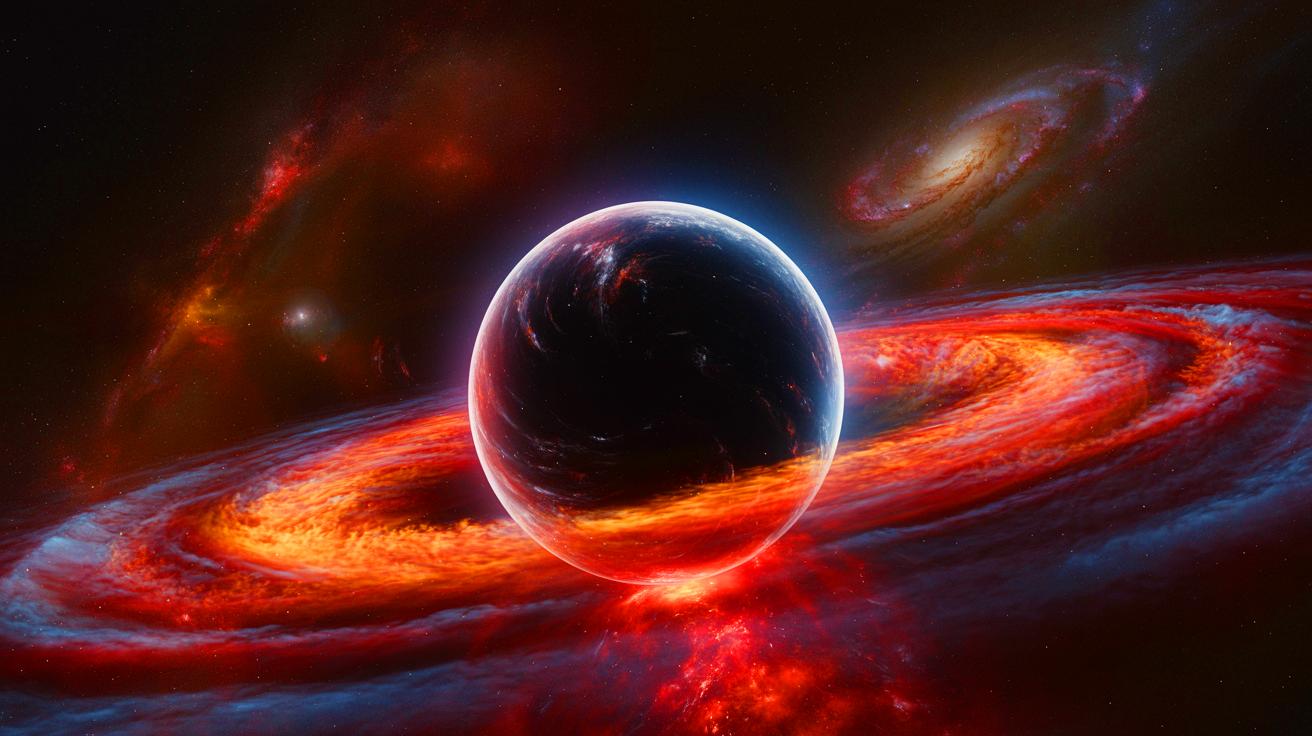
Researchers utilizing the James Webb Space Telescope have identified an enigmatic object known as Abell 2744-QSO1. This supermassive black hole is believed to have formed a mere 700 million years after the Big Bang. Its mass is astonishing, estimated to be around 50 million times that of our Sun. To put this in perspective, the black hole at the center of our Milky Way, known as SgrA*, has a mass of approximately 4 million solar masses despite existing for 13.8 billion years.
Abell 2744-QSO1 presents a unique case among other celestial bodies observed by the JWST. Unlike the “little red dots” galaxies, this black hole is almost entirely devoid of surrounding matter. This characteristic has led astrophysicists to describe it as a “naked” black hole, indicating it has not yet consumed large amounts of gas, and its growth might be limited. The existence of such a massive black hole so early in the universe’s history is both fascinating and perplexing to scientists.
Strengthening the Case for Primordial Black Holes
The detection of Abell 2744-QSO1 by the James Webb Space Telescope lends credence to the theory of primordial black holes. Since the 1970s, scientists like Stephen Hawking have speculated about these black holes that might have originated from density fluctuations in the universe when it existed as a searing plasma. Until now, this was purely theoretical.
With QSO1, researchers believe they have identified a tangible candidate for a primordial black hole. The presence of such a massive black hole at such an early stage defies current models. It is akin to stumbling upon a towering tree in a forest that had not yet seen the first seeds planted. This analogy aptly conveys the magnitude of the challenge that modern cosmology faces in incorporating this discovery.
Rethinking Galaxy Formation: Black Holes as Catalysts
The study posits a revolutionary concept: black holes could serve as the nuclei around which galaxies form. Cosmic objects like QSO1 may have acted as gravitational magnets, attracting gas and stars to shape the earliest galaxies. This hypothesis turns our understanding of cosmogony on its head.
Until now, it was widely believed that supermassive black holes were the byproducts of galaxies. However, QSO1 might prove the opposite, that they are the original cause. This new scenario challenges established notions and opens up new avenues for contemporary theories. The idea that black holes could play such a foundational role in the cosmos is a transformative shift in perspective.
Implications for Understanding the Early Universe
If this hypothesis is validated, our comprehension of the early universe will undergo significant transformation. The James Webb Space Telescope is not merely observing the heavens but is actively contributing to the rewriting of cosmic origins. QSO1 has sparked a new line of inquiry and has reignited the debate over the nature of black holes.
This raises the question: are black holes indeed predecessors to galaxies? Or is there an unknown phenomenon yet to be discovered? Regardless of the outcome, the narrative of galaxy formation will be retold in a new light.
This revelation could mark a pivotal moment in understanding our place in the cosmos.
As the exploration of Abell 2744-QSO1 continues, scientists are faced with the tantalizing possibility that black holes could fundamentally change our understanding of the universe’s early days. This discovery serves as a reminder of the vast unknowns that space still holds. What other cosmic secrets might the universe reveal as our observational technologies advance?