


‘Not Born of a Violent Collision’: Scientists Reveal Stunning Theory That Could Transform Our Understanding of Jupiter
 By
Leah Morrison
By
Leah Morrison
| IN A NUTSHELL |
|
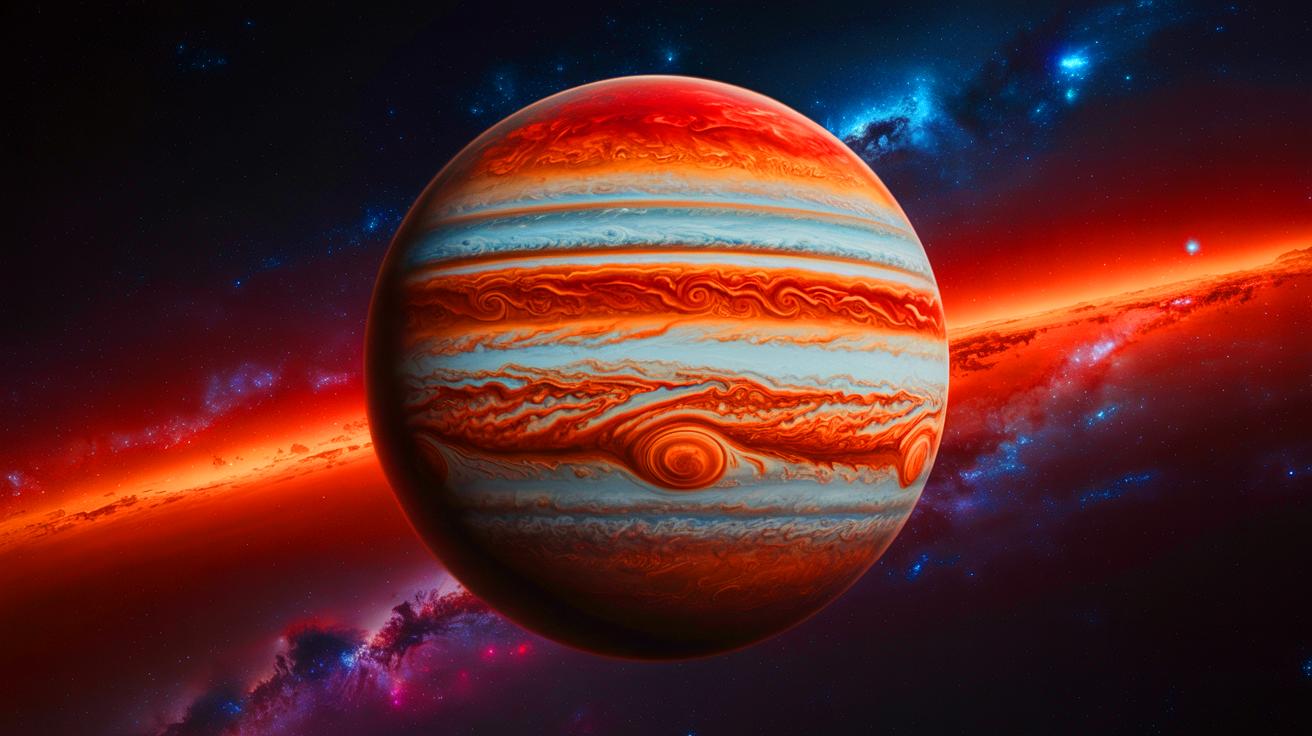
For decades, the formation of Jupiter has intrigued and puzzled astronomers, often described as the outcome of a massive, cataclysmic collision. However, a recent British study utilizing advanced computer simulations challenges this notion, offering a new perspective on how this colossal gas giant came into existence. By suggesting that Jupiter’s formation was a slow and steady process rather than a violent event, this study reshapes our understanding of planetary formation both within our solar system and beyond. These insights could have far-reaching implications for how we comprehend not only Jupiter but also other similar exoplanets.
Simulations Challenge the Giant Impact Theory
Since 2019, the prevailing hypothesis has suggested that Jupiter’s diluted core resulted from a massive collision with another planetary body. This theory posited that such an impact would have mixed Jupiter’s core materials, leading to its current state. To test this idea, researchers from Durham University in the United Kingdom employed the powerful Cosma supercomputer. Designed to model the universe from the Big Bang onwards, this computational behemoth allowed the team to simulate various planetary formation scenarios.
Working in collaboration with NASA, the SETI Institute, and Ohio University, the team utilized the Swift software, an open-source program focused on galactic formation and planetary physics. Their simulations produced a decisive outcome: no scenario could replicate a diluted core like Jupiter’s. Even after a massive impact, heavy materials would eventually settle towards the center, reforming a compact core. This result indicates that a collision alone could not sustain a diffuse or fuzzy core over time.
Jupiter’s Gradual Formation Through Material Accumulation
The findings suggest an alternative origin story for Jupiter. Instead of being shaped by a single violent event, Jupiter may have formed through a gradual accumulation of gas and dust over an extended period. This gradual accretion process would incorporate both heavy and light elements, naturally diluting its core. Such a hypothesis aligns with the characteristics of other gas giants in our solar system, like Saturn, which also possesses a diluted core.
This observation makes the likelihood of multiple planets experiencing similar collisions less plausible. Instead, it seems more logical to envision a common mechanism of slow formation shared by several gas giants. This understanding not only challenges previous notions but also aligns with the broader patterns observed in planetary formation.
Implications for Planetary Formation Beyond Our Solar System
According to researchers, this revised Jovian scenario could have implications far beyond our solar system. If diluted cores are common among gas giants, it may necessitate a reevaluation of how we interpret the internal structures of Jupiter-like exoplanets. Additionally, these new insights could influence our models for detecting exoplanets. By understanding how gas giants form, we can improve the accuracy of simulations that guide telescopes in their search for new worlds.
Thus, this study does more than just challenge an old theory; it opens up a new field of exploration at the intersection of astrophysics, planetary science, and computational cosmology. The potential to explore this area further could revolutionize our understanding of planetary formation on a cosmic scale.
Revisiting Jupiter’s Role in Planetary Formation
Jupiter has long been considered a key player in the formation and evolution of our solar system. Its massive size and gravitational influence have shaped the orbits and compositions of other celestial bodies. By reassessing how Jupiter itself formed, scientists can gain new insights into its role in the broader cosmic landscape. This new understanding might help elucidate the processes that led to the formation of other planets and potentially even the conditions necessary for life.
As researchers continue to refine their models and simulations, they may uncover more nuances in Jupiter’s formation story. Such discoveries could lead to a deeper understanding of the dynamics that govern planetary systems. With each new piece of information, the puzzle of our solar system’s history becomes more complete, offering a richer tapestry of knowledge for future generations.
As we delve deeper into the mysteries of planetary formation, one question remains: How might these new insights into Jupiter’s origins influence our search for life on distant worlds?