


Astronomers Shocked as Hubble Captures Black Hole Devouring Star: “This Changes Everything We Know About Space” and Ignites Fierce Scientific Debate
 By
Ethan Reid
By
Ethan Reid
| IN A NUTSHELL |
|
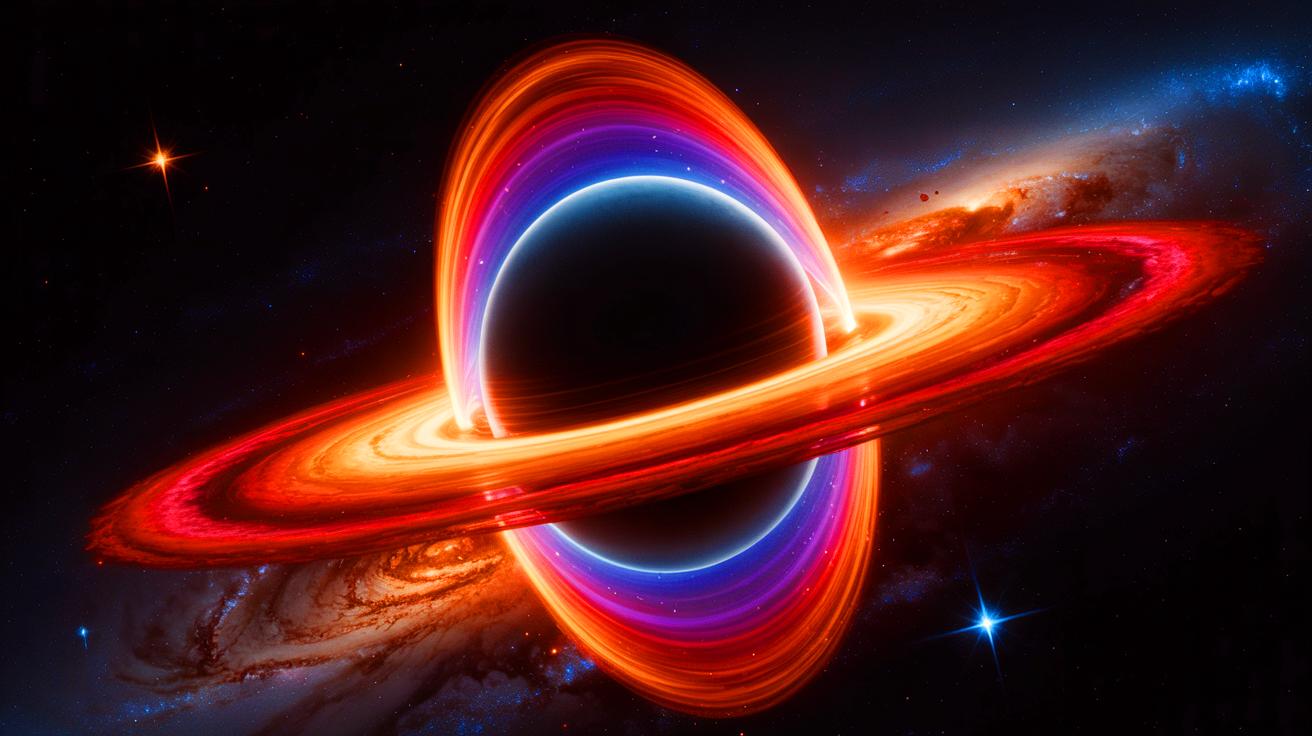
In a remarkable cosmic event, the Hubble Space Telescope recently captured the dramatic act of a black hole consuming a star. This extraordinary observation occurred 450 million light-years away and has sparked significant interest in the astronomical community. The black hole in question, dubbed HLX-1, is notable for its intermediate mass, a rarity that places it between the more commonly observed stellar and supermassive black holes. This discovery not only provides a breathtaking glimpse into the dynamics of our universe but also reignites curiosity about the formation and evolution of such cosmic entities.
The Enigmatic Nature of HLX-1
HLX-1 resides in the galaxy NGC 6099, located in the constellation of Hercules. Its intermediate mass is what makes it particularly intriguing to researchers. Unlike smaller black holes that form from the remnants of dead stars, or massive ones that sit at the center of galaxies, HLX-1 occupies a unique middle ground. This characteristic has made it a focal point of study since its initial detection in 2009.
Over the years, HLX-1 has displayed significant activity, with notable X-ray flares observed in 2012 and again in 2023. These bursts, which reached up to 100 times the intensity of initial detections, indicate the black hole is actively consuming a star. This activity provides an unparalleled opportunity to study the mechanics of black holes and their interactions with surrounding matter.
A Star Shattered and Consumed
The process of a star being drawn into a black hole is both fascinating and violent. As the star is pulled closer, it becomes elongated due to tidal forces, eventually being shredded into streams of stellar material. This effect is often likened to the star being stretched into a thin strand, or “spaghettified,” before it is swallowed by the black hole.
HLX-1’s environment is densely packed with stars, some separated by mere light-months. This proximity suggests that the black hole could have a steady diet of stars to consume for quite some time. The observations were made possible by the combined efforts of the Hubble Space Telescope, which provided optical and ultraviolet data, and the Chandra X-ray Observatory, which offered insights into the X-ray emissions. Together, these instruments have painted a comprehensive picture of this cosmic feast.
A Scientific Milestone in Understanding Galaxies
The discovery of HLX-1 is far more than an isolated astronomical event. It serves as direct evidence for the existence of intermediate-mass black holes, a category long theorized but seldom observed. These entities could potentially explain the gradual assembly of supermassive black holes, which are pivotal in shaping galaxies.
NASA emphasizes that HLX-1 is a critical piece in solving the puzzle of galactic evolution. It presents a chance to delve into how these black holes migrate, merge, or transition between galaxies. The prevailing hypothesis suggests that HLX-1 may have originated at the center of a smaller galaxy that was subsequently absorbed by NGC 6099. This narrative of cosmic migration and absorption offers a window into the dynamic processes that govern the universe.
The Broader Implications of HLX-1
Beyond its immediate scientific value, HLX-1 encourages a broader reevaluation of our cosmic models. It represents a rare opportunity to witness the interaction between a black hole and its environment, potentially rewriting parts of our understanding of black hole growth and behavior.
Each new observation of HLX-1 brings us closer to unraveling the mysteries of the cosmos. This black hole might be a missing link in the cosmic puzzle, offering insights into the invisible workings of our universe. In the vast darkness of space, such discoveries illuminate our path to understanding the fundamental forces that shape everything we see.
As astronomers continue to study HLX-1, questions linger about the future of this black hole and the galaxy it inhabits. Will HLX-1 continue to consume stars at its current pace, or will its activity eventually wane? How might these findings influence our broader understanding of galactic formation and evolution? These questions point to the vast unknowns that still lie ahead in the study of our universe.