

“This Cosmic Marvel Is Straight Out of Sci-Fi!”: Telescopes Capture Unprecedented Phenomenon for the First Time, Astonishing Astronomers Worldwide
 By
Ethan Reid
By
Ethan Reid
| IN A NUTSHELL |
|
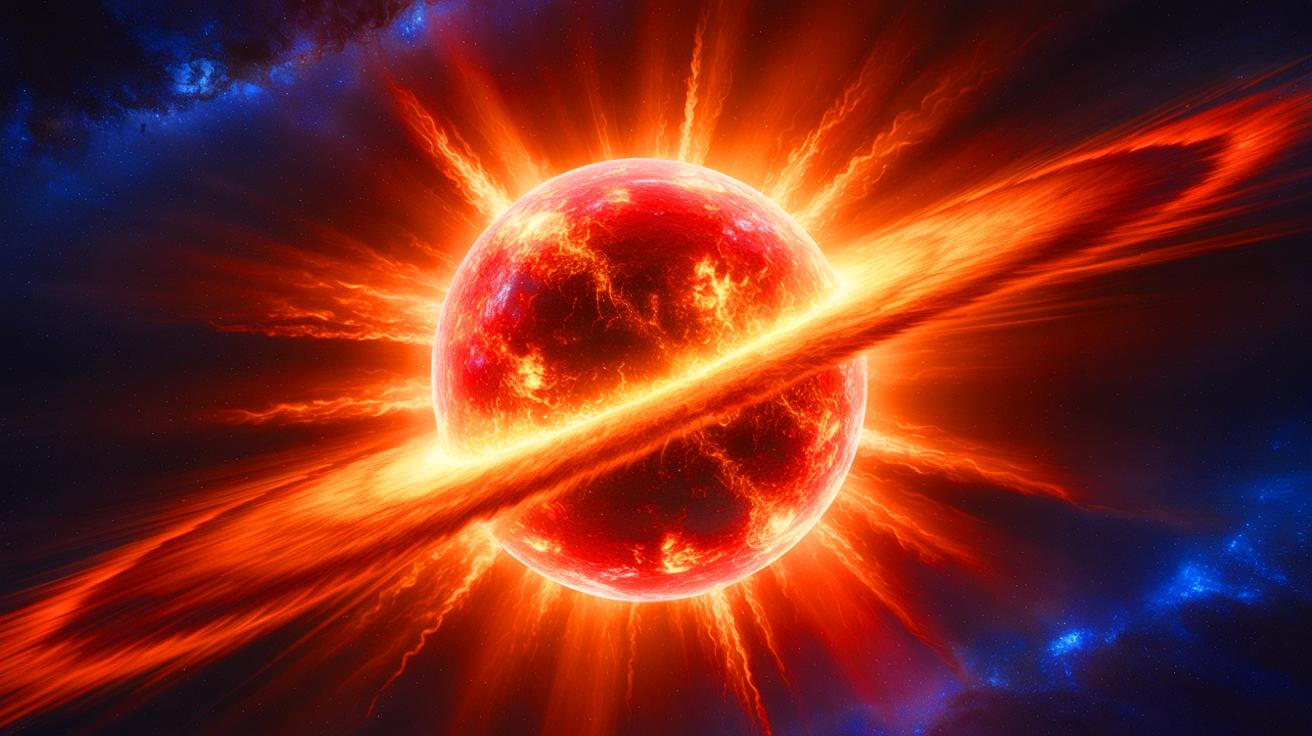
In a groundbreaking event that has left the astronomical community in awe, scientists have, for the first time, captured a cosmic phenomenon that was once thought to be purely theoretical. A massive star has undergone a rare double explosion, challenging our understanding of stellar death. This discovery not only signifies a leap in astrophysical knowledge but also opens new doors for research into the life cycles of stars, potentially altering our grasp of cosmic events.
SNR 0509-67.5: A White Dwarf’s Dual Detonation in the Large Magellanic Cloud
SNR 0509-67.5 is a remarkable supernova remnant located in the Large Magellanic Cloud, about 100,000 miles away. This particular remnant is a type Ia supernova, originating from a white dwarf that had accumulated helium on its surface. For the first time, the Very Large Telescope (VLT) has revealed two distinct layers of calcium, illuminating the double explosion phenomenon.
The first explosion resulted from the helium envelope, while the second was due to the compressed core. This sequence of detonations, long theorized, now stands as a visual testament to the final stages in the lifecycle of compact stars. The double detonation theory, once abstract, is now vividly confirmed, providing astronomers with new insights into the death cycle of stars.
MUSE on VLT: Spectro-Imaging That Unveils the Chemical Signature of Each Explosion
The MUSE instrument on the VLT has played an instrumental role in analyzing the emitted light from the supernova remnants. It revealed filaments of ionized calcium, appearing as striking shades of blue and green. Additionally, optical and infrared spectrums confirmed a high abundance of heavy elements, such as iron and nickel, produced by the second detonation.
Measurements of the ejection velocity from each explosion demonstrated distinct energies released in each event. By comparing these findings with numerical models, astronomers were able to verify the sequence of “helium then core” detonations. This multi-wavelength approach provides a comprehensive diagnosis of the explosion mechanics, offering a clearer understanding of these cosmic occurrences.
Standard Candles and Cosmic Alchemy: Implications for Cosmology and Chemistry
Type Ia supernovae are critical as standard candles in mapping the expansion of the universe. The discovery of double detonation impacts their brightness and duration of emission, necessitating slight adjustments in cosmic distances. Furthermore, these explosions distribute heavy elements, like iron and calcium, throughout space.
This process enriches the interstellar medium, laying the groundwork for the formation of planets and potentially life itself. By integrating the double detonation model into existing frameworks, scientists can enhance their understanding of the chemical evolution and large-scale structure of the universe. This cosmic alchemy, which transforms stellar remnants into building blocks of the cosmos, is a testament to the interconnectedness of all celestial bodies.
Towards a New Era of Observations and Modeling
The observation of SNR 0509-67.5’s dual explosion heralds a new era in astrophysics. Future telescopes, such as the James Webb Space Telescope (JWST) and the Extremely Large Telescope (ELT), will be poised to search for additional double detonations. This will allow for the creation of a dedicated catalog and a deeper understanding of the variability in type Ia supernovae.
Ultimately, these discoveries will necessitate updates in cosmological and stellar chemistry models. Every meter of the cosmos might be influenced by these two phases of stellar death, revealing an ever more complex universe. As we continue to push the boundaries of our knowledge, we must ask ourselves: How many more cosmic mysteries await unveiling, and what will they teach us about our place in the universe?