


James Webb’s Bold Revelation: “This Is Astounding” as NASA Unveils Hidden Heart of a Nebula, Challenging Scientists
 By
Ethan Reid
By
Ethan Reid
| IN A NUTSHELL |
|
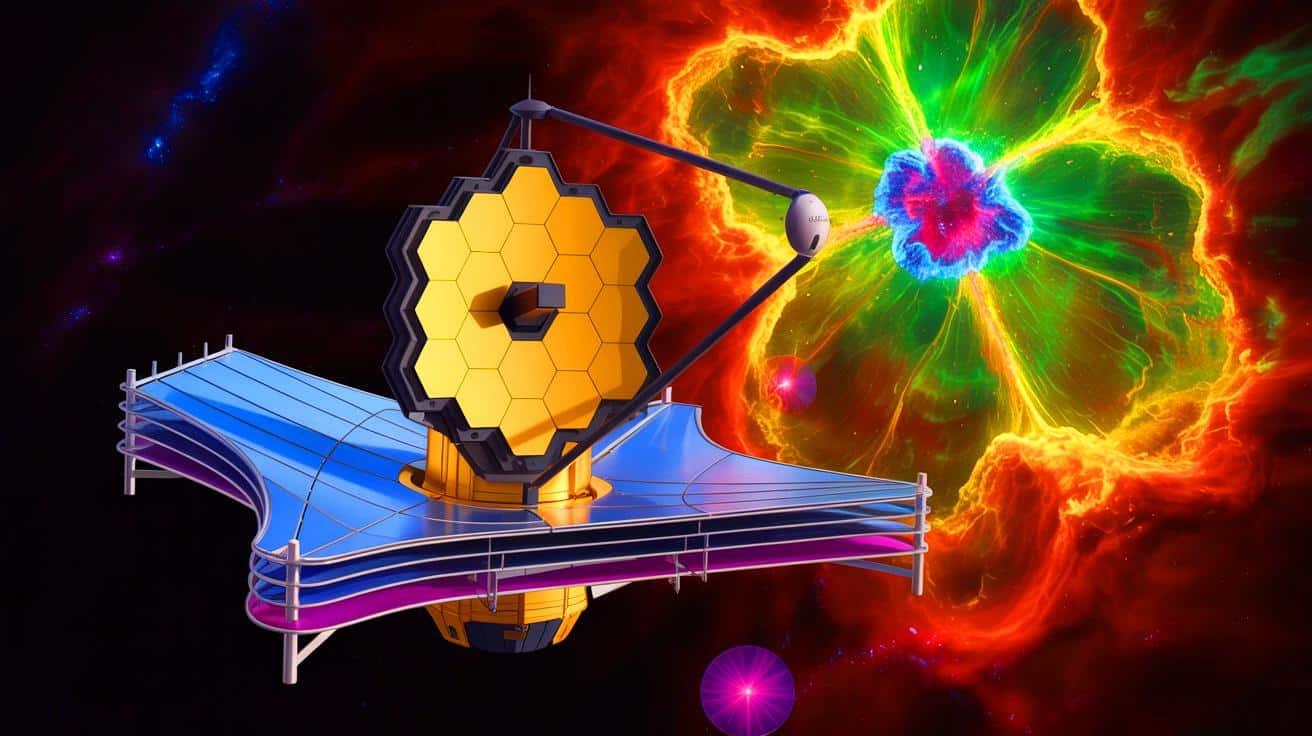
The James Webb Space Telescope has once again demonstrated its groundbreaking capability to unveil the hidden wonders of the universe. By employing its advanced infrared instruments, Webb has penetrated the thick dust clouds of the Butterfly Nebula, also known as NGC 6302, revealing its intricate core structure. This revelation marks a significant milestone in our understanding of stellar evolution and the complex chemistry that occurs at the end of a star’s life. As the telescope continues to push the boundaries of astronomical exploration, it provides an unprecedented glimpse into the processes that shape our cosmos and the intricate dance of atoms and molecules in the universe.
The Hidden Heart of the Butterfly Nebula
The Butterfly Nebula, or NGC 6302, has long captivated astronomers with its beauty and mystery. Located 3,400 light-years away in the constellation Scorpius, it represents a fleeting phase in the life cycle of sun-like stars. The nebula’s core, obscured by a dense ring of dust, remained invisible until now. The James Webb Space Telescope, with its sophisticated instruments, has finally pierced through this veil.
Utilizing the Mid-Infrared Instrument (MIRI), Webb has pinpointed the central star fueling the nebula. This star, with a scorching temperature of 220,000 Kelvin, is one of the hottest known in such nebulae. The discovery of this star also unveiled a previously undetected dust bubble, showcasing the extraordinary sensitivity of Webb’s infrared capabilities. This major breakthrough offers a fresh perspective on the internal architecture of the nebula, providing a detailed view that was previously unimaginable.
A Layered Chemical Architecture
The revelations from Webb extend beyond the identification of the central star. Through a combination of imaging and spectroscopy, MIRI has detected nearly 200 spectral lines. These lines are signatures of various elements and molecules, including iron, nickel, crystalline silicates, and polycyclic aromatic hydrocarbons (PAHs). The presence of PAHs, typically associated with soot or smoke on Earth, in an oxygen-rich nebula is unprecedented.
Remarkably, the dust observed in the central torus is unusually large for cosmic dust, indicating a prolonged period of formation and growth. Additionally, energetic ion jets emanate from both sides of the star, sculpting the nebula’s iconic “wings.” These findings have led to a complete reimagining of the energy and morphological model of NGC 6302, reshaping our understanding of this celestial phenomenon.
A Global First in PAH Formation
One of the most surprising outcomes of this study is the identification of PAH molecules in such an oxygen-rich environment. These molecules, resembling honeycomb structures, are believed to form when stellar winds puncture a bubble in the surrounding gas. This observation is a world-first in this chemical context, providing vital clues about the molecular processes governing the end stages of stellar life.
This discovery also sheds light on the formation of carbon-rich dust, essential components of organic chemistry in the universe. The comprehensive study, published in the Monthly Notices of the Royal Astronomical Society, underscores the unparalleled power of James Webb to reveal the deepest secrets of our cosmos and expand our understanding of the fundamental processes at play in the universe.
The Broader Implications of Webb’s Discoveries
The insights gained from the Butterfly Nebula have far-reaching implications for the field of astronomy. The ability of the James Webb Space Telescope to probe the hidden depths of such nebulae opens new avenues for exploring the life cycles of stars. By studying these processes, scientists can gain a better understanding of how elements essential for life are synthesized and distributed throughout the cosmos.
Moreover, the detection of complex molecules in these environments provides a new framework for studying the chemical evolution of galaxies. As Webb continues its mission, it promises to unravel more mysteries of the universe, offering a window into the past and a glimpse of the potential futures for stars like our own sun.
The James Webb Space Telescope’s revelations about the Butterfly Nebula represent a significant leap forward in our understanding of cosmic phenomena. As it continues to explore the universe’s hidden depths, what other secrets might it uncover? How will these discoveries shape our understanding of the cosmos and our place within it?