



Mysterious Interstellar Visitor at 57,000 mph Shatters Cosmic Models: Scientists Baffled by Its Speed and Size
 By
Ethan Reid
By
Ethan Reid
| IN A NUTSHELL |
|
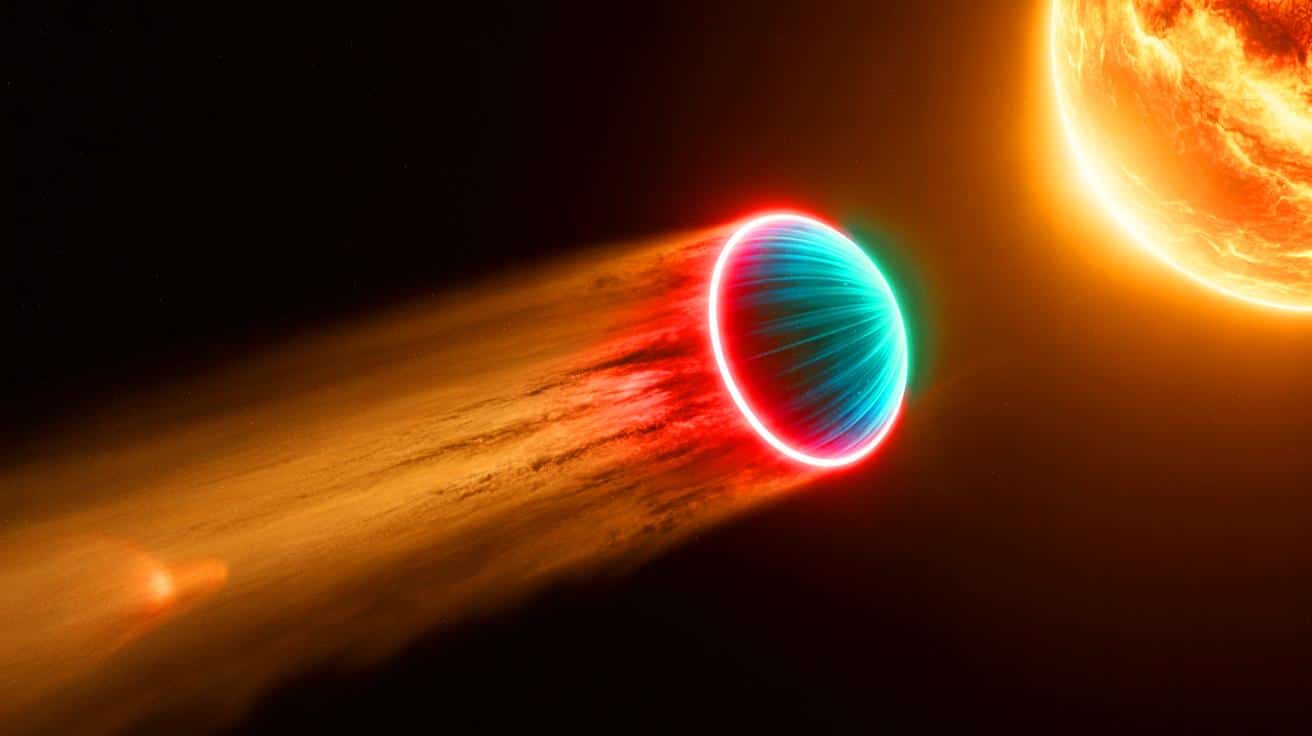
Since July 2025, the astronomical community has been captivated by an extraordinary celestial object known as 3I/ATLAS. This third interstellar visitor to our solar system is currently traversing space at a breathtaking speed. Its colossal size and unprecedented chemical composition challenge existing cometary and planetary formation models. As scientists scramble to gather data before it departs, 3I/ATLAS offers a rare opportunity to expand our understanding of the universe. This mysterious visitor could potentially redefine our knowledge of interstellar objects and their role in the cosmos.
The Unique Chemical and Physical Characteristics of 3I/ATLAS
3I/ATLAS stands apart from any celestial body previously observed. Unlike typical solar system comets, which are primarily composed of water, this object is unusually rich in carbon dioxide. Observations from the James Webb Telescope and the SPHEREx satellite have confirmed a gaseous halo dominated by CO₂, significantly altering our conventional references. This finding suggests a fundamentally different origin or evolution process for 3I/ATLAS compared to known comets.
The structure of its nucleus adds to the intrigue. Measurements vary widely, estimating its diameter between 1,640 feet and 12.4 miles. This range suggests that 3I/ATLAS could be the largest interstellar body ever observed. Furthermore, the nascent dusty tail captured by the Hubble Space Telescope indicates intense activity on an unprecedented scale. Such characteristics compel scientists to reconsider their understanding of comet-like bodies and their potential diversity across the universe.
Trajectory and Speed: A Celestial Anomaly
The exceptional speed of 3I/ATLAS, clocked at 130,000 mph, astounds scientists. This velocity is nearly double that of Borisov, the second known interstellar visitor, and four times that of typical comets. Its hyperbolic trajectory unequivocally confirms its interstellar origin. This path also presents an anomaly, as the object approaches counter to the plane of the ecliptic where planets orbit, and from a direction opposite the “solar apex.”
This rare configuration challenges existing models and assumptions about the flow of interstellar debris. Such findings prompt a reevaluation of how these objects interact with our solar system and what they might reveal about the broader universe. As researchers strive to decode these mysteries, 3I/ATLAS stands as a testament to the unpredictable nature of space exploration and discovery.
Potential Insights Into Other Worlds and New Physics
The origin of 3I/ATLAS’s composition remains shrouded in mystery. Some scientists speculate that it may have formed in an environment rich in CO₂ or exposed to intense radiation, markedly different from our own solar system. These hypotheses open the door to exploring the diversity of planetary systems beyond our own.
Astrophysicist Avi Loeb has even posited a controversial theory of extraterrestrial technological origin, although this idea remains contentious within the scientific community. Despite these debates, the consensus is clear: 3I/ATLAS likely formed naturally but promises to shed light on previously unknown processes. As the clock ticks toward its departure in December 2025, the astronomical community is racing to gather as much information as possible. This limited observation window offers a unique chance to explore the origins and diversity of worlds beyond our own.
Unraveling the Mysteries of Interstellar Visitors
3I/ATLAS is not only a scientific curiosity but also a symbol of the vast unknowns that lie beyond our solar system. Its discovery and study may provide crucial insights into the nature of interstellar travel and the types of bodies that traverse the galaxy. As scientists analyze the data, they hope to better understand the formation and evolution of such objects, potentially leading to breakthroughs in our comprehension of the cosmos.
These findings could revolutionize our perspective on the solar system’s interactions with interstellar space. With each new discovery, the boundaries of what we know and understand continue to expand, igniting the imagination of scientists and the public alike. What other mysteries might be unveiled by studying these cosmic travelers?
The presence of 3I/ATLAS in our solar system is a reminder of the universe’s complexities and the limits of our current understanding. As researchers delve into the data, they are driven by a fundamental question: what other secrets does the universe hold, waiting to be discovered by the next groundbreaking observation?