



Astronomers Declare “Alarming Discovery Stuns Us” As Mysterious Object from Distant Star Enters the Solar System
 By
Ethan Reid
By
Ethan Reid
| IN A NUTSHELL |
|
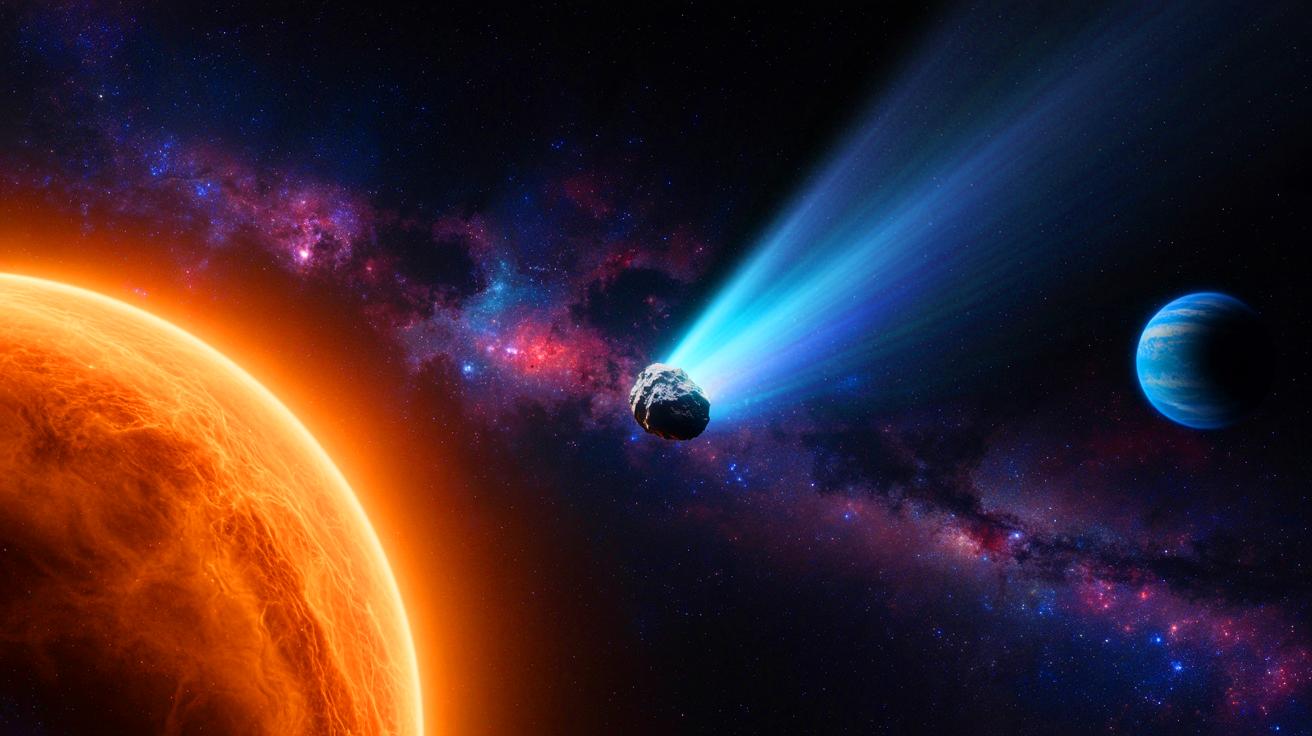
In the summer of 2025, a remarkable celestial event captured the attention of astronomers and the public alike. An interstellar comet named 3I/ATLAS made its way into our solar system, originating from another star. This rare and spectacular visitor offered scientists a unique opportunity to study its trajectory and chemical composition, unveiling potential secrets of the universe. As the third observed object from another star system, 3I/ATLAS presented a wealth of scientific promises and mysteries. Its journey through the solar system, though brief, provided a captivating insight into the vast cosmos beyond our immediate celestial neighborhood.
The Speed and Trajectory of 3I/ATLAS
The comet 3I/ATLAS was detected in early July 2025, moving at an astonishing speed of 136,700 mph on a hyperbolic trajectory. This path confirmed that the comet would not return, as it was on a one-way journey through our solar system. Its detection was made possible by the ATLAS system, which specializes in identifying celestial objects. Despite its close encounter with our solar system, 3I/ATLAS posed no threat to Earth. It maintained a safe distance of more than 168 million miles from our planet. The closest approach to the Sun was projected for late October, within Mars’ orbit.
Initial analyses revealed a striking red coma, likely due to silicates rich in organic matter. The comet also showed traces of rare ices, carbon dioxide, cyanide, nickel, and water. These findings confirmed its cometary nature, characterized by a dust tail opposite the Sun. The data gathered enriched our understanding of its composition and cosmic origins.
A Messenger from the Galactic Past
Researchers suggest that 3I/ATLAS originated from the constellation Sagittarius, near the center of the Milky Way. The interstellar comet is believed to have taken nearly seven billion years to reach our solar system. Its chemical composition indicates it formed in a disk of matter around a young star, followed by an unexplained ejection into deep space. Observations from the Hubble and James Webb telescopes confirmed its cometary nature, though the atypical proportions of molecules like CO2 continue to intrigue scientists. These differences might reflect the extreme conditions of its original system.
Some scientists, like Avi Loeb, speculated about the possibility of extraterrestrial technology, but current observations align with a natural, albeit unique, comet. The comet’s journey offers a glimpse into the conditions of its distant birthplace and its long journey through the galaxy.
An Ephemeral Celestial Observatory
The arrival of 3I/ATLAS presented a unique opportunity to study an object from another star system. Acting as a cosmic messenger, it carried clues about the formation of planets and the diversity of worlds beyond our solar system. In the weeks following its detection, space probes such as Psyche, Juice, and Hubble gathered extensive data. This information allowed researchers to compare 3I/ATLAS to objects within our own system, furthering our understanding of the universe.
The fleeting presence of this interstellar visitor served as a natural laboratory, enriching our knowledge of cosmic phenomena. By studying 3I/ATLAS, scientists hoped to uncover new insights into the processes that shape planetary systems far from our own.
Expanding Our Cosmic Perspective
The encounter with 3I/ATLAS offered humanity a rare glimpse into the vastness of space and our place within it. This fleeting interaction with an interstellar comet reminded us of our fragile connection to the cosmos and fueled our quest for knowledge. The comet’s journey through our solar system was a small but significant step toward understanding our position in the universe. As we continue to explore the mysteries of space, we are constantly reminded of the infinite possibilities that lie beyond our immediate reach.
The visit of 3I/ATLAS to our solar system was a reminder of the dynamic and ever-changing nature of the cosmos. As scientists continue to analyze the data collected from this celestial visitor, we are left to ponder the broader implications of such interstellar journeys. What other secrets might the universe hold, waiting to be discovered by future generations?