


Jupiter’s Appetite Exposed: Supercomputer Unveils Shocking Truth About Giant Planet Devoured in 5.5 Seconds
 By
Ethan Reid
By
Ethan Reid
| IN A NUTSHELL |
|
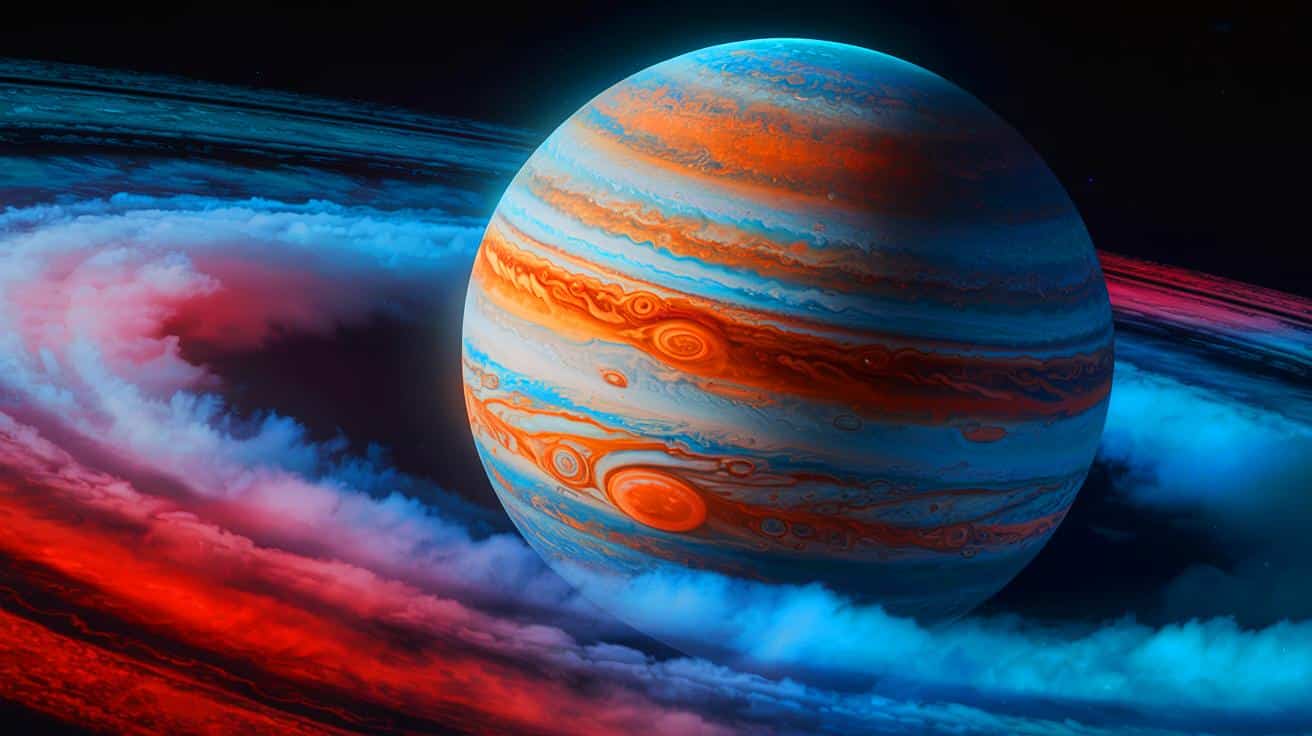
In a groundbreaking study, researchers have challenged the long-held belief that Jupiter’s diluted core resulted from a colossal impact with a massive rocky planet. This study, conducted using a supercomputer, suggests that Jupiter’s internal structure is not the aftermath of a violent collision but rather the result of a gradual process spanning billions of years. The findings not only reshape our understanding of Jupiter but also have significant implications for the study of giant planets both in our solar system and beyond.
Juno’s Revelations: A Diluted Core
The NASA spacecraft Juno has provided unprecedented gravimetric data about Jupiter’s interior. Contrary to standard models, the analyses revealed that Jupiter’s core is diluted and not compact. This discovery was unexpected, as traditional theories envisioned a dense rocky core enveloped by hydrogen and helium. The surprising data from Juno prompted scientists to reconsider previously accepted models.
In 2019, an intriguing hypothesis was proposed to explain this unusual core profile. It suggested that a massive planetary embryo collided with Jupiter during its early formation, causing the core to mix with the surrounding layers. This hypothesis gained traction as a plausible explanation for the observed dilution. However, recent findings have cast doubt on this theory, indicating that a different process may be at play.
The Discovery: Scientists Stunned by Vapor Planet’s Potential, “This Changes Our Understanding”
Simulations Challenge the Impact Hypothesis
An international team of researchers tested the impact hypothesis using advanced simulation tools. The simulations, performed on the supercomputer DiRAC Cosma, revealed that while an impact could destroy the core, the separation of rock and ice from hydrogen and helium occurred within hours. This rapid reformation of a clear-cut core boundary contradicted the observations made by Juno.
The findings suggest that a massive frontal impact cannot account for Jupiter’s diluted core. Instead, the results imply that the internal structure developed gradually over billions of years. This gradual evolution challenges the notion of a singular cataclysmic event and points to a more complex history of Jupiter’s formation.
Supercomputers Unveil Slow Evolution
These insights were made possible through the use of the Swift computational code, which specializes in planetary impact simulations. The precision of this model allowed researchers to track the evolution of materials post-collision with unprecedented realism. The study highlights the power of supercomputers in refining astronomical hypotheses.
By employing these advanced tools, scientists can reconstruct the history of giant planets and dismiss overly simplistic scenarios. The transition between Jupiter’s core and envelope is now understood as the outcome of continuous evolution rather than a catastrophic event. This understanding not only enriches our knowledge of Jupiter but also enhances our comprehension of planet formation processes.
Alternative Mechanisms for Core Dilution
If Jupiter’s diluted core did not result from a giant impact, alternative explanations become necessary. Researchers are now focusing on internal processes such as chemical diffusion and gradual gravitational mixing. These mechanisms could account for the distribution of heavy elements extending to half the planet’s radius.
This breakthrough has broader implications beyond Jupiter. It reshapes our view of giant planet formation in the solar system and exoplanetary systems. If core dilution can occur without a collision, numerous massive celestial bodies across the galaxy may have experienced similar evolutionary paths. Such insights open new avenues for understanding the diversity of planetary systems.
The findings from this study represent a significant shift in our understanding of planet formation and evolution. As our tools and methodologies continue to advance, we gain deeper insights into the complexities of celestial bodies. How might these new perspectives on Jupiter influence our broader understanding of planetary systems across the universe?