

Giant Asteroid Creates 310-Mile Crater: “This Is Our New World” Warns Frantic Scientist
 By
Leah Morrison
By
Leah Morrison
| IN A NUTSHELL |
|
Long before the age of dinosaurs, Earth was struck by a colossal asteroid named S2, which left an indelible mark on the planet’s history. This ancient impactor was an astounding 200 times larger than the asteroid famously responsible for the extinction of the dinosaurs. The cataclysmic event occurred 3.2 billion years ago and resulted in the formation of a massive crater, boiled oceans, and unleashed mega-tsunamis. Despite the devastation, this event also opened pathways for the emergence of life, highlighting the dual nature of such cosmic events.
The Asteroid S2: A Monumental Force of Destruction
In 2014, researchers identified an asteroid known as S2, which collided with Earth some 3.2 billion years ago. At the time of impact, Earth was home to only simple, single-celled microorganisms residing in the oceans. According to a study published in 2024 in the journal PNAS, S2 was estimated to be between 25 and 37 miles in diameter, dwarfing the 6-mile-wide asteroid that ended the reign of the dinosaurs.
The energy released by the S2 impact was nothing short of colossal, estimated to be 50 to 200 times more powerful than the Cretaceous extinction event. Although Earth was already a harsh environment, S2 elevated the planet’s hostility to an unprecedented level. This immense force serves as a reminder of the planet’s vulnerability to cosmic events.
An Impact That Boiled Oceans and Rained Molten Rock
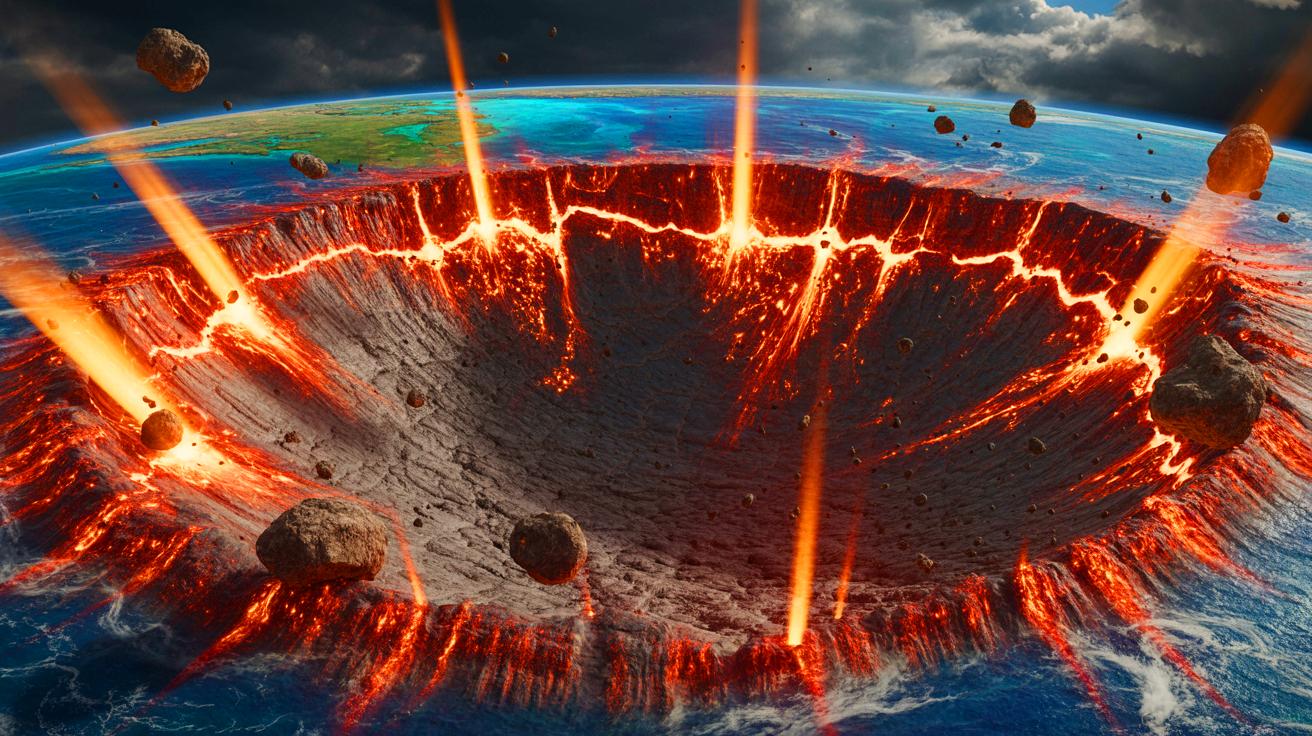
The tremendous impact of S2 created a 310-mile-wide crater, sending shockwaves that launched vast amounts of molten rock into the atmosphere. This led to a terrifying phenomenon where molten rocks rained back down onto Earth. Nadja Drabon, the lead author of the study, vividly describes the scene: “Imagine a rain cloud, but instead of water droplets, it’s burning rocks falling from the sky.”
Furthermore, the intense heat generated by the impact caused the evaporation of several feet of ocean water, with air temperatures soaring to 212°F in certain areas. In addition to these effects, a gigantic tsunami swept over the limited landmasses, showcasing the overwhelming power and reach of S2’s impact. This event starkly illustrates the catastrophic potential of such cosmic collisions.
Catastrophe and Opportunity: Life’s Resilient Response
Despite the extreme violence of the S2 impact, life on Earth managed to persist. During this period, life was restricted to the oceans and comprised primarily of microorganisms. Interestingly, the asteroid’s impact may have enriched the ocean with essential nutrients, potentially accelerating the development and diversification of life. This paradoxical relationship between destruction and creation underlines the complex dynamics of Earth’s history.
This episode serves as a reminder that catastrophic events can sometimes lead to significant evolutionary advances. S2, while a harbinger of destruction, also acted as a catalyst for biological diversity. It exemplifies how life can adapt to and even thrive in the aftermath of Earth-shattering events, emphasizing the planet’s resilience.
Earth’s Dual Nature: Vulnerability and Resilience
Today, the impact of S2 stands as one of the most violent celestial events Earth has experienced, second only to the collision with Theia, which led to the formation of the Moon. The discovery of S2 sheds light on an ancient era when Earth was frequently bombarded by cosmic bodies.
Ultimately, S2 embodies a dual nature: a force capable of widespread devastation and an inadvertent catalyst for life.
This delicate balance is a testament to Earth’s ability to transform adversity into opportunity, illustrating the planet’s enduring resilience in the face of cosmic challenges.
The story of S2 and its impact on Earth highlights the planet’s dual capacity for vulnerability and resilience. While such cosmic events pose significant threats, they also present opportunities for growth and transformation. As we continue to explore our planet’s history, we are left to ponder: How will future cosmic encounters shape the destiny of life on Earth?