

“Heart-Pounding Discovery Unleashed”: Scientists Uncover Stunning Relic That Could Rewrite Human History Forever
 By
Ethan Reid
By
Ethan Reid
| IN A NUTSHELL |
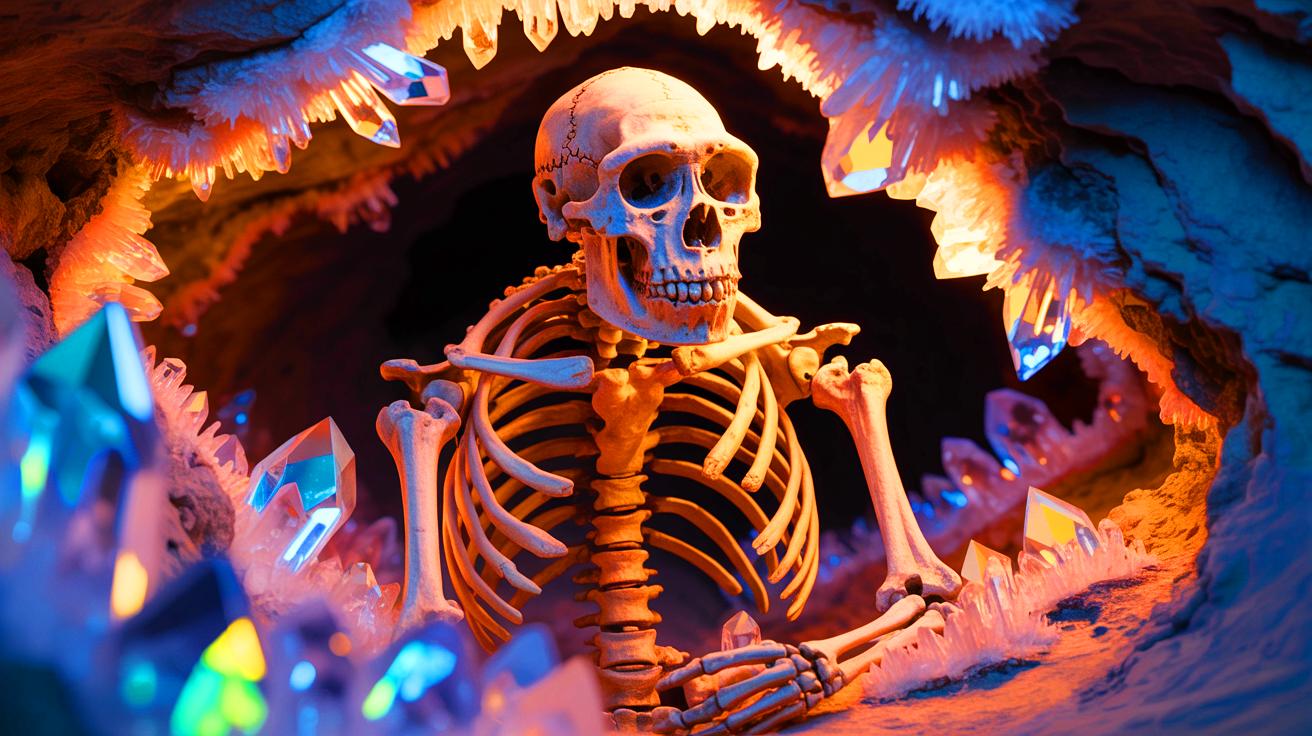
In the heart of Southern Italy lies the cave of Lamalunga, a site of immense archaeological significance. Discovered in 1993, the Altamura Man, a Neanderthal skeleton encased in calcite crystals, offers a unique glimpse into human evolution. This fossil, dating back approximately 150,000 years, is not just a relic; it is a masterpiece of natural preservation. Despite its age, the skeleton remains largely untouched due to its delicate encasement in mineral deposits. The Altamura Man challenges our understanding of Neanderthal life and evolution, providing insights into a lineage that might have evolved in isolation. The story of this fossil is not just about a discovery but about the transformation of our understanding of ancient human history.
The Eternal Resting Place of Altamura Man
Deep within the narrow confines of the Lamalunga cave, explorers stumbled upon a remarkable find: a complete Neanderthal skeleton. The discovery, initially made by spelunkers, brought to light a fossil that has captivated scientists worldwide. What makes this skeleton extraordinary is its preservation within a cocoon of calcite crystals, formed over millennia by mineral-rich water dripping through the cave. These natural formations have rendered the skeleton immovable, effectively turning it into a natural art piece.
Such preservation, while a blessing for the integrity of the fossil, also poses significant challenges. The calcite encasement prevents any attempt to extract the skeleton without causing irreparable damage. As a result, the Altamura Man remains a permanent resident of his rocky abode. Yet, this immobility does not diminish the fossil’s scientific value. Instead, it underscores the complexity of archaeological preservation and the lengths to which researchers must go to study ancient remains.
Exploring Without Touching: Technological Advances
For years, researchers relied solely on photographs to study the Altamura Man. However, the advent of advanced technology has allowed scientists to explore the skeleton in unprecedented detail without physical contact. Using miniature endoscopic cameras and laser scanners, researchers have created a highly accurate 3D model of the fossil. This breakthrough has transformed the Altamura Man from a mere archaeological specimen to a subject of detailed scientific inquiry.
The 3D model reveals a robust adult male, likely in his prime. Missing teeth suggest a history of infections, providing a glimpse into the Neanderthal’s struggles. In 2015, a small scapula fragment was carefully removed for DNA analysis, confirming the fossil’s Neanderthal origins. Uranium-thorium dating techniques estimate the skeleton’s age at around 150,000 years, solidifying its place as one of the oldest known Neanderthal fossils.
An Isolated Neanderthal Lineage
The Altamura Man is not just significant for its preservation but also for what it reveals about Neanderthal evolution. The skeleton exhibits typical Neanderthal features alongside more archaic traits, suggesting a unique evolutionary path. Researchers hypothesize that this individual belonged to a secluded population in Southern Europe, isolated from the major migratory routes of other Neanderthal groups.
This isolation could have led to distinct evolutionary developments, making the Altamura Man a potential missing link in human evolution. The discovery of this fossil, encased and protected by rock, offers a silent yet powerful testament to our past. Though the skeleton may never leave its stony prison, it continues to enrich our understanding of human history.
The Ongoing Story of Altamura Man
The Altamura Man stands as a silent witness to a chapter of human history that is still being written. As technology evolves, so too does our ability to extract knowledge from this remarkable fossil. While the skeleton remains physically inaccessible, its presence continues to provoke questions about the nature of human evolution and the paths our ancestors might have taken.
What other secrets does the Altamura Man hold? How might future technological advancements allow us to learn even more from this ancient fossil? As we ponder these questions, the story of the Altamura Man reminds us of the enduring mysteries of our origins and the endless possibilities for discovery.