



James-Webb Reveals Hidden Cosmic Treasure That Shatters What We Know About The Galaxy’s Billions Of Stars
 By
Leah Morrison
By
Leah Morrison
| IN A NUTSHELL |
|
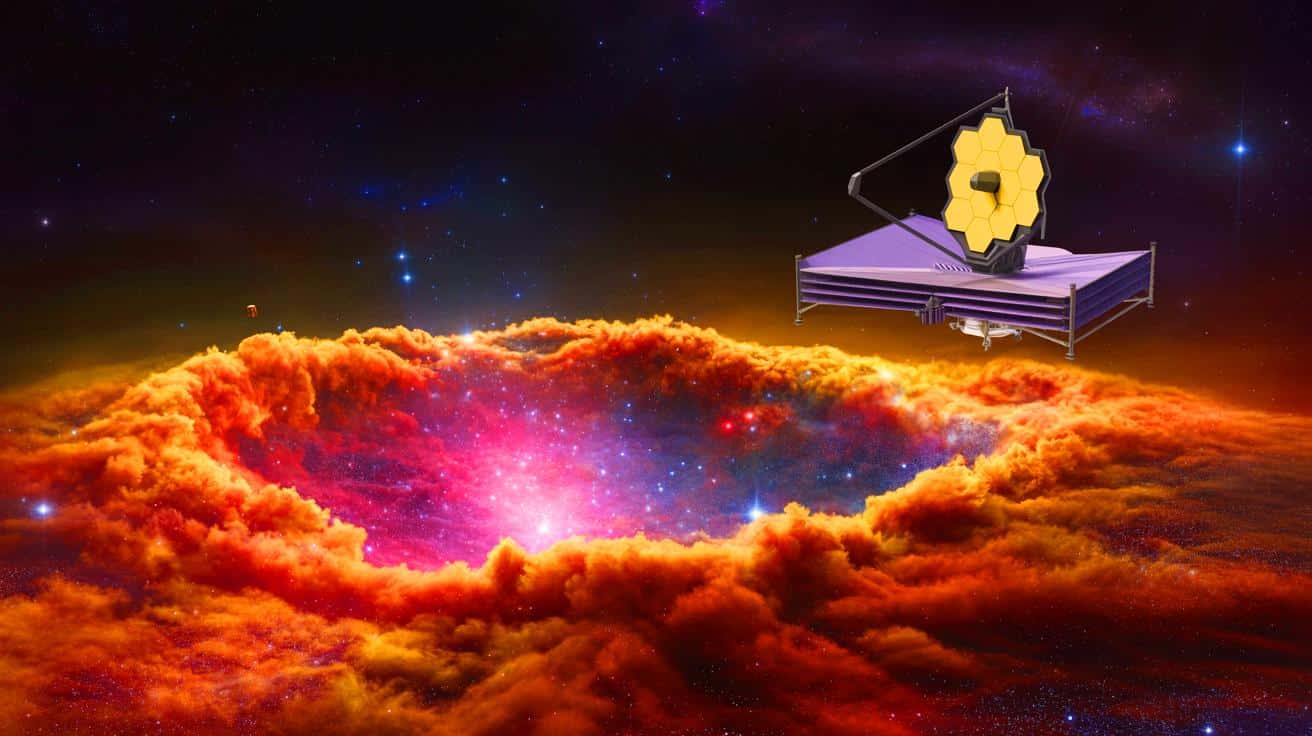
The James Webb Space Telescope has turned its powerful infrared instruments toward one of the most secretive regions of our galaxy, revealing the spectacular and almost otherworldly images of Sagittarius B2. This gigantic molecular cloud, located near the center of the Milky Way, is a cosmic treasure trove, brimming with star formation activity. As the telescope pierces through the dense curtains of dust, it unveils a scene of stellar birth where gas and dust combine to create thousands of stars. This revelation not only deepens our understanding of star formation but also raises intriguing questions about the origins of our own solar system.
The Proximity of Sagittarius B2 to the Galactic Center
Sagittarius B2, or Sgr B2, is positioned a mere 390 light-years from the supermassive black hole Sagittarius A*. This black hole resides at the core of our galaxy, approximately 26,673 light-years from Earth. This proximity offers a unique observational opportunity, akin to peering into a bustling neighborhood adjacent to the central hub of the Milky Way. The James Webb Telescope’s infrared capabilities have finally penetrated the dust shrouds obscuring this region, revealing a vibrant environment of star formation. Here, gas and dust are actively coalescing to form new stars.
This newfound clarity allows scientists to examine the processes occurring in this cosmic neighborhood with unprecedented precision. The telescope’s observations provide insights into the dynamic interactions between the molecular cloud and the galactic center’s intense gravitational forces. Such a vantage point not only enhances our understanding of star formation but also sheds light on the complexities of galactic evolution. As astronomers continue to analyze these observations, they aim to unravel the intricate relationship between Sgr B2 and the supermassive black hole, offering a clearer picture of our galaxy’s core.
Why Sagittarius B2 Is a Remarkable Star Factory
Sagittarius B2 is a colossal molecular cloud, standing out as one of the largest in the Milky Way. With a diameter of over 140 light-years and a mass equivalent to three million suns, it is a true giant in the cosmos. What astonishes astronomers is its efficiency; despite containing only 10% of the gas in the galactic center, it produces half of its stars. This level of activity is unparalleled among its neighbors. Temperature variations within the cloud range from -382°F to 86°F, creating diverse environments conducive to star formation.
The cloud’s chemical richness adds another layer of intrigue. Nearly half of the known interstellar molecules have been identified within Sgr B2, including complex organic compounds. These molecules represent the chemical building blocks that, under the right conditions elsewhere, could lead to the development of life. This molecular diversity not only highlights the cloud’s role as a stellar nursery but also positions it as a potential site for studying the precursors of life. The presence of such molecules raises fundamental questions about the potential for life elsewhere in the universe.
Astronomers Bet on Flat Telescope to Shatter 400-Year Tradition and Uncover New Earth-Like Planets
James Webb’s Role in Transforming Our Understanding of Star Formation
The James Webb Space Telescope, with its advanced infrared technology, is unveiling details previously hidden from view. Researchers like Adam Ginsburg at the University of Florida are leveraging these data to understand the birth of massive stars and the unique characteristics of Sagittarius B2 compared to the rest of the galactic center. The telescope’s discoveries are providing fresh insights while simultaneously introducing new mysteries to explore.
Nazar Budaiev, another scientist involved in the study, notes that every discovery made by Webb paves the way for further exploration of the universe’s secrets. The telescope’s revelations offer a glimpse into the complex processes that govern star formation. By examining the intricate dance of gas and dust within Sgr B2, scientists are uncovering the fundamental mechanisms driving stellar evolution. These findings not only enhance our understanding of star formation but also have the potential to inform broader theories about the lifecycle of galaxies.
What Sagittarius B2 Tells Us About Our Own Origins
The images captured by James Webb provoke reflection on the origins of our solar system. The molecules and nascent stars within Sagittarius B2 may mirror the conditions that existed billions of years ago when our solar system was forming. This molecular cloud serves not only as a cosmic laboratory but also as a reflection of our past.
As we delve deeper into these stunning images, we are reminded of the vastness of what remains to be discovered. Each image captured by Webb is both an answer and a catalyst for new questions, emphasizing the perpetual nature of scientific inquiry. In this journey of exploration, we have only begun to scratch the surface. What implications do these discoveries hold for our understanding of the universe, and how might they reshape our perception of our place within it?