


“This Is Astounding”: A Super Galactic Monster Is Emerging Before Our Eyes (and It’s Closer Than You Think)
 By
Ethan Reid
By
Ethan Reid
| IN A NUTSHELL |
|
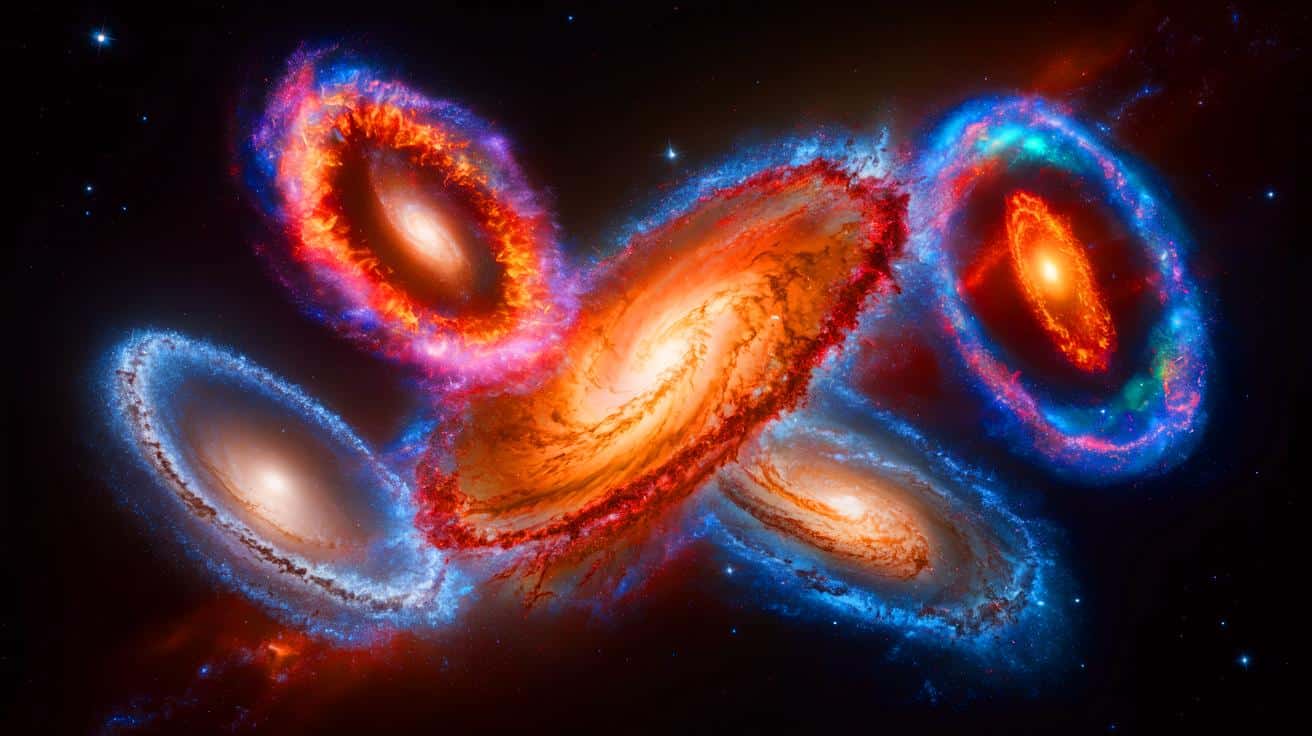
The James Webb Space Telescope has once again unveiled a cosmic wonder: the simultaneous merger of five galaxies in the early universe. This rare event, occurring just 800 million years after the Big Bang, provides an unprecedented view into the chaotic and dynamic processes that shaped the cosmos. The discovery, dubbed the “Quintet of JWST,” offers a unique opportunity for astrophysicists to study the intricate dance of galaxies, shedding light on the early universe’s complex nature. As researchers continue to analyze this celestial phenomenon, it challenges existing models and raises new questions about galaxy formation and evolution.
Five Galaxies in Collision: A Rare Cosmic Dance
In an event that seems straight out of a science fiction narrative, five galaxies have been observed colliding in the early universe, a mere 800 million years after the Big Bang. The James Webb Space Telescope documented this extraordinary alignment, referred to as the “Quintet of JWST.” Such a rare occurrence, with a statistical chance of less than 1%, offers a unique glimpse into the universe’s formative years. This simultaneous collision is comparable to witnessing multiple comets colliding, an improbable yet enlightening scenario for scientists.
The significance of this discovery lies in its rarity and the insights it provides into galactic behavior. Seeing such a complex interaction so early in the universe’s history is akin to finding a bustling metropolis in a prehistoric world. It challenges existing theories and encourages scientists to rethink their understanding of cosmic evolution. The Quintet of JWST is not related to the Stephan’s Quintet, further highlighting the uniqueness of this cosmic event.
Infrared Insights: James Webb’s Confirmation
While the Hubble Space Telescope had previously identified these galaxies, it was the infrared capabilities of the James Webb Space Telescope that revealed their active merger. The telescope’s advanced instruments detected a massive halo of gas surrounding the entire system, a clear indicator of an ongoing galactic fusion. This discovery underscores the importance of infrared technology in uncovering hidden cosmic phenomena.
Moreover, spectroscopic analysis revealed that these galaxies share the same redshift, confirming their physical interaction rather than mere visual proximity. This shared redshift signifies that the galaxies are not just neighbors but are engaged in a gravitational dance, pulling and twisting the fabric of space around them. This finding highlights the dynamic and interconnected nature of the universe, even in its early stages.
Star Formation Frenzy: A Cosmic Birthplace
The collision of these galaxies has sparked an intense period of star formation. The system is rich in primordial gas, and gravitational interactions compress this gas, leading to the rapid birth of new stars. This process transforms the area into a stellar nursery, creating stars at an unprecedented rate.
Despite the vast distances between the galaxies, ranging from 43,300 to 60,700 light-years, gravitational forces forge bridges of matter, known as tidal tails, between them. These structures are the visible scars of a cosmic encounter, illustrating the raw power of gravity in shaping the universe. The discovery of these tidal tails provides valuable insights into the processes that govern galaxy formation and evolution.
The Fate of a Galactic Giant: From Birth to Death
The future of this galactic monster may be one of calm or even death. After the current burst of star formation, the Quintet of JWST might evolve into a massive but inactive galaxy within a billion years. This transformation could result in a cosmic behemoth with a frozen core, devoid of new stellar activity.
The potential presence of supermassive black holes at the centers of these galaxies could drive this transition. If these black holes become active, their powerful galactic winds might expel the surrounding gas, halting star formation altogether. The end of this spectacular cosmic event would mark a significant shift in the galactic lifecycle, raising questions about how such processes influence the broader universe.
The discovery of the Quintet of JWST adds a crucial piece to the cosmic puzzle, revealing a more dynamic and violent early universe than previously thought. This finding challenges existing predictive models and suggests that complex structures formed much earlier in the universe’s history. As astronomers delve deeper into this phenomenon, they seek to uncover whether similar systems exist elsewhere, offering further insights into the universe’s early days. What other cosmic surprises lie hidden in the universe, waiting to be discovered by the watchful eyes of telescopes like James Webb?