


“This Is Not Science Fiction!”: Discover This Mind-Bending Vision of Earth’s Distant Future as Pangea Proxima Forms in 250 Million Years
 By
Ethan Reid
By
Ethan Reid
| IN A NUTSHELL |
|
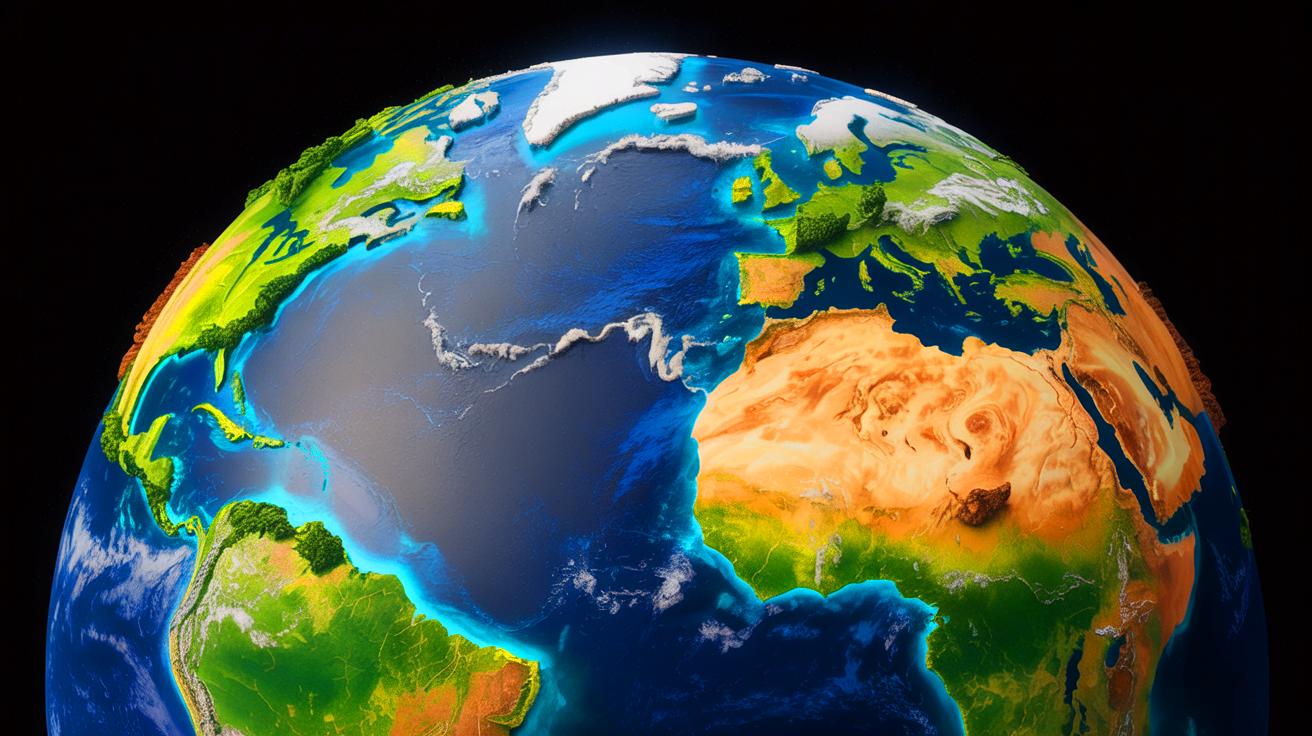
The Earth is an ever-changing planet, constantly reshaping itself through geological processes that span millions of years. While it currently hosts seven continents, the dynamic nature of Earth’s interior suggests that these landmasses are in perpetual motion. Over hundreds of millions of years, they could converge to form a colossal supercontinent. This cyclical process of continental drift and collision has shaped Earth’s history and will continue to do so, giving rise to fascinating geological phenomena that captivate scientists and curious minds alike.
The Phenomenon of Supercontinents
The concept of supercontinents is not new to Earth. Throughout its history, our planet has seen the rise and fall of at least three major supercontinents: Columbia, Rodinia, and the well-known Pangea. These massive land formations were eventually broken apart by the same tectonic forces that created them. The process of plate tectonics, which involves the movement of the Earth’s lithospheric plates, is a driving force behind the formation and breakup of continents.
The idea of a future supercontinent, tentatively named “Pangea Proxima,” has intrigued geologists for decades. Proposed by the American geologist Christopher Scotese in the early 1980s, this concept envisions a world where continental drift leads to the amalgamation of the Americas, Africa, and Eurasia into a single landmass. This new supercontinent would include an expansive inland sea, a remnant of the Indian Ocean. Meanwhile, Australia and Antarctica could merge to form another significant landmass to the south.
Impact on Climate and Environment
The formation of a new supercontinent would undoubtedly trigger profound climatic changes. As continents collide and merge, intense volcanic activity would likely ensue, releasing vast quantities of greenhouse gases into the atmosphere. This process could result in a dramatically arid environment, contributing to widespread extinctions. The landscape of Earth would transform, reshaping ecosystems and challenging the adaptability of life forms.
Recent advancements in geodynamic modeling have provided alternative scenarios for Earth’s future configuration. Some models suggest that in 200 to 250 million years, all continents, except Antarctica, could cluster around the North Pole, forming a supercontinent known as “Amasia.” Meanwhile, “Aurica,” a potential supercontinent near the equator, could emerge from the closure of the Atlantic and Pacific Oceans and the fragmentation of Eurasia.
Understanding Plate Tectonics
The study of plate tectonics is essential to understanding the movement of continents and the formation of supercontinents. The Earth’s lithosphere is divided into several large and small tectonic plates that float atop the semi-fluid asthenosphere beneath. These plates move at a relatively slow pace, driven by forces such as mantle convection, slab pull, and ridge push. Over millions of years, these movements result in the shifting of continents, the formation of mountain ranges, and the creation of ocean basins.
One of the most significant aspects of tectonic activity is subduction, where one tectonic plate is forced beneath another. This process not only recycles Earth’s crust but also plays a crucial role in the formation of supercontinents. As oceanic plates subduct beneath continental plates, the continents are drawn closer together, setting the stage for future collisions and the eventual formation of a supercontinent like Pangea Proxima.
The Future of Earth’s Continents
While the idea of Pangea Proxima is a compelling vision of Earth’s future, it is essential to recognize the timescale involved. The processes driving continental drift and supercontinent formation occur over hundreds of millions of years. As such, these changes are far beyond the scope of human observation but offer valuable insights into the dynamic nature of our planet.
Understanding the potential configurations of future supercontinents not only enriches our knowledge of Earth’s geological history but also underscores the significance of geological processes in shaping our environment. As scientists continue to explore these possibilities, they contribute to a deeper appreciation of our planet’s complexity and resilience.
In reflecting on the potential for a new supercontinent, one must wonder how these monumental changes will influence Earth’s climate, biodiversity, and human civilization. What will the world look like when the continents converge once again, and how will life on Earth adapt to such a dramatic transformation?