


NASA Exposes Astounding Truth: “3/I ATLAS Is No Alien Ship: Just Wait Until You See The Real Explanation”
 By
Ethan Reid
By
Ethan Reid
| IN A NUTSHELL |
|
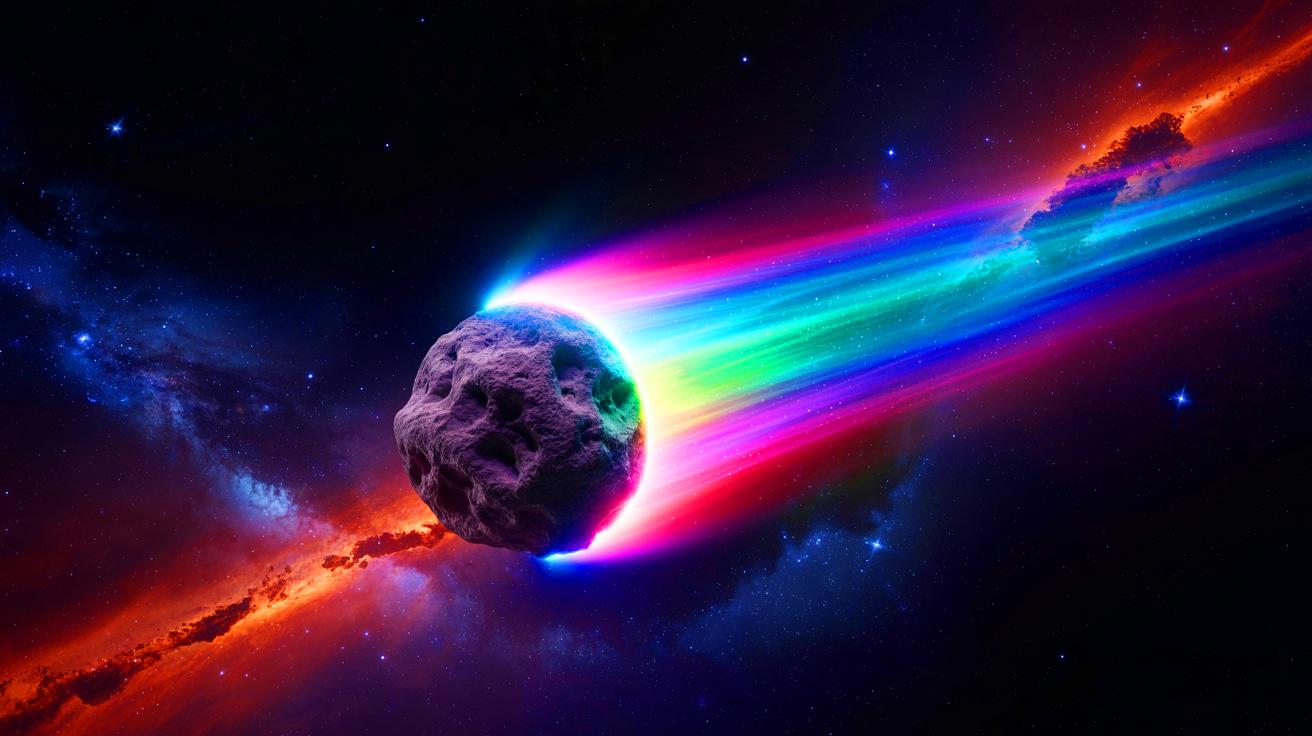
In July 2025, the astronomical community was abuzz with the discovery of 3/I ATLAS, an interstellar object that captured the imaginations of scientists and the public alike. This discovery, made by NASA, led to a flurry of theories ranging from the plausible to the fantastical, with some suggesting that the object might be of extraterrestrial origin. Despite these speculations, NASA has firmly stated that 3/I ATLAS is a natural comet. This debate highlights the tension between science and speculation, especially when it comes to the mysteries of the cosmos.
Harvard Astrophysicist Revives Alien Hypothesis
On July 1, 2025, NASA announced a groundbreaking discovery: 3/I ATLAS, an object from another star system, had entered our cosmic neighborhood. This announcement sparked widespread interest, not least due to the subsequent claims of renowned Harvard astrophysicist, Avi Loeb. Loeb published a study on the arXiv server suggesting that 3/I ATLAS could be of extraterrestrial origin, potentially sent by an alien civilization with hostile intentions.
Loeb’s assertions were not entirely unexpected. In 2017, he had made similar claims about ‘Oumuamua, the first interstellar object ever observed, which he suggested might be an alien artifact. However, the scientific community ultimately determined ‘Oumuamua to be an icy comet. In the case of 3/I ATLAS, Loeb added an element of threat, proposing that anomalies in its trajectory and signature indicated a technological artifact rather than a natural comet. This hypothesis has fueled both fascination and fear.
NASA Affirms: 3/I ATLAS Is Just an Interstellar Comet
Loeb’s statements quickly gained traction in the media, leading to public concern over a potential alien threat. The idea of a Harvard professor suggesting hostile intentions from an extraterrestrial civilization caught widespread attention. However, NASA stepped in to quell the growing anxiety. Tom Statler, NASA’s program scientist for small bodies, dismissed any extraterrestrial origin for 3/I ATLAS.
“It looks like a comet. It behaves like a comet. In almost all respects, it resembles the comets we are familiar with. While it does have some interesting properties that differ slightly from those of comets in our solar system, it behaves like a comet. The evidence overwhelmingly indicates that this object is a natural body. It’s a comet.”
In essence, there is no UFO, no hidden message, no imminent danger. 3/I ATLAS is simply an icy object propelled from another system, traversing ours, a rare yet natural phenomenon.
Alien Hypothesis Fuels Fascination and Controversy
Despite NASA’s clarification, Avi Loeb remains steadfast in his position. He acknowledges that the comet hypothesis is the simplest explanation but urges the scientific community to maintain an open mind. He suggests that science should not hastily dismiss unconventional hypotheses, as many truths begin as marginal ideas.
For much of the scientific community, however, Loeb’s approach crosses the line from speculation to sensationalism. By promoting unverifiable hypotheses, he risks muddying scientific discourse and undermining public trust in institutions like NASA. Nonetheless, the study of interstellar objects like ‘Oumuamua and 3/I ATLAS challenges our understanding of planetary formation, cosmic trajectories, and our place in the universe. This may be the true lesson of these celestial phenomena.
Balancing Curiosity and Scientific Rigor
No, 3/I ATLAS is not an alien spacecraft, and humanity is not on the brink of an attack from an unknown civilization. Yet, this incident underscores our enduring fascination with the mysteries of space. Avi Loeb occupies a unique position in this dynamic, straddling the line between iconoclastic researcher and media provocateur, demonstrating how the boundary between rigorous science and fictional storytelling can blur.
Can we dream of contact with an intelligence from elsewhere? Certainly. But when that day comes, it will take more than trajectory anomalies to make us believe.
As we continue to explore the cosmos, the line between scientific inquiry and speculative storytelling often becomes blurred. How can we balance our innate curiosity about the unknown with the need for scientific rigor? What role should speculative ideas play in advancing our understanding of the universe?