

NASA Uncovers The Most Terrifying Satellite Mystery Ever: ‘Invisible Space Debris’ Threatens Global Communications Now
 By
Ethan Reid
By
Ethan Reid
| IN A NUTSHELL |
|
The mystery of inexplicable satellite failures has perplexed the space industry for decades. Despite advanced technology and rigorous engineering, satellites have been known to malfunction with no apparent cause. However, recent breakthroughs by American researchers have shed light on this enigma, pointing to a surprising culprit: electrons from space. The findings, which have significant implications for satellite operations and safety, reveal that these electrons can discharge suddenly, leading to system failures. This discovery not only explains past anomalies but also opens new avenues for preventing future disruptions in satellite services.
Electrons: The Hidden Threat to Satellites
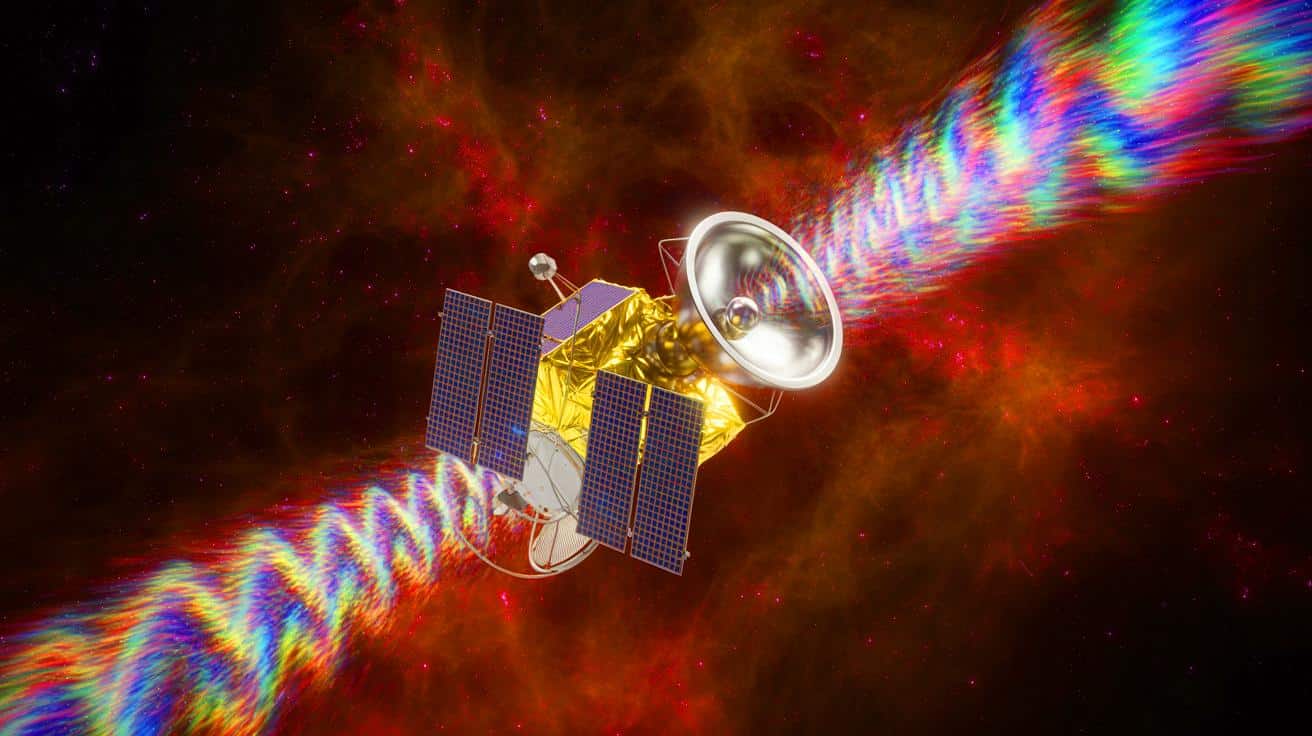
For years, satellites have experienced sudden and often irreversible failures while in orbit. The mystery of these breakdowns has been a persistent challenge for the space industry. A study from the Los Alamos National Laboratory, published in September 2025, offers a compelling explanation: Spacecraft Environment Discharges (SED). These discharges occur when satellites accumulate electrons while traversing specific orbital regions. At a critical point, this charge is released as a microscopic spark, acting like a devastating short circuit that fries onboard electronic systems.
The phenomenon is not entirely new. In 1994, a solar storm deactivated two Canadian satellites within hours. However, until now, there had been no reliable correlation between these malfunctions and the surrounding electronic environment. The recent study provides the missing link, demonstrating how electron discharges can lead to catastrophic satellite failures.
How Military Technology Unraveled the Mystery
The breakthrough in understanding these failures came through data collected from the STP-Sat6, a satellite operated by the U.S. Department of Defense. The satellite is equipped with two critical sensors: one measures electron density, while the other analyzes radio signals. This dual-sensor approach allowed researchers to monitor electromagnetic activity around the satellite in real-time.
The findings were striking. In 75% of cases, electron peaks preceded SED events by 30 to 45 minutes. This time window is crucial as it offers a chance to anticipate and potentially prevent failures before they occur. As Amitabh Nag, the study’s lead author, explains, “We knew SED existed, but we needed direct evidence linking electron density to discharge events.” With hundreds of cases documented over 12 months, this connection is now firmly established.
Implications for Satellite Operations and Costs
The implications of this discovery are profound for the satellite industry. Historically, satellite failures were unpredictable and unpreventable. Now, with onboard detection systems, satellites could be warned in advance of potential electronic storms. This would allow operators to put sensitive functions into standby mode until the threat has passed.
This concept is akin to an onboard space weather system, capable of forecasting electronic storms before they strike. Given the high cost of satellites and associated missions, a 30-minute advance warning could potentially save millions of dollars in equipment. Researchers are already considering integrated systems for future satellite generations and hope to develop a dynamic map of high-risk orbital zones where electron charges are more likely to accumulate.
A New Era in Satellite Reliability
While terrestrial weather is notoriously unpredictable, space weather remains largely underexplored. However, with this advancement, space becomes a bit more foreseeable. For engineers working in orbit, this represents a quiet yet crucial revolution. Thanks to the Los Alamos study, future satellites could be designed to be more resilient, intelligent, and autonomous against invisible threats.
The era of inexplicable satellite failures may soon be a thing of the past. With a clearer understanding of why satellites fail and how to prevent it, the industry stands on the brink of a new chapter in satellite technology and reliability.
As the space industry continues to evolve, these findings offer a promising path forward, potentially transforming how satellites are designed and operated. With the advent of space weather forecasting, the future of satellite operations looks promising. Yet, as we move forward, important questions remain: How swiftly will the industry adopt these new systems, and what further discoveries might be on the horizon as we continue to explore the vast expanse of space?