



“This Changes Everything”: NASA Rover Spots Mysterious Object From Another System on Mars (It’s Closer Than You Think)
 By
Ethan Reid
By
Ethan Reid
| IN A NUTSHELL |
|
In a remarkable development, NASA’s Perseverance rover may have captured images of an interstellar object flying over Mars. This unexpected discovery has intrigued astronomers and curiosity seekers alike. The object in question is the comet 3I/ATLAS, a celestial body originating from another solar system. The appearance of such an object is rare and shrouded in mystery, opening new avenues for understanding the cosmos. As scientists delve into this intriguing find, they are faced with hypotheses, blurry images, and a plethora of questions that could alter our perception of the universe.
The Significance of 3I/ATLAS: A Rare Interstellar Visitor
3I/ATLAS stands as the third interstellar object ever detected in our solar system, following in the footsteps of ‘Oumuamua and 2I/Borisov. First observed in July 2025, this comet has captured the scientific community’s attention with its unusual speed and trajectory. Its origin remains a topic of debate among researchers. Some speculate it could have come from a distant planetary system in the process of formation, while others suggest it might be a fragment from a massive exoplanet.
Such visitors are exceedingly rare, making each appearance a valuable opportunity to deepen our understanding of cosmic dynamics. The potential insights gained from studying these objects could significantly expand our knowledge of interstellar travel and the formation of planetary systems. As 3I/ATLAS continues its journey through our solar system, it brings with it the promise of new discoveries and the potential to unlock long-held cosmic secrets.
Perseverance’s Images: A Luminous Trail Under Scrutiny
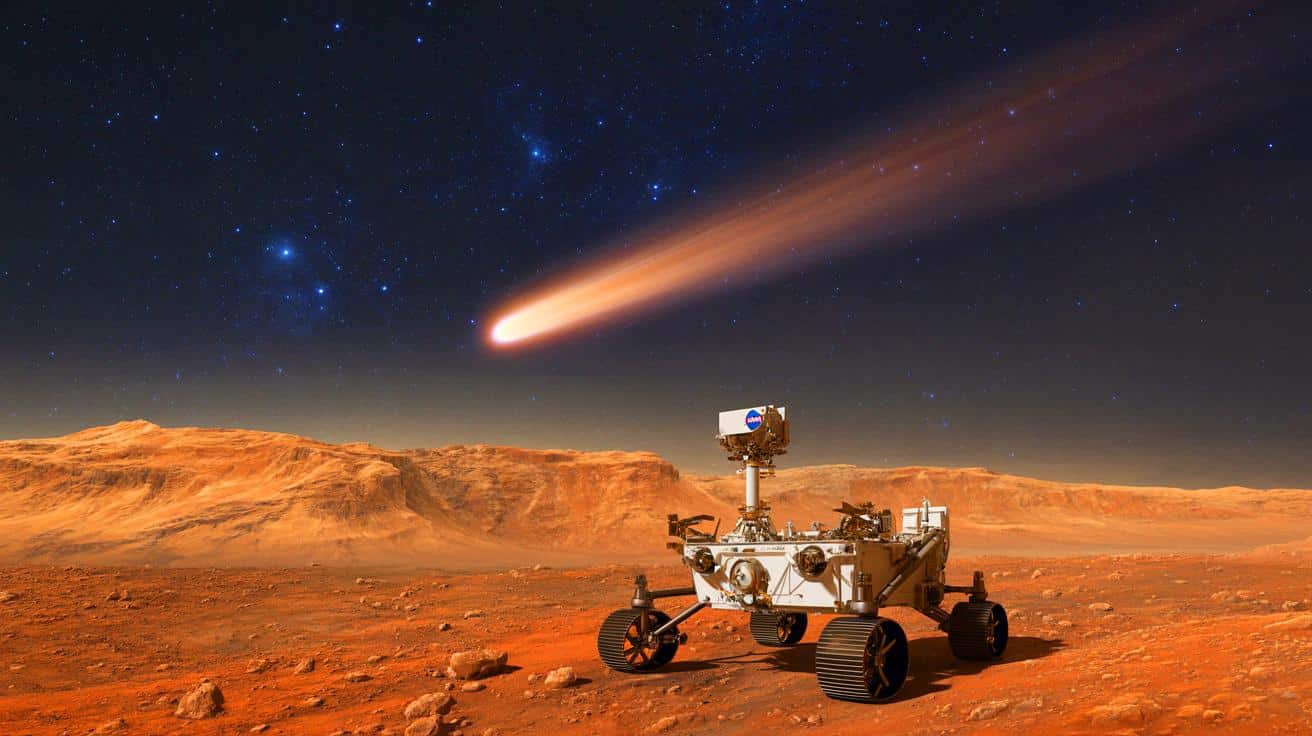
The Navcam on NASA’s Perseverance rover captured two images showing a long, glowing streak in the Martian sky. According to astronomer Avi Loeb, this streak measures an impressive 31,000 miles. However, this figure may not accurately represent the object’s true size. This discrepancy arises from the long exposure time used by the camera, which stacked hundreds of images over a ten-minute period. As a result, a simple point of light was transformed into an elongated trail.
While some astronomers remain cautious, suggesting the visible object could be an optical artifact or an atmospheric phenomenon, the images have fueled speculation and debate. The question of whether the images indeed show 3I/ATLAS remains unanswered, adding an element of intrigue to the ongoing investigation. As scientists work to verify the object’s identity, the images captured by Perseverance continue to be a focal point of interest and discussion.
HiRISE and the Quest for Clarity
In tandem with Perseverance’s observations, the Mars Reconnaissance Orbiter also captured an image of 3I/ATLAS on October 3 using its HiRISE camera, known for producing highly detailed images. This development raises hopes of gaining a clearer understanding of the object. However, the captured image has yet to be released, adding an element of anticipation to the scientific community’s efforts.
Avi Loeb posits that even a single bright pixel could provide enough information to estimate the comet’s actual size. According to his calculations, 3I/ATLAS might measure about 3.1 miles in diameter and weigh an astonishing 33 billion tons. Despite these impressive figures, the rigorous process of analyzing HiRISE data requires time and precision. Teams must compare the image with other datasets to rule out any potential errors. This methodical approach, though frustratingly slow, underscores the scientific commitment to accuracy and detail.
A Cosmic Enigma: More Questions Than Answers
This encounter with an interstellar object is exceedingly rare. Observing such an anomaly at this distance is akin to spotting a shark in the mountains, improbable, yet undeniably real. Yet caution is warranted. It remains uncertain whether the images truly depict 3I/ATLAS. Even if HiRISE confirms its presence, many questions remain unanswered.
Is it a comet? An asteroid? Or something entirely different? Some researchers have even ventured to suggest more audacious possibilities, including the notion that it could be a technological artifact. While this hypothesis is divisive, it serves as a reminder that astronomy is a field ripe with surprises. The farthest objects in the universe often challenge our understanding and push the boundaries of what we know.
As the scientific community continues to unravel the mysteries surrounding 3I/ATLAS, the potential for groundbreaking discoveries looms large. This event not only highlights the need for continued exploration but also underscores the profound complexity of the cosmos. As we await further insights, one must wonder: What other cosmic enigmas lie waiting to be discovered, just beyond our reach?