

“This Comet Terrifies Scientists”: Racing Past Mars and Posing Unexpected Threats (and It’s Closer Than You Think)
 By
Ethan Reid
By
Ethan Reid
| IN A NUTSHELL |
|
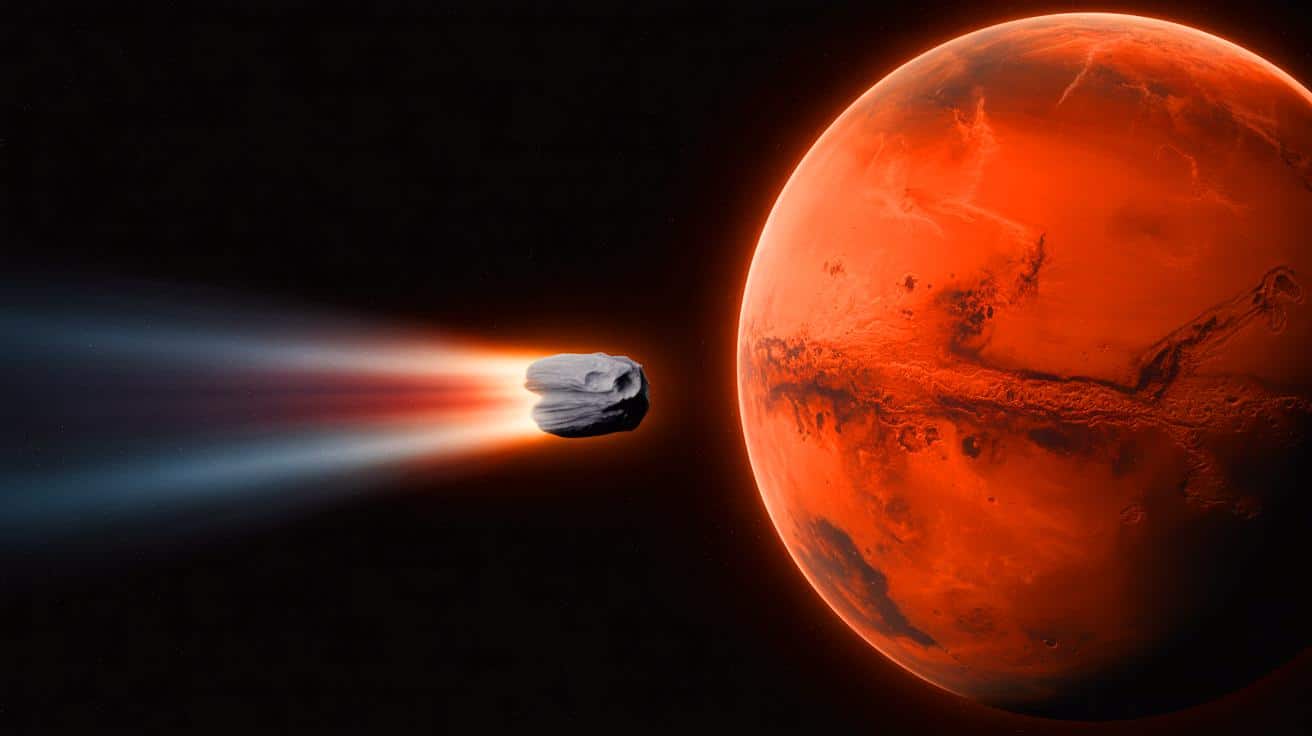
In recent weeks, the scientific community has been abuzz with the approach of a mysterious celestial visitor. The interstellar comet 3I/ATLAS is racing through our solar system at an astonishing speed, providing a rare opportunity to study an object from beyond our cosmic neighborhood. As it nears Mars, scientists are eager to glean insights into its origin and composition. This cosmic event has mobilized observatories and space agencies worldwide, making it a focal point of research and speculation about the universe’s vastness and the potential connections between distant star systems and our own.
The Mystifying Origins of Comet 3I/ATLAS
The discovery of comet 3I/ATLAS has sparked intrigue among astronomers and the general public alike. Unlike typical comets that originate from within our solar system, 3I/ATLAS hails from a distant star system. It is only the third interstellar object ever observed, following the paths of ‘Oumuamua and Borisov. This distinction alone makes it a valuable subject of study.
Traveling at speeds that defy conventional understanding, 3I/ATLAS is a blazing interstellar traveler. As it approaches Mars, it presents a unique opportunity for scientists to examine an object that has journeyed across the stars. Observations from Earth-based telescopes have already provided preliminary data on its chemical composition and brightness, but much remains hidden as the comet is currently obscured by the Sun.
Despite this challenge, the comet remains under close observation by missions on and around Mars. Understanding the evolution of such interstellar objects could offer clues about the formation of planetary systems and the potential for life beyond Earth.
European Spacecraft on High Alert
In response to the comet’s approach, the European Space Agency (ESA) has mobilized its resources to study 3I/ATLAS. The Mars Express and ExoMars Trace Gas Orbiter have adjusted their instruments to monitor the comet’s passage near Mars. This alignment allows scientists a fleeting but precious window to gather data.
The primary focus is on analyzing the comet’s coma, the cloud of gas and dust that surrounds it as it is heated by the Sun. Researchers are particularly interested in identifying complex organic molecules within this cloud. Such findings could bolster the hypothesis that life-building compounds travel between star systems, suggesting that life’s origins may be more universal than previously thought.
By examining the comet’s structure and composition, scientists hope to enhance our understanding of the universe’s interconnected nature and the potential for life beyond our solar system.
NASA’s Martian Rovers Join the Hunt
NASA is also actively participating in this cosmic event. The Mars Reconnaissance Orbiter is diligently scanning for any spectral or luminous signatures of 3I/ATLAS. Meanwhile, the Curiosity and Perseverance rovers, stationed on the Martian surface, are keeping an eye on the skies for any sign of the comet’s influence.
Should a fragment of the comet enter Mars’ atmosphere, even momentarily, it would be a scientific treasure trove. The analysis of interstellar dust could provide groundbreaking insights into the formation of planetary systems.
Every data point, from a slight change in brightness to a gas emission, is valuable. These observations could unravel the internal structure of this enigmatic interstellar visitor, offering a glimpse into the broader workings of our universe.
Juice Mission: The Next Frontier
The exploration of 3I/ATLAS will not end with its passage by Mars. The European mission Juice, Jupiter Icy Moons Explorer, is set to continue the pursuit. En route to Jupiter’s icy moons, Juice will have the opportunity to observe 3I/ATLAS from a new perspective.
This extended observation will allow scientists to compare data collected near Mars with that from farther afield, closer to Jupiter. Such a comprehensive analysis could reveal critical details about the comet’s internal structure, density, and stellar origins.
Some researchers speculate that 3I/ATLAS might originate from a young, gas-rich star system, while others view it as a relic from an ancient world. Regardless of its origins, this comet underscores a fundamental truth: our curiosity knows no bounds, and our universe is far more expansive than we can currently comprehend.
The passage of comet 3I/ATLAS through our solar system serves as a reminder of the vastness of space and the enduring mysteries that lie beyond our reach. As scientists continue to study this interstellar traveler, they hope to uncover secrets about the building blocks of life and the interconnectedness of the cosmos. What other celestial phenomena await discovery, and how might they reshape our understanding of the universe and our place within it?