


This Translucent Creature Terrifies Marine Scientists (And It Could Lurk in Your Waters)
 By
Ethan Reid
By
Ethan Reid
| IN A NUTSHELL |
|
In the dark, mysterious depths of a cave in China’s Yunnan province, scientists have uncovered a startling find: a new species of almost invisible cave-dwelling fish. Named Triplophysa baishuijiangensis, this tiny, translucent creature provides valuable insights into how life adapts to extreme environments. Each exploration of this kind reveals the incredible capacity of nature to innovate and adapt. The discovery has intrigued biologists worldwide, drawing attention to the extraordinary adaptations organisms can develop in response to unique ecological pressures.
The Bold Expedition Into Yunnan’s Depths
Picture a dedicated team of researchers, headlamps affixed to their helmets, navigating the flooded caves of southwest China. Near the village of Xiaoganxi in Yunnan province, they encountered a highly elusive creature. During their expedition, the scientists collected eleven specimens using nets and transported them to a laboratory for further analysis. This meticulous process highlights the dedication required to study such hidden wonders of the natural world.
These fish belong to the genus Triplophysa, a family of freshwater loaches that thrive in mountain rivers and caves. However, this species stands out due to its unique characteristics. With vestigial eyes, a complete lack of pigmentation, a fully developed lateral line, and specific fin structures, Triplophysa baishuijiangensis appears perfectly evolved for survival in a world devoid of light. The adaptations observed in these fish demonstrate the profound changes life undergoes to thrive in isolated and challenging environments.
A Translucent Skin and Visible Organs
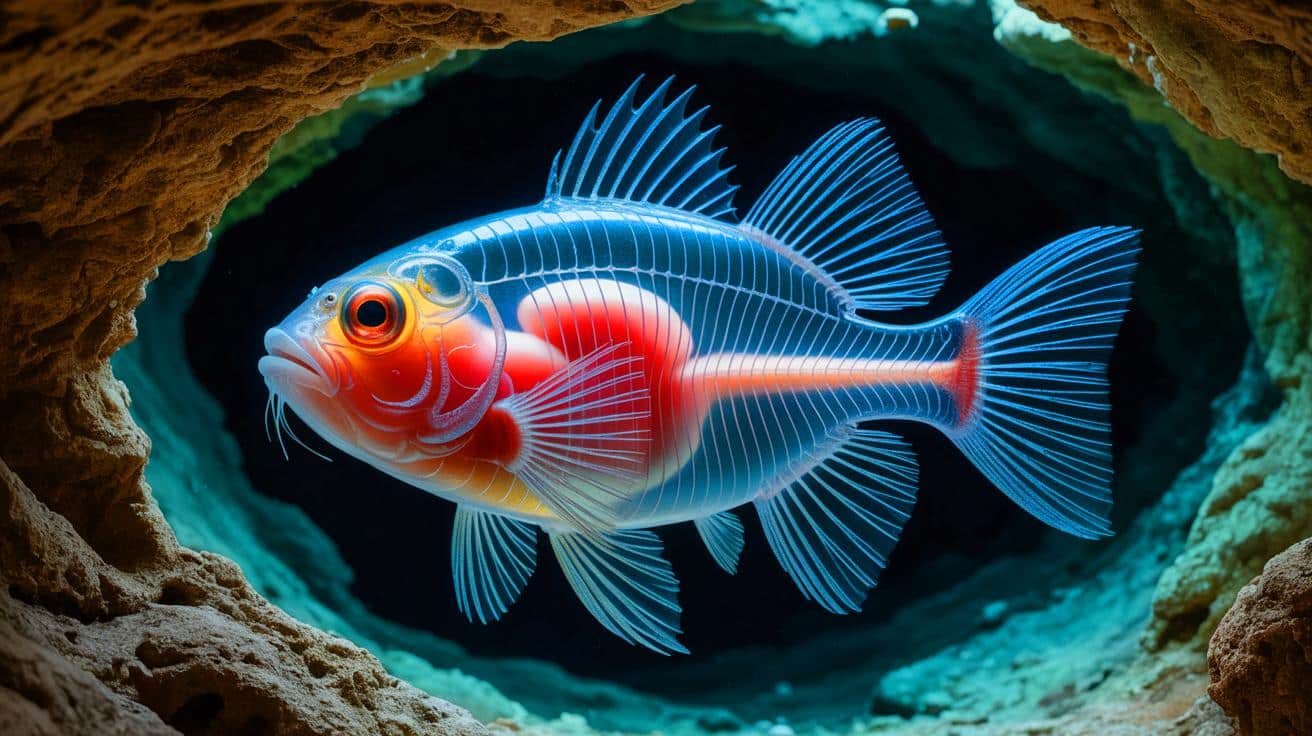
The first thing that strikes observers is the fish’s unusual appearance. Without scales, colors, or functional eyes, Triplophysa baishuijiangensis looks like it belongs in a science fiction tale. Its translucent skin reveals internal organs, offering a live dissection view to the curious eye. This transparency is not coincidental but a result of evolutionary necessity.
In the pitch-black environment of caves, color serves no purpose. By losing pigmentation, the fish conserves energy, which is scarce in such nutrient-poor habitats. Additionally, eyes are useless in complete darkness and have regressed over time. Instead, the fish have developed sensory barbels around their mouths, aiding in food detection and navigation through rocky passages. The entire body of Triplophysa baishuijiangensis appears sculpted by the relentless logic of survival.
The Evolution of an Isolated Species
Geneticists have compared the DNA of Triplophysa baishuijiangensis with that of other loaches from the same genus. The results reveal a clear genetic divergence, signifying that this population has been isolated for thousands of years, evolving slowly to adapt to underground life. This phenomenon, known as troglobitic speciation, is well-documented in cave-dwelling species.
When a group of animals becomes confined in a dark, stable environment, they gradually transform. Their senses, physical forms, and behaviors change over time. The body of Triplophysa baishuijiangensis tells a compelling story of extreme adaptation, showcasing the remarkable capacity of life to evolve in response to environmental challenges.
A Scientific Discovery Illuminating Evolutionary Mysteries
Beyond scientific curiosity, this discovery reminds us of life’s incredible ability to reinvent itself. Even in the most remote corners of the planet, devoid of light, life finds a way to exist, adapt, and surprise us. With its translucent body and refined senses, Triplophysa baishuijiangensis becomes a symbol of biological resilience.
This finding raises intriguing possibilities about other undiscovered species that may be lurking in the unexplored caves of Yunnan. What other secrets does this subterranean world hold, and how might they further our understanding of life’s adaptability?
The discovery of Triplophysa baishuijiangensis in Yunnan’s caves opens a window into the fascinating world of evolutionary biology. It underscores the persistence and ingenuity of life in overcoming environmental challenges. As scientists continue to explore and uncover the hidden wonders of our planet, what new insights into the adaptability of life might they reveal next?