


“This Unknown Life Form Is a Revelation”: Discovery of Mysterious Black Substance on Ship Stuns Experts and Raises Alarming Questions
 By
Ethan Reid
By
Ethan Reid
| IN A NUTSHELL |
|
In a surprising twist of fate, a routine inspection turned into a groundbreaking discovery when a marine technician found a mysterious black substance on the rudder of an ancient ship. This isn’t the plot of a science fiction movie, but a real-life event that has left the scientific community buzzing with excitement. The substance, initially dismissed as grime, revealed itself to be a new life form promising insights into biology and renewable energy. This discovery challenges our understanding of life and its resilience, as well as offering potential energy solutions.
A Routine Inspection Unveils a New Life Form on a Ship’s Rudder
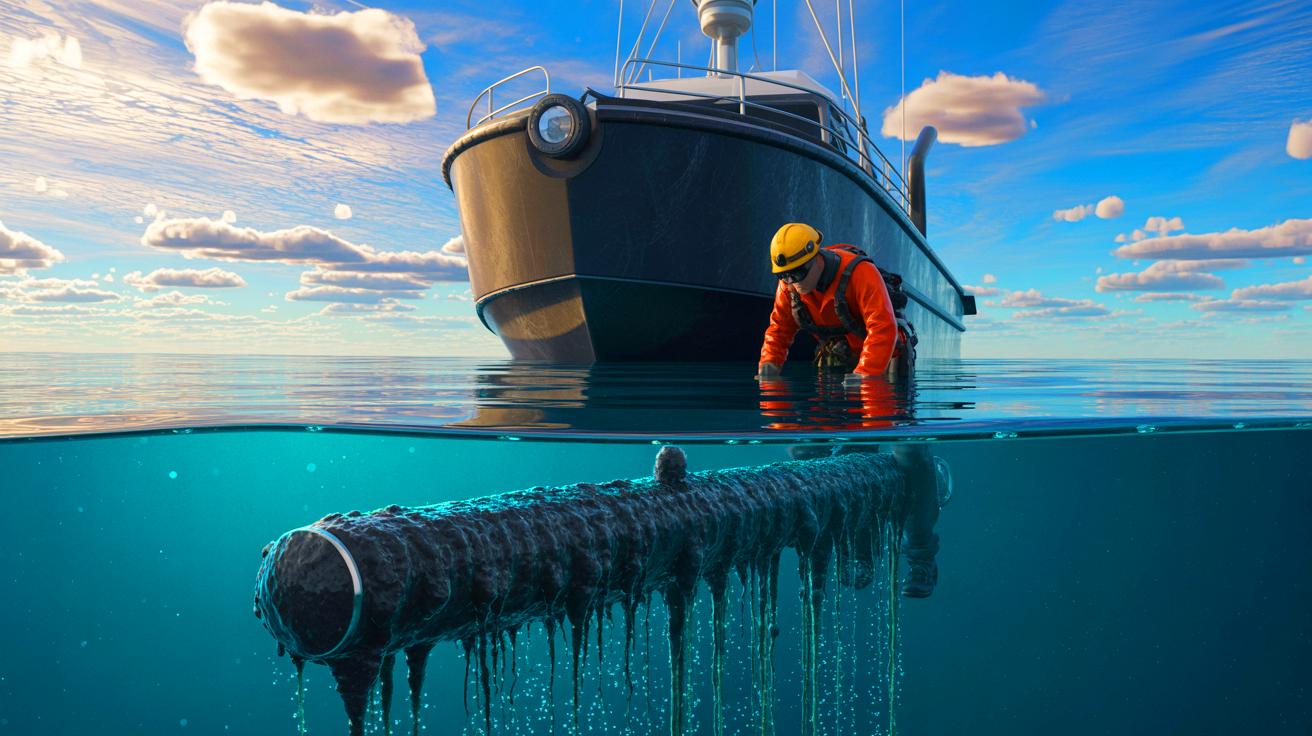
It all began during a routine inspection on a research vessel navigating the Great Lakes in the United States. Doug Ricketts, a marine technician at the Great Lakes Observatory in Minnesota, was cleaning the rudder of the Blue Heron when he stumbled upon a black, slimy substance. Upon collecting a sample, Doug inadvertently uncovered a microbial habitat unlike any known to science. This substance, later dubbed “ShipGoo001,” was more than just an anomaly; it was a potential game-changer.
ShipGoo001 turned out to contain a previously unknown microbial ecosystem capable of producing methane, a gas with significant energy potential. This accidental discovery could have far-reaching implications for both biological research and the development of new energy sources. The presence of this microbial life challenges our understanding of where and how life can exist, offering new avenues for scientific exploration.
The “ShipGoo001”: A Living Archive from the Depths
Following its discovery, researcher Cody Sheik from the University of Minnesota at Duluth named the substance “ShipGoo001.” Inside this goo, he identified unknown archaea, microorganisms that thrive without oxygen in stable, lukewarm conditions. The rudder, however, was submerged in the oxygen-rich waters of the Great Lakes, posing a fascinating mystery. How did these anaerobic creatures come to inhabit such an environment?
This enigma has opened up numerous hypotheses about the origins, resilience, and adaptability of life. Scientists are intrigued by the possibility that these organisms might have originated from the depths of the ocean or perhaps from an entirely different ecosystem. This discovery underscores the complexity of life and the potential for finding life forms in unexpected places, reshaping our understanding of life’s adaptability.
Uncovering a New Branch of Life Capable of Methane Production
Genetic analysis of ShipGoo001 allowed scientists to reconstruct 20 genomes, several of which were completely novel. Among these discoveries were an unclassified order of archaea and a new bacterial genus, effectively redrawing the tree of life. The implications of this discovery are vast, as it not only adds new branches to the tree of life but also highlights the diversity of life forms yet to be discovered.
More intriguingly, ShipGoo001 might hold the key to future biofuel production due to its ability to produce methane, a gas with significant energy applications. This “black goo” could become instrumental in developing sustainable energy solutions, offering a bridge between biological research and renewable energy innovation.
A Lesson in Humility: Science in Unseen Places
Cody Sheik, who had previously explored hydrothermal vents and other extreme environments, never imagined that a ship’s rudder could harbor such a discovery. This finding serves as a poignant reminder that science often lurks in the unseen corners of the world. Sometimes, it is in the overlooked grime of a ship’s hull that we encounter new forms of life.
This discovery lies at the intersection of biology, energy, and scientific curiosity, urging us to reconsider our assumptions. Perhaps one day, this black goo will become not only a crucial energy source but also a testament to the value of curiosity and open-mindedness in scientific pursuits. What other secrets of life might be hidden in the overlooked crevices of our world?