


“Unbelievable Secrets Unearthed”: Scientists Stunned by 4,000-Year-Old Symbols Hinting at Lost Civilizations
 By
Ethan Reid
By
Ethan Reid
| IN A NUTSHELL |
|
In the arid landscapes of southwestern Sinai, a discovery has emerged that may challenge our understanding of ancient religious narratives. Archaeologists have uncovered inscriptions that could provide an unprecedented glimpse into the historical origins of key biblical figures. These inscriptions, discovered at the Serabit el-Khadim site, potentially reference Moses, a figure of profound significance in Jewish, Christian, and Islamic traditions. This finding, if verified, could reshape historical and religious scholarship, offering tangible evidence of stories that have been passed down through millennia. Yet, the implications of these inscriptions are as complex as they are potentially groundbreaking.
The Discovery of Ancient Inscriptions
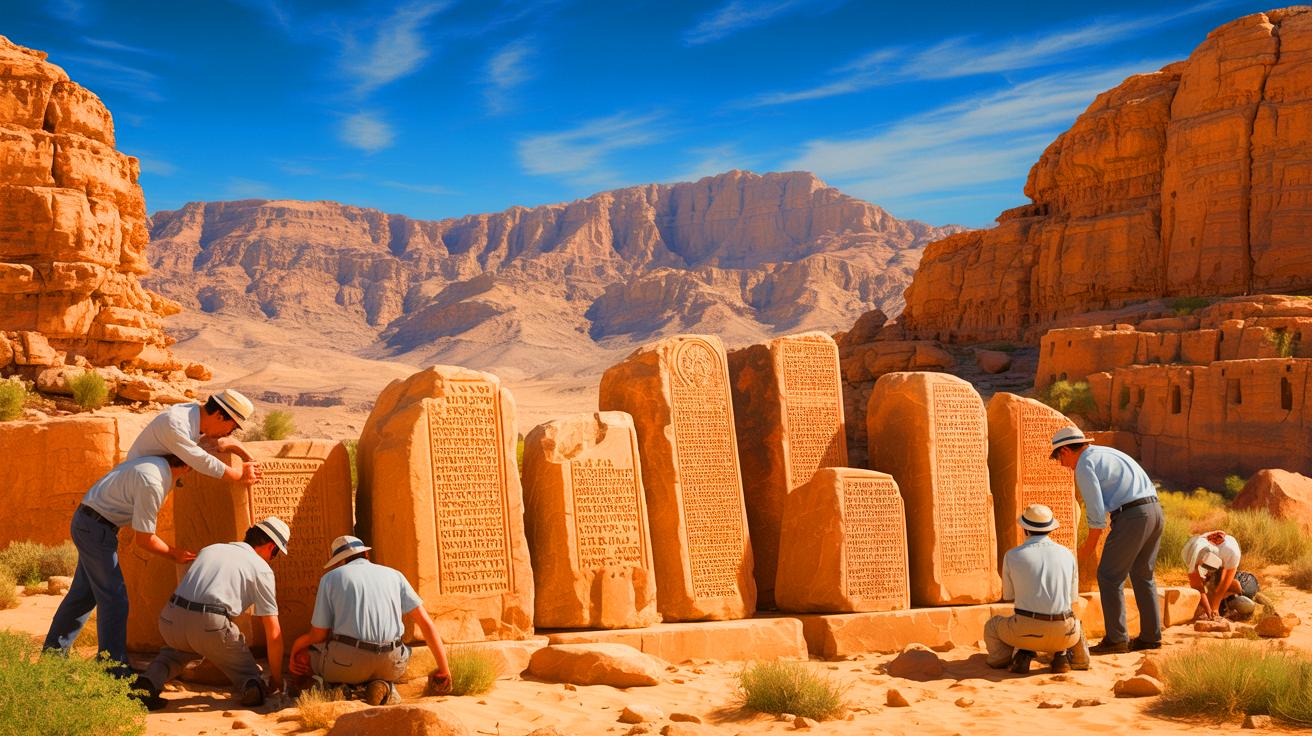
The site of Serabit el-Khadim has long been a focal point of archaeological interest due to its ancient mining activities and temple dedicated to the goddess Hathor. However, recent findings have shifted the spotlight to inscriptions found etched into rocks over 3,800 years ago. These inscriptions, analyzed using advanced 3D technology by Israeli archaeologist Michael S. Bar-Ron, may contain phrases that explicitly reference Moses. Bar-Ron suggests that phrases like “zot mi’Moshe” and “ne’um Moshe” hint at a direct connection to this pivotal biblical figure.
The inscriptions were created using proto-Sinaitic script, a precursor to the Phoenician alphabet. This script was likely developed by a scribe familiar with both Egyptian hieroglyphs and early Semitic writing systems. Bar-Ron posits that the poetic and personal style of these inscriptions might indicate a single author, potentially Moses himself or someone in his close circle. Such a hypothesis, while captivating, remains subject to rigorous scholarly debate and verification.
Religious and Cultural Implications
Adding to the intrigue, the inscriptions appear to overlay Hebrew divine names onto those of Egyptian deities. For instance, the name “El,” an ancient Hebrew god, is inscribed alongside “Ba’alat,” associated with Hathor. This superimposition could signify a significant spiritual or religious shift during that era. The potential erasure of Egyptian names in favor of Hebrew ones might hint at the emergence of monotheistic beliefs, challenging the prevailing polytheistic traditions of the time.
If these interpretations hold true, the inscriptions could provide invaluable insights into the early development of Hebrew religious traditions. Such a shift might represent the nascent stages of monotheism, a concept that would profoundly influence religious belief systems worldwide. The implications of this discovery extend beyond archaeology, touching upon the fields of theology, history, and cultural studies.
Scientific Debate and Skepticism
The hypothesis of Moses’ historical existence, as suggested by these inscriptions, has ignited considerable debate within the academic community. Critics, such as Egyptologist Thomas Schneider, have raised concerns about the reliability of Bar-Ron’s findings. Schneider points out the inherent challenges in interpreting proto-Sinaitic script, which can lead to misidentification of letters and meanings.
Despite the controversy, the potential historical reference to Moses continues to captivate scholars and the public alike. Even if the connection to Moses remains speculative, the discovery encourages further exploration into the historical contexts of biblical narratives. It underscores the importance of archaeological endeavors in uncovering new layers of understanding about ancient civilizations and their belief systems.
The Significance of Serabit el-Khadim
Serabit el-Khadim, with its rich history of mining and religious activity, stands as a testament to Egypt’s complex cultural and spiritual past. The site, long associated with the worship of Hathor, now finds itself at the center of a potentially transformative debate about the historical veracity of biblical narratives. If indeed traces of a figure like Moses can be found here, it would be an extraordinary convergence of history, archaeology, and faith.
Bar-Ron remains committed to his research, planning to examine additional fragments at the site. The intersection of science and spirituality at Serabit el-Khadim offers a unique opportunity to explore the origins of our collective spiritual memory. As scholars continue to investigate, the site may yet reveal more about the ancient world and its narratives.
The discovery at Serabit el-Khadim invites us to reconsider long-held assumptions about the historical accuracy of biblical accounts. While the debate over the inscriptions’ meanings and implications continues, they undeniably offer a fresh perspective on the intersection of history, faith, and cultural evolution. As new evidence emerges, what other secrets of our spiritual past might be waiting to be uncovered?