


China’s Astounding Plan to Save Earth: “Massive Space Strike Filmed Live” Could Prevent Asteroid Apocalypse
 By
Ethan Reid
By
Ethan Reid
| IN A NUTSHELL |
|
In recent years, the world has witnessed significant advancements in space exploration and planetary defense. Following NASA’s successful DART mission, which altered the trajectory of the asteroid Dimorphos, China is preparing to launch an ambitious mission of its own. This initiative aims to demonstrate a comprehensive approach to deflecting asteroids, featuring a dual mission design with both an impactor and an observation probe. Such efforts underscore the growing emphasis on developing capabilities to protect Earth from potential cosmic threats.
China’s Planetary Defense Strategy Since 2021
China’s ambitions in planetary defense were first announced in 2021 during a dedicated conference. The country’s goal was straightforward: to send a space impactor to collide with an asteroid and alter its orbit. This idea, unveiled shortly before NASA’s DART mission, has since evolved into a well-structured space strategy. China’s pursuit of this mission positions it as an emerging leader in planetary protection.
Recently, Wu Weiren, a member of the Chinese Academy of Engineering and head of the lunar program, provided further details about the mission at an international congress in Hefei, China. He confirmed that planning for the mission is in its advanced stages, reflecting China’s strong commitment to taking decisive action in space defense. Such developments highlight China’s growing influence in the realm of space science and its determination to contribute significantly to global efforts in safeguarding our planet from extraterrestrial threats.
Lancement Simultané: Impact and Observation
China’s upcoming mission, which currently lacks an official name, targets an asteroid located tens of millions of miles from Earth. The mission’s objective is to alter the asteroid’s trajectory by a mere 3 to 5 centimeters. While seemingly minor, such a deflection could be crucial in preventing a potential collision with Earth in the future.
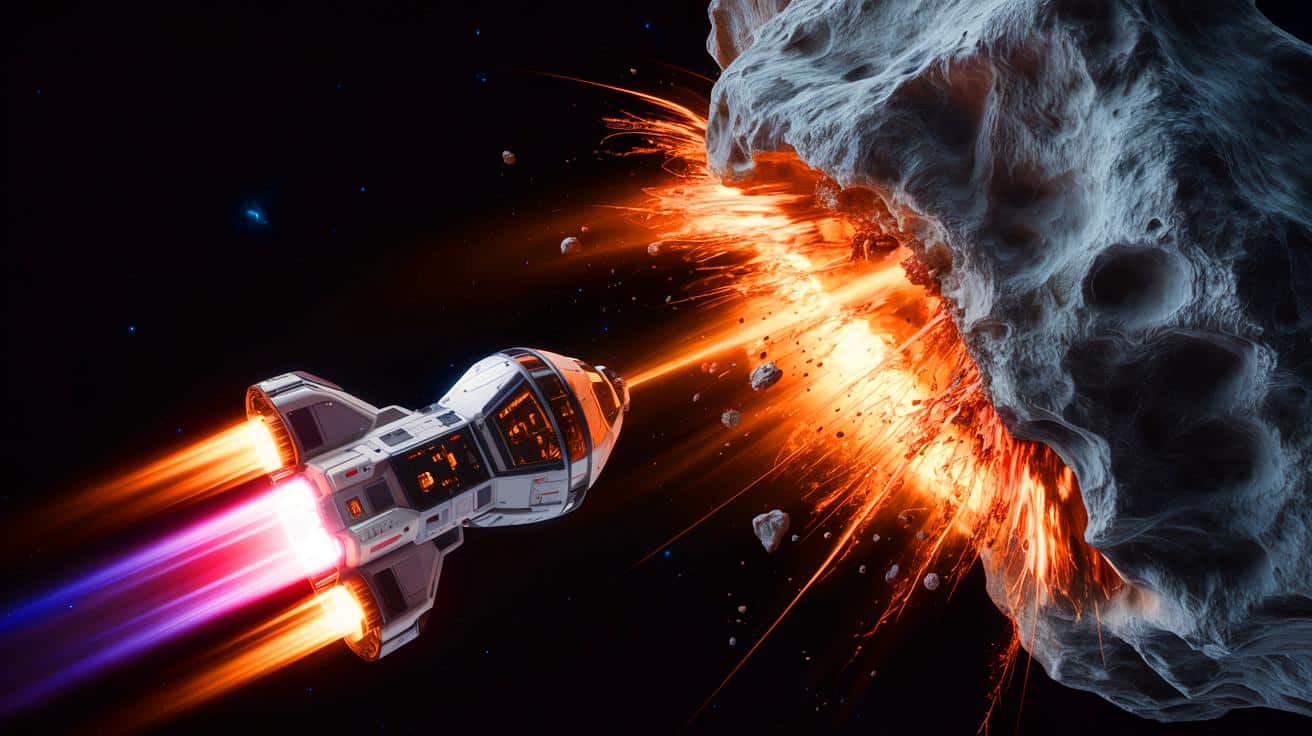
Unlike NASA’s DART mission, which was followed by the Hera probe years later, China plans to launch two spacecraft simultaneously. One will serve as the impactor, while the other will act as the observer. This dual launch strategy aims to provide immediate and continuous analysis of the collision’s effects, allowing scientists to gain valuable insights more rapidly. This approach underscores the importance of real-time data collection and analysis in enhancing our understanding of asteroid deflection techniques.
Real-Time Observations and Data Collection
The second spacecraft, dedicated to observation, will have the crucial task of filming the impact, studying the resulting debris, and measuring the collision’s exact effect on the asteroid’s trajectory. Additionally, the mission will leverage Chinese telescopes, both in orbit and on the ground, to supplement the data collected.
This combination of tools represents a significant scientific advancement, enabling simultaneous data collection. The information gathered will be invaluable for engineers and astronomers as they refine deflection models. Moreover, it will enhance our understanding of asteroids’ internal structures, which is essential for developing effective deflection strategies. China’s mission, therefore, not only contributes to planetary defense but also advances our broader knowledge of these celestial bodies.
An Ambitious and Proactive Space Policy
This mission is part of a broader, proactive space policy. In May 2025, China’s Tianwen-2 probe was launched towards the asteroid Kamo’oalewa to bring back a sample to Earth. Such initiatives highlight China’s rising prominence in applied space science. With this new asteroid deflection project, China asserts its ambition to become a central player in planetary security.
While the precise launch schedule remains unconfirmed, the scientific community is closely monitoring this mission. If successful, China will establish a critical milestone in humanity’s ability to protect Earth from space threats. This endeavor could one day mean the difference between a global catastrophe and a successful prevention effort. How will China’s growing expertise in space defense shape the future of international collaboration in safeguarding our planet?