


NASA Uncovers Terrifying Truth: “Trapped Stars in Black Holes” May Revolutionize Our Understanding of the Universe Forever
 By
Ethan Reid
By
Ethan Reid
| IN A NUTSHELL |
|
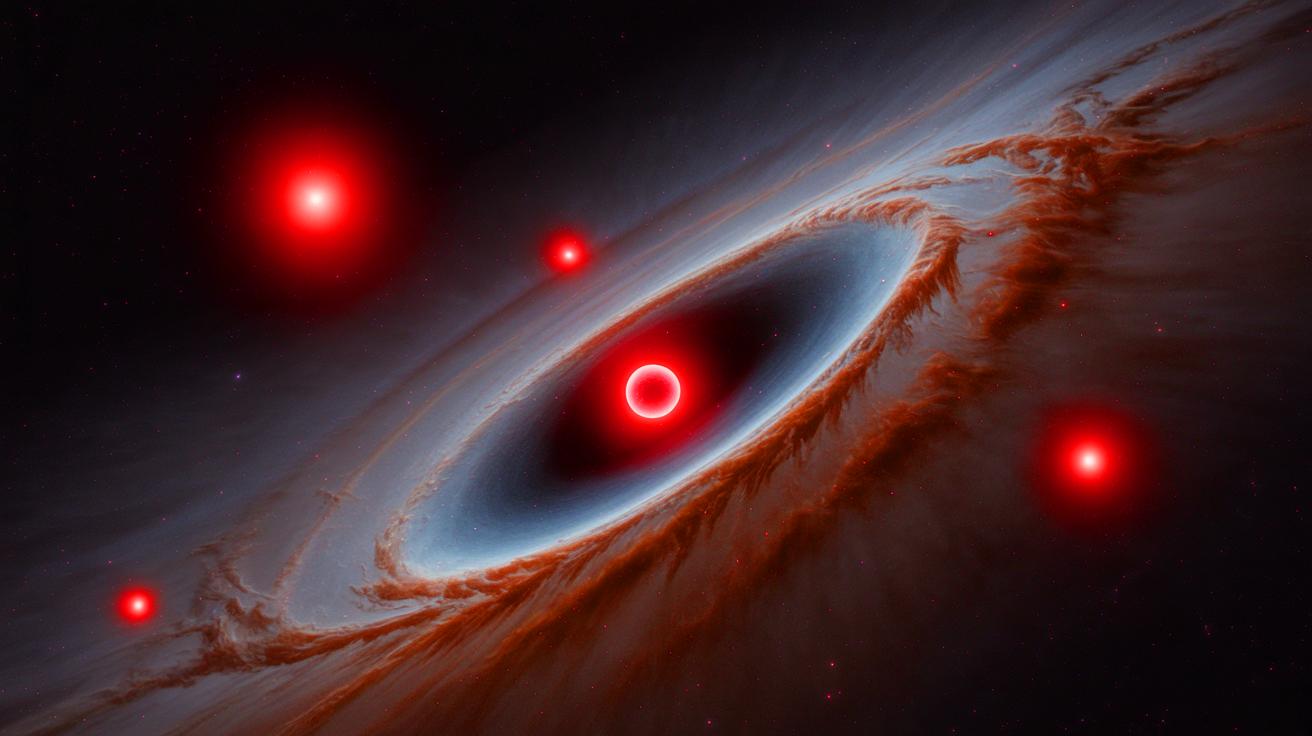
The James Webb Space Telescope (JWST) has once again captured the attention of the scientific community, revealing potential discoveries that challenge our current understanding of the universe. Recent findings suggest that the mysterious “little red dots” seen in the JWST’s early images might not be mature galaxies, as initially thought, but rather stars captured by supermassive black holes. This revelation could significantly alter our perception of supermassive black hole formation, providing new insights into the early universe and the evolution of cosmic structures.
The Enigma of the Red Dots
Since its deployment, the James Webb Space Telescope has been a crucial tool for astronomers, uncovering thousands of stars, planetary systems, and even signs of oceans. Among its most intriguing findings are the extremely bright red dots observed 500 to 700 million years after the Big Bang. Initially interpreted as mature galaxies, these red dots posed a challenge to existing cosmological models due to their unexpected brightness and density. This led scientists to nickname them “universe breakers” because their existence seemed to defy the known rules of galaxy formation.
The brightness of these dots suggested a stellar density that contradicted the expected timeline of cosmic evolution. Traditional models struggled to explain how such mature galaxies could form so soon after the Big Bang. This discrepancy prompted researchers to reconsider their initial assumptions, leading to the hypothesis that these red dots could be something entirely different from mature galaxies.
A Hidden Black Hole Behind the Glow
An intensive investigation by a team from Pennsylvania State University examined around 4,500 distant galaxies to unravel the mystery of these red dots. Their research led to the identification of an object with an extreme mass, referred to as “The Cliff.” Spectral analysis of its light, dating back 11.9 billion years, revealed a surprising discovery: it was not a galaxy but a supermassive black hole.
Surrounded by a dense cloud of hydrogen gas, this black hole creates an illusion of a stellar atmosphere. The gas absorbs surrounding matter, converting it into energy and emitting red light. This phenomenon makes the objects appear as though they are ancient stars when captured in the images produced by the JWST. The identification of these supermassive black holes hidden by gas bubbles provides a plausible explanation for the perplexing brightness of the red dots.
The Ancestors of Modern Supermassive Black Holes
These newly identified hybrid objects, termed “black hole stars,” may represent the embryonic stage of the massive black holes found at the centers of galaxies today. Unlike stars that shine through nuclear fusion, these objects emit energy through accretion, a process where they consume their surroundings. This accretion generates the intense light and energy observed in the JWST images.
According to Joal Leja, co-author of the study, this is “the most convincing hypothesis to date, and the only one that fits the data so well.” By reconciling JWST observations with theoretical models, this hypothesis offers a new framework for understanding how supermassive black holes developed throughout cosmic history. The concept of black hole stars could reshape our understanding of the universe’s early stages and the evolution of its most enigmatic structures.
Future Investigations Into the Gas Density
Despite their vast distance and size, these black hole stars present a challenging target for further study. Researchers aim to analyze their gaseous environment, density, and behavior to gather more information about the formation of the universe’s first black holes. Understanding these parameters is crucial for piecing together the complex puzzle of cosmic evolution.
As researchers delve deeper into the mysteries of these red dots, they are reminded of the universe’s inherent complexity and unpredictability. The statement, “The universe is stranger than we can imagine,” resonates with scientists as they explore the potential implications of these findings. The humble red dots may hold the key to unlocking some of the universe’s most profound secrets, challenging us to rethink our place in the cosmos.
The revelations uncovered by the James Webb Space Telescope invite a reevaluation of established theories and prompt new questions about the universe’s origins and development. As scientists continue to investigate these enigmatic objects, one question remains: what other cosmic secrets lie hidden, waiting to be discovered by the next generation of telescopes and researchers?