



The Shining Rings: “This Discovery Amazes Us” as Scientists Unveil Distant Planet Birth Spectacle
 By
Ethan Reid
By
Ethan Reid
| IN A NUTSHELL |
|
The recent discovery of a distant exoplanet forming around a young star has captivated the scientific community. This remarkable finding was made possible through the use of advanced telescopic technology, revealing the intricate and luminous rings surrounding the star. These observations provide a rare glimpse into the early stages of planetary formation, offering new insights into the processes that shape celestial bodies. As researchers continue to study this phenomenon, the implications for our understanding of exoplanetary systems are profound, potentially reshaping our knowledge of the universe and our place within it.
Observing a Planet in Formation
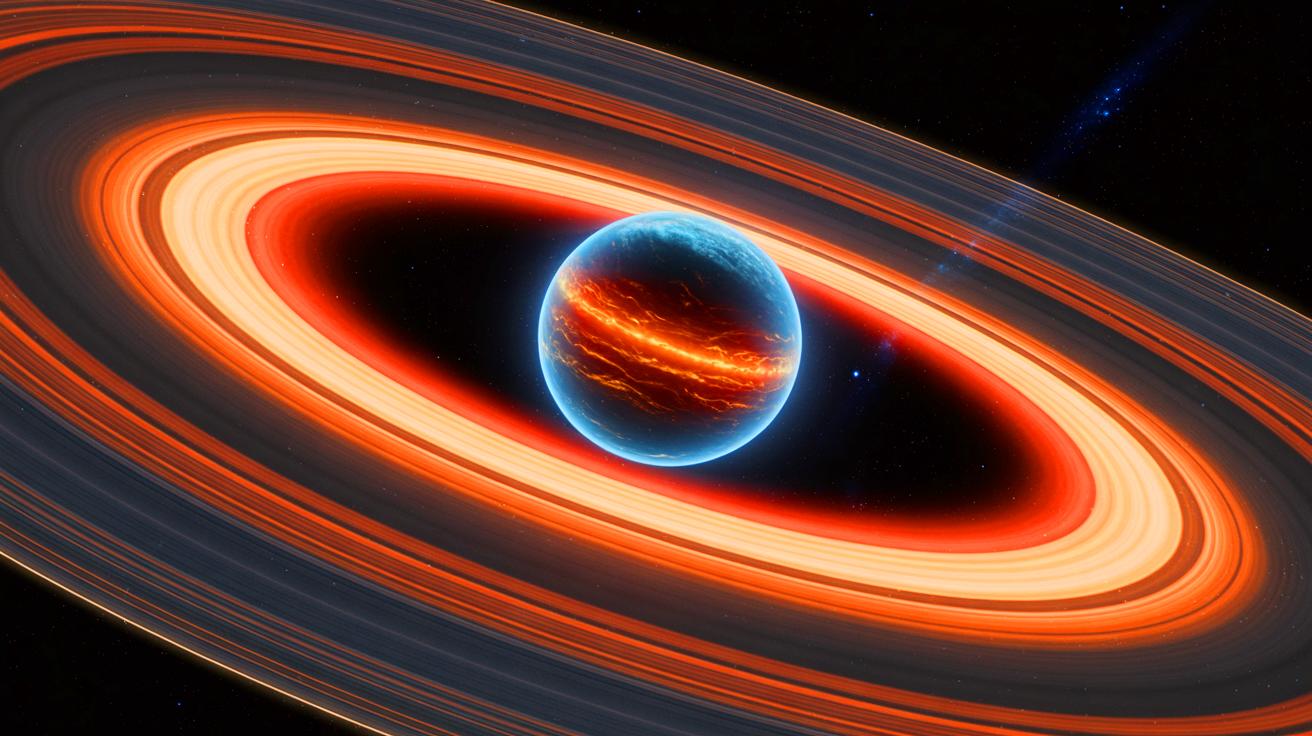
Astronomers have identified an exoplanet, named WISPIT 2b, orbiting a young star approximately 1,400 trillion miles from Earth. This gas giant, comparable in size to Jupiter, is situated within a complex protoplanetary disk composed of multiple rings. Such disks are rarely observed, making this a significant discovery in the field of astronomy.
WISPIT 2b, at a mere age of 5 million years, is actively carving paths through its surrounding disk of dust and gas. The planet behaves like a “cosmic Pac-Man,” consuming the material in its path. This direct observation, akin to watching a giant vinyl record, marks a major milestone in the study of exoplanets, providing a rare opportunity to witness a planet’s formation in real-time.
The Discovery: Scientists Stunned by Vapor Planet’s Potential, “This Changes Our Understanding”
A Young Stellar System as a Research Laboratory
The research team, led by Richelle van Capelleveen from the University of Leiden, highlights the extraordinary nature of this system. Utilizing the Very Large Telescope (VLT) in Chile, they captured infrared images of WISPIT 2b, which still emits residual heat from its formation. This young stellar system offers a clear view of the interactions between the planet and its formation disk.
The protoplanetary disk surrounding the star WISPIT 2 spans a distance 380 times greater than the distance between Earth and the Sun. As a result, this system will likely serve as a benchmark for future studies, providing valuable insights into the dynamics of planetary formation and evolution.
An Unexpected Observation Leading to Planetary Confirmation
Initial observations involved quick snapshots of young stars, aiming to identify bright planets. The researchers were astonished to discover a stunning multi-ring disk during these observations. This prompted them to request additional observations to further study the phenomenon.
Through this method, they successfully pinpointed WISPIT 2b within one of the disk’s gaps, confirming its planetary nature. Subsequent visible light images, captured by researchers at the University of Arizona, revealed that the planet is still actively gathering material. This ongoing accretion signifies that WISPIT 2b is not yet fully formed and continues to evolve within its celestial nursery.
A Scientific Breakthrough Revitalizing Planetary Genesis Research
This unique image signifies the dawn of a new scientific era for researchers. It sheds light on why many exoplanetary systems differ significantly from our solar system. As Christian Ginski, a key member of the research team, remarked, “This system will be closely studied for many years.” The youthful enthusiasm and technological expertise of the researchers promise further breakthroughs in the field.
Jake Byrne, a student at the University of Galway, emphasized the significance of their findings, stating, “This is an incredible discovery that will advance research on planetary formation.” Scientists now aim to identify other forming planets, hoping to enhance our understanding of how worlds are born and evolve within distant solar systems.
As this discovery paves the way for future explorations, the scientific community remains eager to uncover more about the universe’s mysteries. What other hidden phenomena might await discovery in the vastness of space, and how will these revelations reshape our understanding of the cosmos?