


“This Changes Everything”: NASA’s Discovery Around This Dead Star Could Revolutionize Our Understanding of the Vast Universe
 By
Ethan Reid
By
Ethan Reid
| IN A NUTSHELL |
|
In a groundbreaking discovery that has the potential to reshape our understanding of the cosmos, NASA has identified a dead star exhibiting unexpected properties. This remarkable find was made using the Imaging X-ray Polarimetry Explorer (IXPE), which detected a millisecond pulsar showcasing an extraordinary cosmic event. Such findings not only challenge our current understanding but also open new avenues for astronomical research. By observing these phenomena, scientists are able to delve deeper into the mysteries of our universe, offering insights that were once thought to be the realm of science fiction.
PSR J1023+0038: The Dance Between Cosmic Gluttony and Particle Explosions
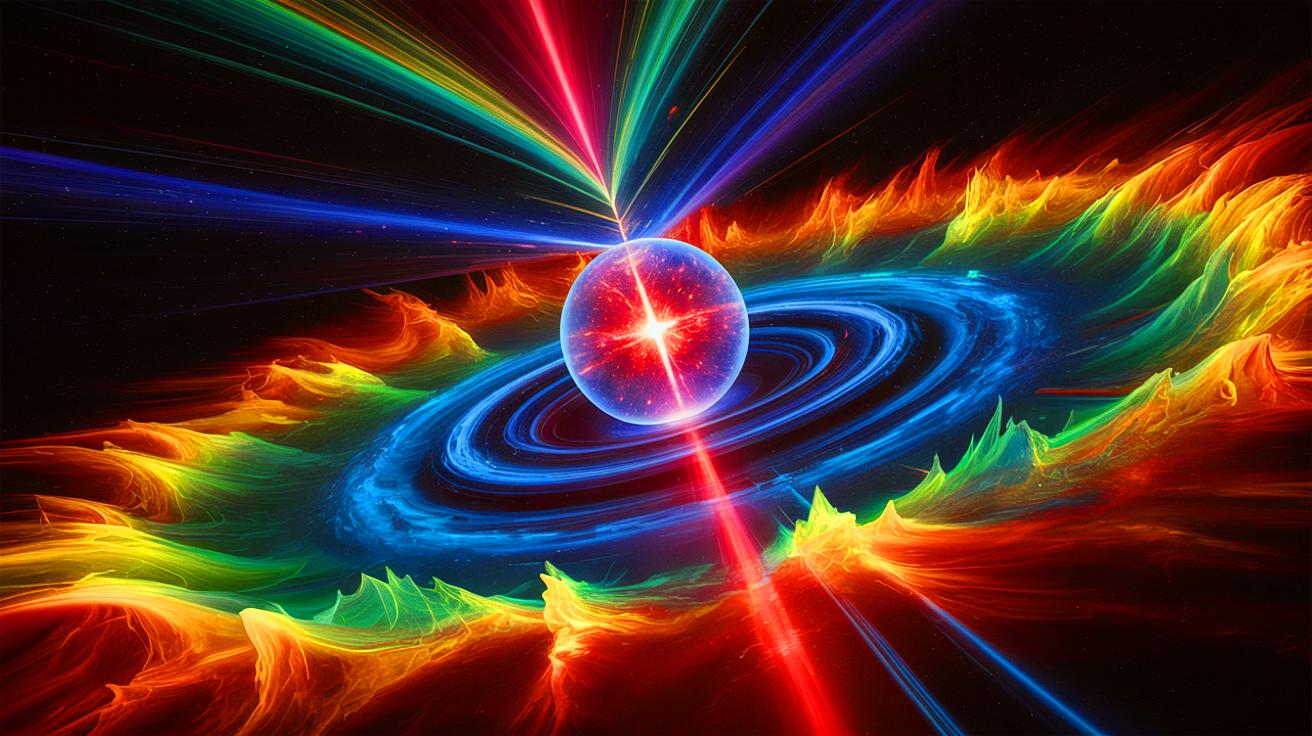
The subject of this astonishing discovery is PSR J1023+0038, a millisecond pulsar that remains from a supernova. This celestial body alternates between two distinct phases: a calm phase, where it draws in matter from a companion star forming a disk of accretion, and an active phase, during which it emits a wind of overheated particles. Such transitions occur every few hours, creating the illusion of the pulsar ‘dying’ and ‘rebirthing’.
The observation of these cycles was made possible through the combined efforts of three significant instruments: the IXPE, the Very Large Telescope (VLT), and the Very Large Array (VLA). These tools allowed astronomers to meticulously track the movement of matter and energy, providing documented evidence of a behavior that was previously theoretical. Through images and spectra, scientists have been able to capture the fascinating life cycle of PSR J1023+0038, offering a new perspective on pulsars and their dynamic existence.
IXPE Shatters Records with 12% Polarization Discovery
The IXPE observatory recorded an unprecedented 12% polarization in X-rays emitted by PSR J1023+0038, a result never before seen in pulsars of this type. Alongside, radio waves showed a 2% polarization, and visible light displayed a 1% polarization, all sharing the same orientation. This remarkable consistency suggests that these emissions are generated by the same mechanism: the particle wind impacting the accretion disk, which results in polarized light. It’s not merely the fall of matter that causes a glow, but the intense collision between matter and magnetic fields.
By integrating these findings with data from the VLT and VLA, researchers have confirmed the sequence of ‘matter absorption’ followed by ‘particle explosion’. This marks the first direct evidence of such a process, providing a new understanding of the physical principles governing pulsars. Such insights are not only crucial for astrophysics but also for enhancing our comprehension of cosmic mechanics and the behavior of celestial bodies.
Implications for Stellar Magnetospheres and Relativity Theory
This discovery has far-reaching implications, particularly for models of the magnetosphere in neutron stars. It reveals how the magnetic field recharges after each accretion phase, offering a real-world test for general relativity in ultra-intense fields. As astronomers continue to study the transitions of PSR J1023+0038, they will be able to estimate the critical mass necessary to reignite the pulsar. Furthermore, these multi-wavelength observations will refine measurements of rotation speeds and radiation pressures.
Ultimately, these new tools and insights will aid in deciphering the life and death cycles of pulsars not only within our galaxy but also beyond. The potential to apply these findings to other stellar phenomena marks a significant advancement in our understanding of the universe, paving the way for further exploration and discovery.
Towards a Catalog of Dual-Destiny Stars
The unveiling of this bistable cycle heralds a major turning point in astrophysics. Future missions, including the IXPE, VLT, VLA, and the James Webb Telescope, will focus on identifying other bistable pulsars. A dedicated catalog will soon emerge, prompting a revision of our theories on stellar death.
The universe continues to surprise us, revealing wonders even in the final moments of a star’s life. What was once deemed science fiction is now reality, as stars can indeed die and be reborn, defying human imagination. With these revelations, one must wonder: what other cosmic secrets are waiting to be discovered in the vastness of the universe?