

“This Cosmic Discovery Changes Everything”: Scientists Stunned as First-Ever Planetary Birth Beyond Solar System Captured in Stunning Detail
 By
Leah Morrison
By
Leah Morrison
| IN A NUTSHELL |
|
The universe has always been a source of wonder and mystery, with each astronomical discovery peeling back layers of the cosmic onion to reveal more about our existence. The recent observations made with the combined might of the James Webb Space Telescope and ALMA have added another chapter to this unfolding narrative. They have captured the birth of a new planetary system, a spectacle that takes place 1,300 light-years away from Earth. This event not only deepens our understanding of the cosmos but also connects us to the very origins of our own solar system. It’s an awe-inspiring reminder of the vastness and intricacy of the universe.
Witnessing the Birth of a Solar System: What Meteorites Couldn’t Show Us
Scientists have long understood that planets form within a disc of gas and dust surrounding young stars. However, the precise moment when solid minerals first emerge has remained elusive, observed only in the context of our solar system’s history. This is no longer the case, thanks to the young star HOPS-315, nestled within the Orion Nebula. Utilizing the powerful eyes of James Webb and ALMA, astronomers have identified silicate crystals such as forsterite and enstatite. This discovery marks the beginning of solid matter condensation, the foundational building blocks of planets.
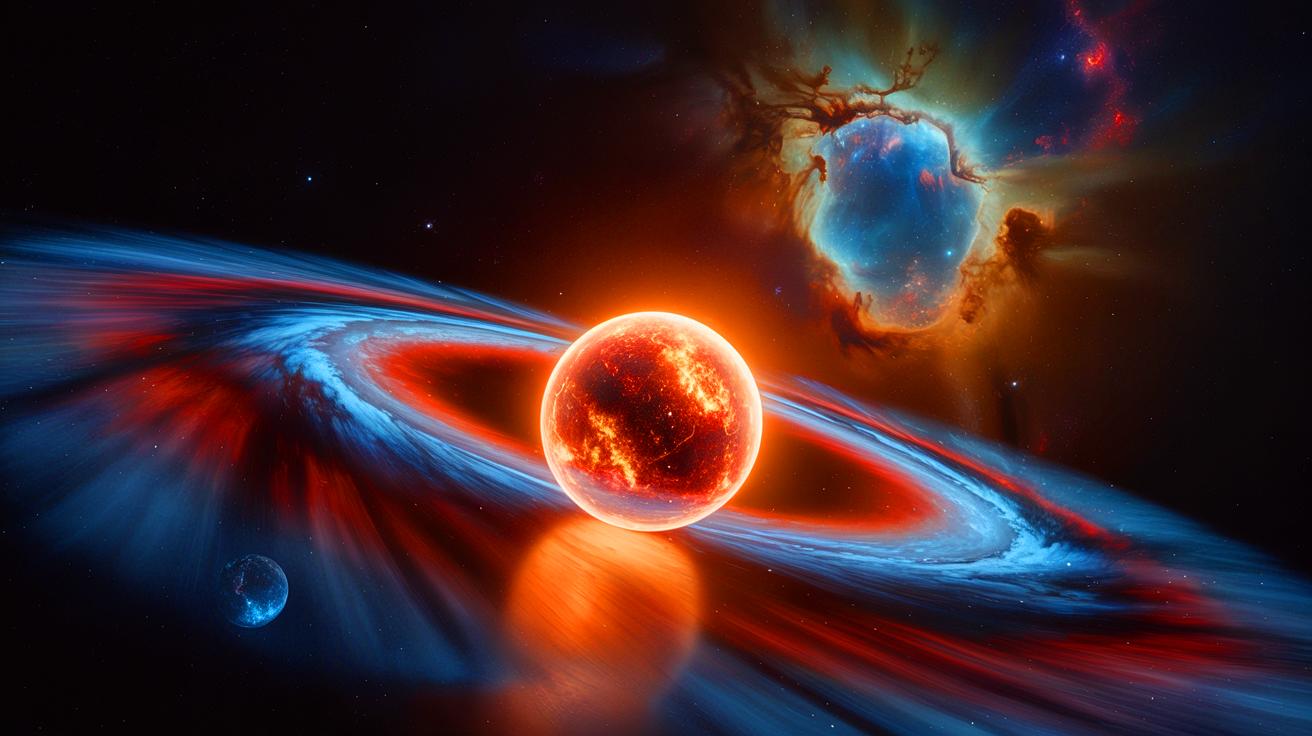
Until now, scientists have relied on fossil evidence from meteorites to piece together the early stages of planetary formation. These new images vividly illustrate how hot gas condenses into solid minerals around the budding star HOPS-315. The observations from ALMA, complemented by artistic impressions, depict silicon monoxide molecules transitioning into solid silicates. This revelation offers a direct look at the processes that lead to planet formation, something that meteorites alone could never fully reveal.
A Cosmic Time Capsule: HOPS-315 as a Mirror of Our Origins
Data from this discovery indicate that these crystals form within 1.4 astronomical units of the star, a region where temperatures exceed 1,880 degrees Fahrenheit. These are the perfect conditions for creating amoeboid olivine aggregates, similar to those found in the oldest meteorites in our solar system. Essentially, the events unfolding around HOPS-315 mirror the processes that occurred 4.6 billion years ago around our own Sun.
Interestingly, the location of these crystals corresponds to the current position of our asteroid belt. The parallels are striking, transforming this system into a cosmic time machine, offering a glimpse into the moment when our world began to take shape. The observation allows researchers to finally test their theoretical models of planetary formation. Many hypotheses, previously unverifiable, can now be scrutinized and refined, providing new hope for understanding how worlds are born.
A New Chapter in the History of the Universe
What we are witnessing is more than a scientific advancement; it’s an emotional revelation for anyone who has pondered our origins. Observing the birth of a planetary system is akin to reading the opening lines of the universe’s grand narrative. The most astounding part? We are only beginning to decipher its language.
With the capabilities of James Webb and ALMA, we are no longer mere spectators of the cosmos. Instead, we are witnesses to genesis, and perhaps, future explorers of nascent worlds. This discovery signifies a new era of cosmic exploration, one where humanity plays an active role in uncovering the universe’s mysteries.
The Emotional Impact of Cosmic Discoveries
This discovery is not just a step forward for science but a profound emotional experience for humanity. It connects us to the universe in a deeply personal way, reminding us of our place in the cosmic tapestry. Seeing a planetary system being born is like turning the pages of an ancient book, each page revealing secrets of the universe’s earliest moments.
As we continue to explore and understand the cosmos, we find ourselves at the threshold of an era where we are not just observers but participants in the universe’s story. The findings from HOPS-315 invite us to ponder the future of space exploration and question what other cosmic secrets await our discovery. Are we ready to embrace the next chapter of our journey through the stars?