


“This Interstellar Comet Shakes Our Solar System” (and It’s Closer Than You Think)
 By
Leah Morrison
By
Leah Morrison
| IN A NUTSHELL |
|
The cosmos recently presented a rare spectacle: the interstellar comet 3I/ATLAS passed through our solar system, observed from Mars. This cosmic traveler, originating from beyond our stellar neighborhood, was captured on camera by two European space probes. Despite the staggering distance, these images provide a unique glimpse into an event of scientific significance. The encounter emphasizes the importance of continued exploration and understanding of celestial bodies that can offer insights into the universe’s formation and evolution.
Close Encounter with Mars: A Celestial Spectacle
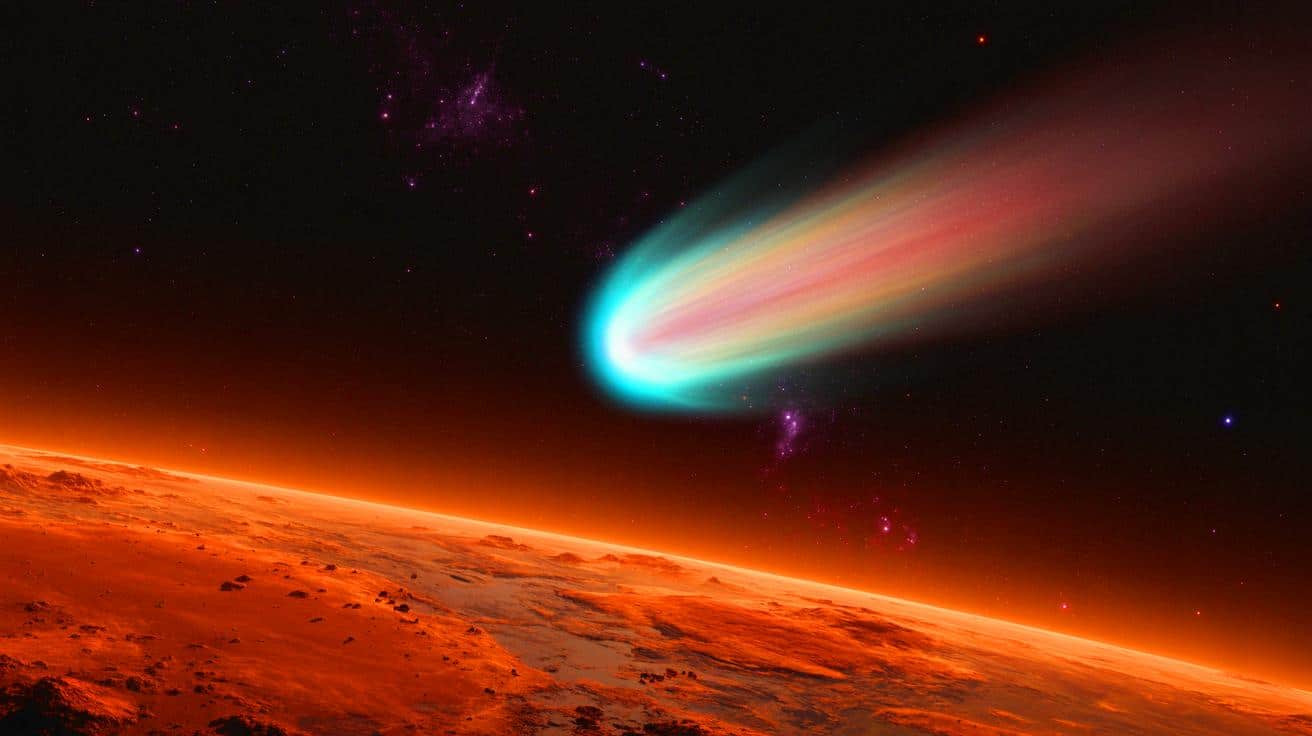
From October 1 to 7, 2025, two European Space Agency (ESA) probes, the ExoMars Trace Gas Orbiter and Mars Express, witnessed a rare cosmic event. The interstellar comet 3I/ATLAS passed within 18.6 million miles of Mars. In astronomical terms, this distance is considered a near miss, providing a remarkable opportunity for observation.
The significance of 3I/ATLAS lies in its interstellar origin. It is only the third such comet to be observed, following 1I/’Oumuamua in 2017 and 2I/Borisov in 2019. These comets are precious to scientists as they offer a rare glimpse into materials from other star systems. Their presence prompts questions about the composition and dynamics of distant worlds, offering a broader context for our understanding of the solar system and beyond.
Technical Triumph: Capturing the Elusive Visitor
The task of capturing images of 3I/ATLAS was a significant technical challenge. The cameras aboard the Martian probes are designed primarily for planetary observation, not for capturing distant celestial objects. However, in this instance, they succeeded in detecting the comet, showcasing their versatility and the ingenuity of the teams behind them.
The ExoMars orbiter’s CaSSIS camera detected the comet, even though it was 100,000 times fainter than Mars. The comet’s nucleus, about 0.62 miles in diameter, remained invisible, a task likened to spotting a cell phone on the Moon from Earth. However, the comet’s coma, the halo of gas and dust, was visible, forming as the comet approached the Sun and its ice began to sublimate. Although the images are blurry, they mark a crucial step in ongoing studies and future missions.
An Ancient Traveler: Insights Into Other Worlds
The comet 3I/ATLAS is estimated to be over 3 billion years older than our Sun, which itself is 4.6 billion years old. This ancient age makes it the oldest comet ever observed, offering an unprecedented look into the early universe. Interstellar comets like 3I/ATLAS are considered time capsules, largely unchanged since their formation, unlike those that have spent millennia within our solar system.
These celestial bodies provide scientists with a unique opportunity to examine primordial materials from different solar systems. Each particle of dust from the comet could offer clues about the formation of other worlds. According to the ESA, such observations are crucial for comparing primordial materials across different solar systems, potentially illuminating our understanding of planetary formation on a galactic scale.
Future Observations: JUICE’s Role in Unveiling the Comet’s Secrets
As 3I/ATLAS continues its journey towards the Sun, the JUICE probe, en route to Jupiter, is poised to observe the comet at its most active phase. The data collected by JUICE will be essential in analyzing the gases emitted by the comet, providing a deeper understanding of its composition and activity.
Colin Wilson, a researcher on the project, emphasized the excitement of witnessing probes respond to unexpected situations. This collaboration between multiple space missions underscores the importance of international cooperation in space exploration, enabling comprehensive data collection and analysis. The comet continues to challenge and expand our scientific and technical boundaries, connecting us to the vastness of the universe.
The passage of 3I/ATLAS through our solar system offers a rare opportunity to glean insights into the origins of distant celestial bodies. As we gather and analyze data from this interstellar visitor, it prompts us to reflect on the broader questions of cosmic formation and existence. What other mysteries do these ancient travelers hold, and how might they reshape our understanding of the universe?