


“This Monster of the Deep Terrifies With Its Titanic Dimensions (And It’s Lurking Closer Than You Think)”
 By
Ethan Reid
By
Ethan Reid
| IN A NUTSHELL |
|
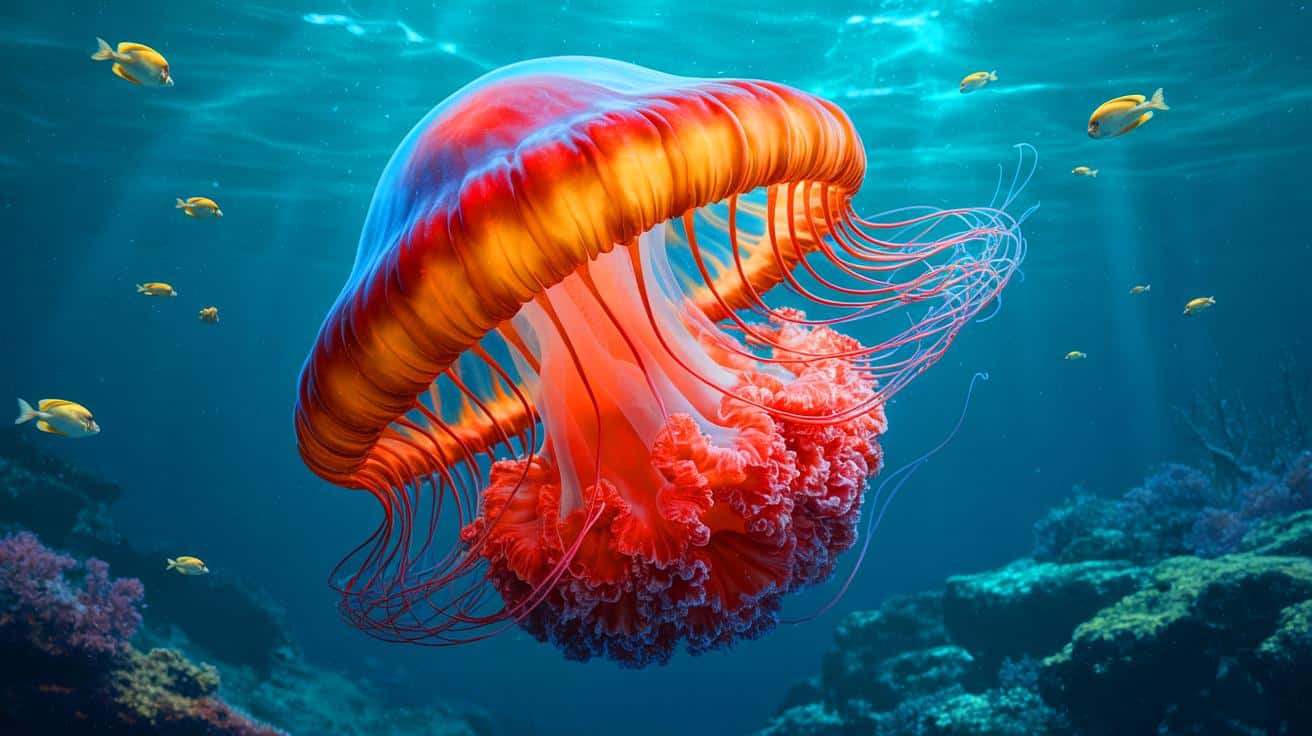
The lion’s mane jellyfish, a remarkable marine creature, captivates and mystifies scientists with its immense size and peculiar characteristics. Known scientifically as Cyanea capillata, this jellyfish is not only the largest but also one of the heaviest ever recorded in the ocean. Its tentacles stretch to extraordinary lengths, creating an almost invisible yet lethal net for unsuspecting prey. While its sheer size is awe-inspiring, the lion’s mane jellyfish embodies the enigmatic nature of marine life, where beauty and danger often coexist in unexpected ways.
The Sheer Weight and Size of the Lion’s Mane Jellyfish
When most people think of jellyfish, they envision small, translucent creatures drifting aimlessly in the water. However, the lion’s mane jellyfish shatters this perception with its colossal dimensions. This extraordinary jellyfish can weigh up to a ton and boasts a bell diameter exceeding six and a half feet. These measurements make it the heaviest jellyfish known to science.
The tentacles of the lion’s mane jellyfish are another story of wonder. They can reach lengths of up to 120 feet, comparable to a ten-story building lying on its side across the ocean. These tentacles are organized into eight dense groups, each containing up to 150 venomous filaments. This intricate network forms an almost invisible yet dangerous trap for any creature that comes too close.
Natural Hunting Technology: Venomous Tentacles
The tentacles of the lion’s mane jellyfish are equipped with thousands of specialized cells called cnidoblasts. These cells are capable of delivering a potent neurotoxin that can paralyze small fish almost instantaneously. The jellyfish is a silent predator, employing precision that rivals surgical tools.
This effective hunting mechanism has even inspired literary works, such as Arthur Conan Doyle’s portrayal of the jellyfish in a Sherlock Holmes adventure. The sting of a lion’s mane jellyfish can be exceedingly painful and potentially dangerous to humans, particularly for those with allergies or after prolonged contact.
Marine Giants: Lion’s Mane vs. Nomura’s Jellyfish
Is the lion’s mane jellyfish truly the largest in the world? In 1856, an American geologist reported observing a massive specimen off the coast of Massachusetts, measuring 7.5 feet across with tentacles 120 feet long. While this might be an absolute record, some experts argue that the title should go to Nomura’s jellyfish, an Asian species that can reach 440 pounds and a diameter of over six and a half feet within a year.
Nomura’s jellyfish are prevalent in the seas of China and Japan, where they have caused ecological issues by disrupting fishing activities and marine balances. Despite this, when it comes to tentacle length, the lion’s mane jellyfish remains unmatched.
“This Interstellar Comet Shakes Our Solar System” (and It’s Closer Than You Think)
The Paradox of Dangerous Jellyfish
Interestingly, a jellyfish’s size does not necessarily correlate with its danger level. For instance, the irukandji jellyfish, which measures only a few inches, possesses venom so potent that it causes the “Irukandji syndrome,” a severe physical distress that may last for days. In comparison, the lion’s mane jellyfish, although impressive in size, is less frequently encountered and poses less of a threat to humans.
This paradox serves as a humbling reminder from nature that size is not an indicator of danger. In the depths of the ocean, terrestrial logic does not apply. The lion’s mane jellyfish fascinates us precisely because it represents this marine imagination where beauty and fear intertwine.
The lion’s mane jellyfish challenges our understanding of ocean life with its extraordinary features and enigmatic presence. As we continue to explore the depths of our oceans, what other mysteries might we uncover about these fascinating creatures? How do these giants of the deep fit into the broader ecosystem, and what can they teach us about the delicate balance of marine life?